
US West Asia allies refuse to open airspace, bases for strikes on Iran
 4 Min Read
Jordan, Saudi Arabia, the UAE, Turkey, and other US allies in West Asia have refused to allow US forces to use their territory for aggression against Iran.
-
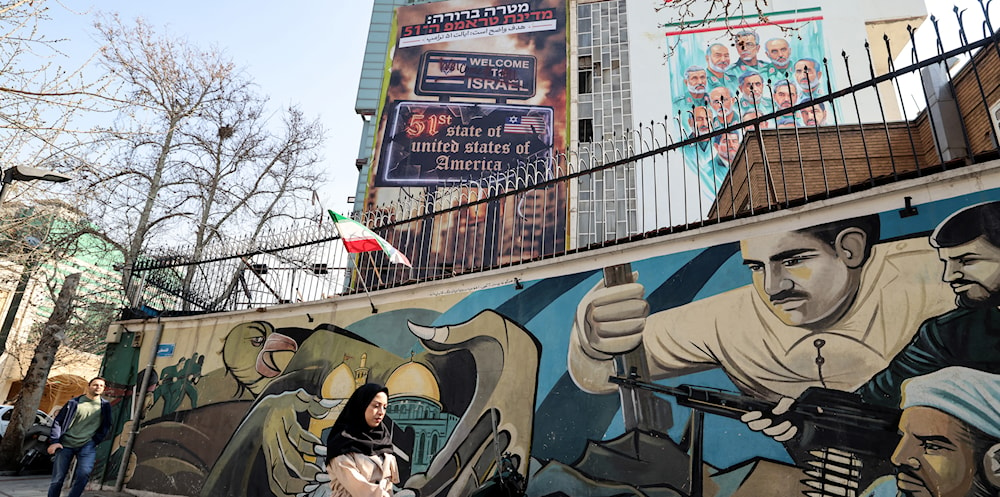
A woman walks past an anti-Israeli and anti-US billboard hanging from a building on Palestine Square in Tehran on February 25, 2026 (AFP)
Nearly every major US ally across West Asia has publicly refused to allow Washington to use its territory, airspace, or infrastructure for potential military strikes against Iran.
Jordan, Saudi Arabia, the United Arab Emirates, Bahrain, Kuwait, Qatar, and Turkey have all stated as much in recent weeks, issuing an unusually united front as the Trump administration ramps up its pressure campaign against the Islamic Republic over its nuclear programme.
Jordan's government confirmed that the presence of US forces at Muwaffaq Salti Air Base, where satellite imagery has shown a build-up of US fighter jets, electronic warfare aircraft, and cargo planes, is governed by an existing defense agreement. "Jordan reiterates that it will not serve as a launchpad for attacks against Iran," government sources told Newsweek.
Gulf states say no
Saudi Crown Prince Mohammad bin Salman went further during a call with Iranian President Masoud Pezeshkian last month, stating that Riyadh "will not allow the use of its airspace or territory in any military actions against the Islamic Republic of Iran," according to the official Saudi Press Agency.
However, satellite imagery confirmed a surge of US aircraft at Prince Sultan Air Base in the kingdom.
The UAE's Foreign Ministry similarly "reaffirmed the United Arab Emirates' commitment to not allowing its airspace, territory, or waters to be used in any hostile military actions against Iran." Bahrain, Kuwait, and Qatar have been reported to hold comparable positions, according to regional officials cited by Newsweek.
Turkey's red line
Perhaps the most geopolitically significant refusal has come from Turkey, a NATO ally that hosts US nuclear weapons at Incirlik Air Base and shares a direct border with Iran. Ankara denied reports that its airspace was used during last June's US strikes on Iranian nuclear facilities.
Turkish Foreign Minister Hakan Fidan told CNN Türk earlier this month that "the region is not in a position to handle a new war," urging both sides toward "more creative solutions."
A Turkish Embassy official in Washington told Newsweek that Ankara "supports a diplomatic solution and strongly advises against military operations."
The military build-up
As the US and Iran prepare for the third round of indirect nuclear talks on Thursday, the US continues to amass significant firepower in the region. Two carrier strike groups are now positioned near Iran: the USS Abraham Lincoln near the Gulf of Oman and the USS Gerald R. Ford en route.
The build-up represents the largest US military concentration in West Asia since the 2003 US-led invasion of Iraq.
It is important to note that Washington demonstrated during the 12-day war last June that it retains the capacity to strike Iran without relying on regional bases.
The US used B-2 stealth bombers flown directly from Whiteman Air Force Base in Missouri, nearly 7,000 miles away, to target nuclear facilities at Esfahan, Fordow, and Natanz. US sea and air-based assets provide additional firepower regardless of partner cooperation.
Risks of escalation
A broader conflict would not be contained in a bilateral exchange. Yemen's Ansar Allah has threatened to intervene should the US assault Iran. Meanwhile, the Islamic Resistance in Iraq has issued similar warnings. Iraq's government has repeatedly urged Washington to keep Baghdad out of any confrontation.
Diplomacy still open
Regional powers, particularly Saudi Arabia and the UAE, have been actively lobbying the Trump administration toward a negotiated resolution. Oman, maintaining its traditional neutral posture, is currently mediating US-Iran nuclear talks. A third round of negotiations is expected in Geneva this week.
President Trump, for his part, has insisted he retains full decision-making authority on any military action. "I am the one that makes the decision," he wrote on Truth Social on Monday. "I would rather have a Deal than not, but if we don't make a Deal, it will be a very bad day for that Country."
Read more: Analysis: Is West Asia on the Brink of War or a Strategic Standoff?


