
Venezuela approves amnesty bill for political violence since 1999
 3 Min Read
Venezuela’s National Assembly unanimously passes a bill for democratic coexistence, granting amnesty for criminal cases linked to political violence since 1999.
-
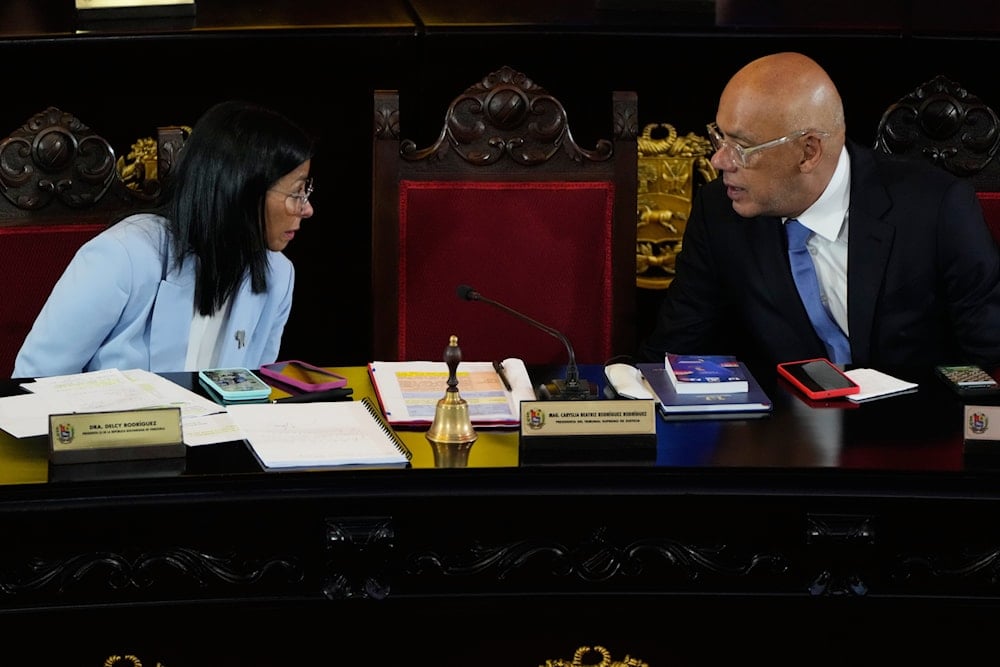
Venezuelan acting President Delcy Rodriguez speaks with her brother, National Assembly President Jorge Rodriguez during a ceremony opening of the new judicial year at the Supreme Tribunal of Justice in Caracas, Venezuela, Jan. 30, 2026. (AP)
Venezuela’s National Assembly has unanimously approved a bill granting amnesty for what “democratic coexistence,” covering criminal cases linked to periods of political violence dating back to 1999.
In a statement published on X, the legislature said lawmakers voted unanimously in favor of the draft law, marking a significant move aimed at addressing long-standing political disputes and related legal cases in the country.
Earlier, Venezuela’s interim president, Delcy Rodríguez, announced on January 31 that the government plans to introduce a General Amnesty Law covering all acts of political violence from 1999 to the present.
The proposal was unveiled during the Solemn Session of the Judicial Opening 2026 and will be presented to the National Assembly by the Commission for Judicial Revolution and the Program for Coexistence and Peace.
Rodríguez said the measure follows precedents set by two amnesty laws enacted under former president Hugo Chávez and one under current president Nicolás Maduro.
“May this be a law that serves to heal the wounds left by political confrontation fueled by violence and extremism, that serves to reestablish justice in our country, and that serves to restore coexistence among Venezuelans,” Rodríguez said, adding that individuals prosecuted or convicted of homicide, drug trafficking, corruption, or serious human rights violations would be excluded from the amnesty.
During the Supreme Court ceremony, the acting president also called for a Great National Consultation on a new justice system, aimed at ensuring that “justice becomes the queen of republican virtues” and securing “peace and the future of Venezuela as an independent, free, sovereign, and peaceful nation.” Rodríguez emphasized that these initiatives reflect “the spirit of Chávez and Maduro.”
Not the first time
Under Chávez, the first general amnesty was published on April 17, 2000, granting broad political amnesty during the early part of his presidency to figures involved in politically motivated offenses from prior years. Venezuela adopted a broad political amnesty under former president Hugo Chávez on December 31, 2007, when he signed a decree pardoning individuals involved in the April 2002 coup attempt and related political unrest. The measure was framed as a step toward national reconciliation after years of intense polarization.
The amnesty covered political crimes connected to the coup period, though it excluded serious offenses such as common crimes and grave human rights violations. At the time, Chávez said the decision was intended to help the country “turn the page” on a period marked by confrontation and instability.
A third amnesty initiative came years later during Venezuela’s political crisis. On January 25, 2019, the Western-imposed National Assembly approved an Amnesty Law involving civilians, military personnel, and officials involved in actions against the government since January 1, 1999.


