
War on Iran exposes limits of US power and alliances: Axios
 5 Min Read
Washington’s pressure on allies over the Iran war reveals growing fractures within the US alliance system and the limits of military coercion against Tehran.
-
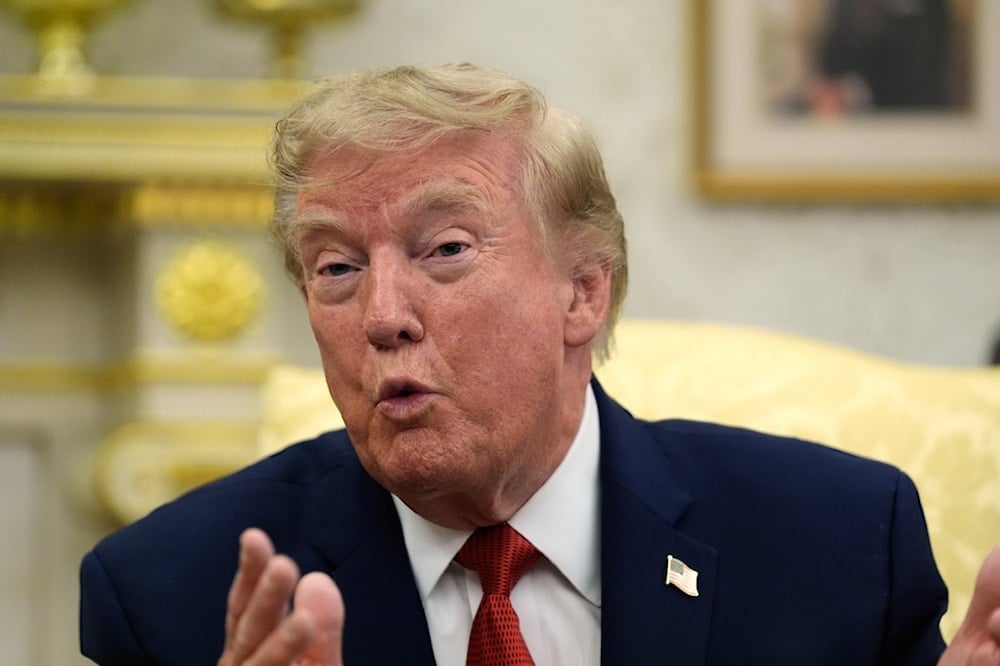
US President Donald Trump speaks as he meets with lifeguard Ryder Williams in the Oval Office of the White House, Monday, Aug. 17, 2026, in Washington. (AP Photo/Manuel Balce Ceneta)
US President Donald Trump is escalating pressure on Washington’s allies over their refusal to participate in the US war on Iran, with South Korea becoming the latest target of his demands for support, Zachary Basu writes for Axios.
Trump ordered the Pentagon to "substantially reduce" the annual Ulchi Freedom Shield military exercises with South Korea on Sunday, citing their cost and his "very good relationship" with DPRK leader Kim Jong Un.
The US-South Korean drills have long been a central component of Washington’s military presence on the Korean Peninsula.
Trump, however, linked the decision to Seoul’s refusal to participate in the US campaign against Iran.
In a post on Truth Social, Trump said he had "recently asked the President of South Korea if they would like to join us in the Denuclearization of the Islamic Republic of Iran, and they said, 'No thanks!'"
"We can't go around and protect all of these countries, especially when they're not there to help us," the US President told reporters on Monday.
Read more: Erdogan presses Trump to pursue talks With Iran to ease tensions
Washington demands alignment from allies
South Korea is not the only US ally facing pressure over the war on Iran.
Basu noted in his report that the Pentagon has circulated a questionnaire among NATO allies examining their alignment with the Trump administration’s foreign policy as Washington considers where to maintain or withdraw US troops.
The questionnaire reportedly asks about support for US military operations, military access, weapons purchases, and whether individual countries have "shown alignment" with the Trump administration’s foreign-policy approach.
Germany and Spain have also faced pressure from Washington. The Pentagon moved in May to withdraw roughly 5,000 US troops from Germany after Chancellor Friedrich Merz criticized Trump’s Iran strategy, according to Basu.
Trump also threatened to cut off all trade with Spain after Madrid rejected US requests to use its military bases for strikes against Iran.
Basu, citing Reuters, reported that a Pentagon official subsequently floated the possibility of suspending Spain from NATO.
Oman has also come under pressure despite its role as an intermediary in attempts to reach an agreement with Iran.
Trump threatened on Monday to "bomb the sh*t out of" the longtime US partner if it "gets in the way" of an agreement with Tehran.
Iran resists US pressure as talks remain stalled
The pressure campaign is unfolding as Washington continues to face difficulty securing an agreement with Tehran.
The 60-day deadline set by Trump and Iran for a final peace agreement expired Monday without a deal, with the two sides reportedly further apart than when they signed their June memorandum of understanding, according to Basu.
The Strait of Hormuz remains a major point of contention. Trump has insisted that the strategic waterway is "open" while also suggesting that it could become US territory.
Commander-in-chief of the Iranian army, Major General Amir Hatami, stated that Trump committed a "grave mistake" in his comments about occupying the strait.
"The guardians of Iran will crush those who approach it," Hatami stressed.
The United States can deploy military forces, impose economic pressure, and threaten further escalation, but those instruments have not compelled Iran to accept Washington’s demands.
Tehran’s continued resistance has consequently become a direct challenge to the US strategy of using military and economic power to impose its will in West Asia.
US military resources stretched across multiple fronts
The confrontation with Iran is also affecting Washington’s military posture in other regions.
The US Navy is moving the USS George Washington from the western Pacific to relieve the long-deployed USS Abraham Lincoln, temporarily leaving the region without a US aircraft carrier, according to reporting cited by Basu.
The redeployment comes as Washington maintains military commitments across West Asia, Europe, and the Asia-Pacific.
The developments also raise questions over the ability of the United States to maintain its military reach across multiple theaters while facing growing resistance to its policies.
US alliance system faces growing divisions
The White House has defended Trump’s approach.
"President Trump has successfully made America respected again, and the results speak for themselves – nine wars have ended, hostages have been freed from Gaza, trade deals are fairer, and now, Iran will be prevented from ever possessing a nuclear weapon," White House spokesperson Anna Kelly said in a statement.
"At the same time, the President will never allow the United States to be treated unfairly, and he is righting decades of wrongs of his predecessors by ensuring all of our diplomatic relationships are reciprocal."
Basu writes that South Korea has declined to participate in the US campaign, Spain has rejected US requests for access to its bases, Germany has criticized Washington’s Iran strategy, and Oman has continued diplomatic efforts aimed at reaching an agreement.
The developments point to increasing friction within the US-led alliance system as Washington seeks to turn its partners into participants in its military and geopolitical agenda.
Washington's failure to bring Iran to agree to its terms shows that America's military might has its limits when confronted by a state prepared to resist.


