
Trump approval sinks to 33% as Iran war weighs on US voters
 4 Min Read
US President Donald Trump’s approval rating falls to 33%, its lowest level of his current presidency, as growing opposition to the prolonged war on Iran, rising fuel prices, and economic concerns weigh on public support.
-
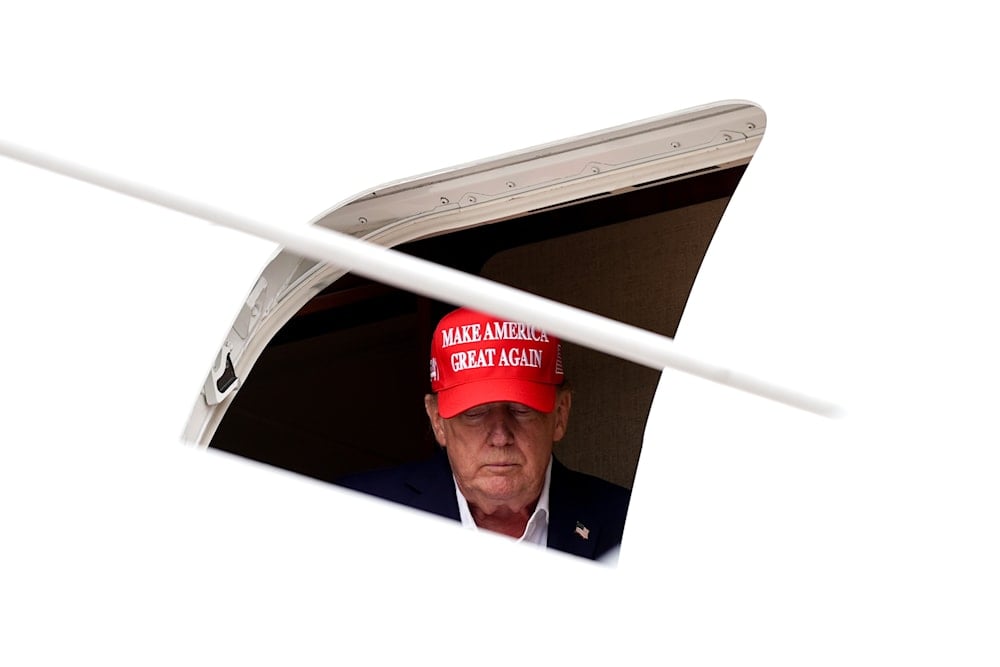
US President Donald Trump disembarks Air Force One, on August 16, 2026, at Joint Base Andrews, Md. (AP)
US President Donald Trump’s approval rating has fallen to 33%, its lowest level since he returned to the White House, as public concern deepens over the duration and economic impact of Washington’s war on Iran, a new Reuters/Ipsos poll found.
The four-day survey, which concluded on Monday, showed that 64% of respondents disapproved of Trump’s performance, while only one-third approved. The latest figure is down from 35% in a Reuters/Ipsos poll conducted earlier this month and matches the lowest approval rating Trump recorded during his first term, in December 2017.
Trump began his second presidency in 2025 with approval just below 50%, but his standing has deteriorated significantly this year after he ordered military strikes against Iran alongside "Israel".
The conflict has since disrupted a significant share of global oil flows and contributed to rising fuel prices in the United States, placing additional pressure on households already struggling with the cost of living.
Americans expect prolonged war
Public skepticism over the conflict appears widespread.
Around 80% of Americans surveyed said they believe the US campaign against Iran "will go on for an extended period of time," including 87% of Democrats and 71% of Republicans. Only 16% said they expected the war to end within a few weeks.
The result contrasts sharply with Trump’s earlier assurances that the confrontation would be relatively brief.
Iran has continued to withstand US and Israeli military pressure while maintaining restrictions on oil traffic through the Strait of Hormuz, keeping global energy markets under strain even as the intensity of fighting has eased.
Only one in five Americans surveyed said they believe the war has been worth the cost. Among Republicans, support was significantly higher but still reached only about half.
Trump defends rising gasoline costs
Trump has sought to justify the economic consequences of the war by linking them to his administration’s stated goal of preventing Iran from developing nuclear weapons.
Speaking at a political rally in Garden City, New York, on Friday, Trump said paying "a tiny little bit more for your gasoline" was justified if it ensured that "a very evil country" could not obtain a nuclear weapon.
The president has repeatedly shifted between warnings of further military escalation and claims that a diplomatic agreement with Tehran could soon be reached. However, the growing perception that the conflict could drag on is creating political difficulties for Republicans ahead of the November 3 midterm elections.
The party is seeking to retain its narrow majority in the House of Representatives, while Democrats increasingly believe they could also compete for control of the Senate.
Democrats gain advantage on economy
The latest polling also points to a shift in voter attitudes toward economic management.
Some 38% of voters said Democrats were better positioned to handle the economy, compared with 35% who favored Republicans.
Reuters/Ipsos polling conducted earlier in August found Democrats overtaking Republicans on the economy for the first time in roughly a decade.
Democrats also hold an advantage when voters are asked which party is better equipped to address the cost of living, an issue that has become increasingly important as higher energy prices feed into household expenses.
Trump campaigned on promises to contain inflation and avoid prolonged foreign wars, making the current economic and military environment particularly damaging to his political standing.
Republican immigration advantage narrows sharply
Republicans continue to hold a slight lead on immigration, but their advantage has narrowed considerably.
The latest survey found that 40% of registered voters preferred the Republican approach to immigration, while 38% favored Democrats. The two-point gap is the smallest recorded during Trump’s current presidency.
In January 2025, Republicans held a 26-point lead on the issue.
The shift comes despite a significant decline in border crossings under Trump, as criticism grows over his administration’s nationwide immigration crackdown, including deadly confrontations and the rising number of detainees, among them children.
The Reuters/Ipsos survey was conducted online among 1,166 adults across the United States and has a margin of error of approximately three percentage points in either direction.
Read more: FT poll: Most US voters say Trump’s war on Iran 'not worth the cost'


