
War Plan Red resurfaces as US rhetoric alarms Canada
 3 Min Read
Trump's aggressive rhetoric revives fears over War Plan Red as Canada braces for potential US threats, military planning, and border tensions.
-
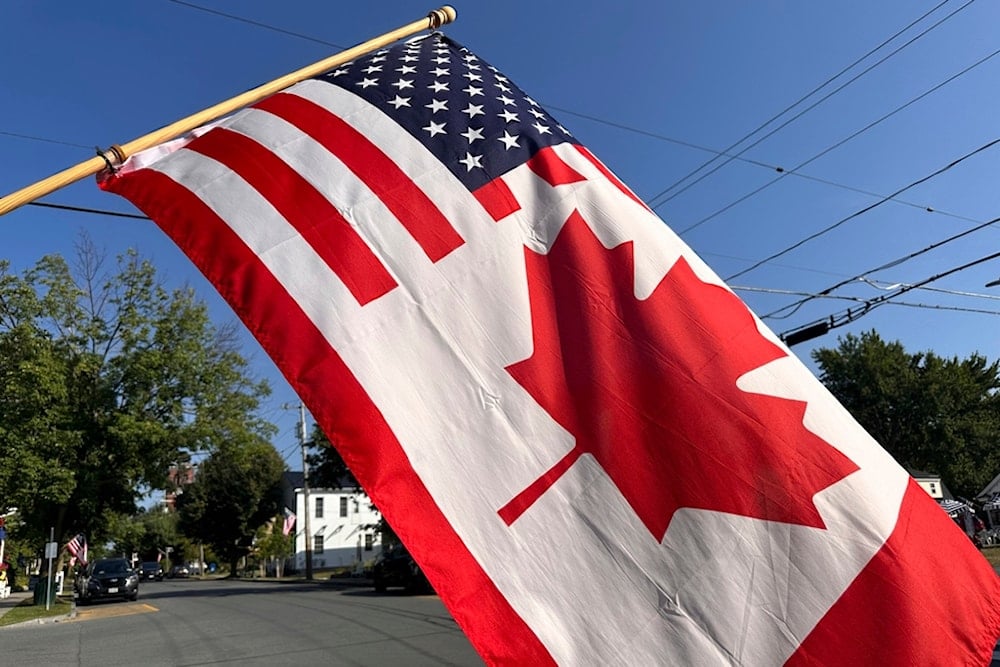
A combination US-Canada flag flies in Sackets Harbor, N.Y., on Thursday, July 24, 2025 (AP)
A once-forgotten military blueprint, War Plan Red, a 1930s-era US strategy for invading Canada, has resurfaced in public discourse amid rising tensions between Washington and Ottawa. With US President Donald Trump reviving aggressive rhetoric on territorial expansion, concerns over United States–Canada relations are growing.
War Plan Red, originally drafted in 1927 and approved in 1930, outlined a theoretical US conflict with Great Britain, where Canada was viewed as a likely battleground. The plan detailed coordinated attacks using poison gas, seizure of ports, destruction of infrastructure, and mass internments.
Once dismissed as a relic of pre-WWII paranoia, the plan is drawing new interest following Trump’s controversial remarks and actions, including threats to annex Canada, Greenland, and Venezuela.
Trump administration sparks fresh fears
In early January 2026, Trump reignited debate by ordering the kidnapping of Venezuelan President Nicolas Maduro, and later declaring US interest in seizing Greenland for its strategic and mineral value. Days later, Canadian media reported that Canada’s military had modeled a hypothetical US invasion and was exploring guerrilla defense tactics.
In a viral social media post, Trump shared a digitally altered map showing the US flag imposed over Canada, Greenland, and Venezuela. He also told Canadian Prime Minister Mark Carney that the Canada–US border was “just a straight line” that could be redrawn by “force and persuasion.”
These statements, coupled with references to War Plan Red, have alarmed lawmakers and Canadian national security experts, who now see Trump’s rhetoric as more than symbolic.
Read more: Trump: Canada opposes Greenland defense, chooses ties with China
Experts warn of deepening strategic threats
Canadian conflict analyst Thomas Homer-Dixon warns that Canada's proximity and dependency on US goodwill leave it highly vulnerable. "We’ve been critically dependent on the friendship and benignness of the United States," he said. "And all of a sudden, both those things have just disappeared."
He fears Trump could use border insecurity or political unrest, like an Alberta secession push, as justification for direct intervention or annexation. “They may ultimately succeed, but it’s going to really hurt,” Homer-Dixon said, advocating for Scandinavian-style civil defense models.
Read more: Carney accuses Trump of undermining Canadian sovereignty
Canadian military readies for worst-case scenarios
The Canadian Forces are exploring strategies to rapidly expand the supplementary reserve, currently comprising 4,384 inactive soldiers, to as many as 300,000 personnel.
A directive in May 2025 outlined training federal and provincial workers in drone piloting, logistics, and firearms to bolster civil defense.
Simultaneously, proposals from the Cascade Institute call for a national service program, estimated to cost between C$1.1 billion and C$5.2 billion, depending on scope.
Canada and the US have only had a handful of military conflicts with each other since their times as colonies of the British and French.
One of the most notable conflicts between the two occurred in 1812, aptly named the War of 1812, between the United States and British-ruled Canada. The war ended inconclusively and included events such as the burning of Washington.


