
Canada yields to US threats, rules out China free trade deal
 4 Min Read
Mark Carney says Canada won’t pursue a free trade deal with China, reaffirming USMCA commitments after Trump threatened100% tariffs on Canadian goods.
-
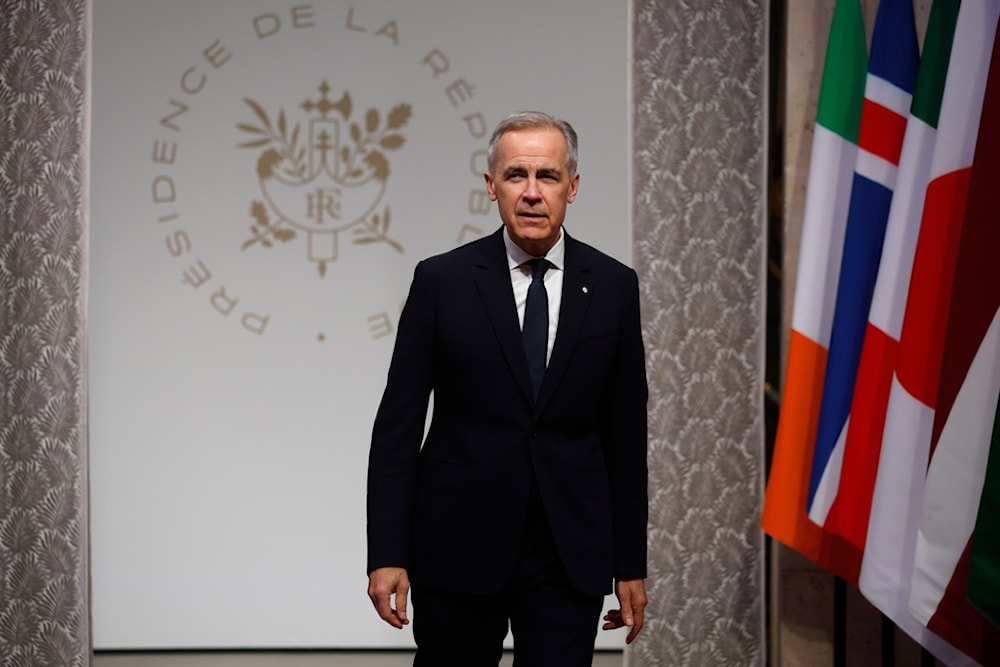
Canadian Prime Minister Mark Carney arrives for a meeting of the Coalition of the Willing at the Elysee Palace in Paris, France, Tuesday, January 6, 2026 (Pool photo via AP)
Canadian Prime Minister Mark Carney announced that Ottawa has no intention of pursuing a free trade agreement with China, capitulating to threats by Washington and reaffirming Ottawa’s commitment to the United States-Mexico-Canada Agreement (USMCA).
His remarks come in direct response to US President Donald Trump’s threat to impose 100% tariffs on Canadian imports if Canada moved forward with a trade deal involving Beijing.
Carney emphasized that any trade decisions taken by Canada will remain within the framework of USMCA, which requires prior notification before negotiating free trade with non-market economies.
“We have no intention of doing that with China or any other non-market economy,” Carney stated. “What we have done with China is to rectify some issues that developed in the last couple of years.”
Read more: Canada keeps Nazi war criminal list secret, cites diplomatic concerns
China agreement targets tariffs, not full trade deal
The recent agreement between Canada and China was limited in scope. It reduced tariffs on a select group of goods following tit-for-tat duties imposed by both sides in 2024.
That year, Canada aligned with the US by implementing 100% tariffs on Chinese electric vehicles (EVs) and 25% on steel and aluminium, prompting Beijing to respond with 100% tariffs on Canadian canola products and 25% on pork and seafood.
Breaking from the US earlier this month during a visit to Beijing, Carney negotiated tariff cuts that did not amount to a free trade pact.
Trump threatens tariffs if Canada opens to Chinese goods
Trump strongly criticized Canada's attempts to strike a trade deal with China, stating that the move was "self-destructive".
“Canada is systematically destroying itself. The China deal is a disaster for them,” Trump wrote on Truth Social on Sunday.
Trump further accused Carney of trying to turn Canada into a “Drop Off Port” for Chinese goods headed to the US. In a social media post, Trump warned, “If Carney thinks he is going to make Canada a ‘Drop Off Port’ for China to send goods and products into the United States, he is sorely mistaken.”
US Treasury Secretary Scott Bessent echoed the concern, stating that Canada’s shift could undermine American trade defenses against China, especially as the USMCA heads toward renegotiation this summer.
Read more: US Treasury chief rejects yuan as reserve currency
Electric vehicle cap and Chinese market access
As part of the revised tariff arrangement, Carney capped Chinese electric vehicle imports to 49,000 units per year, increasing to around 70,000 over five years, taxed at a 6.1% rate. Before 2024, there had been no cap on such imports.
Carney noted that this quota represents just 3% of the 1.8 million vehicles sold annually in Canada, and said that in exchange, China has agreed to begin investing in Canada’s auto industry within three years.
Tensions rise over trade, sovereignty, and global alliances
The dispute over trade policy is unfolding alongside rising political tensions. Carney, speaking at the World Economic Forum in Davos, urged “middle powers” to work together to resist coercion by great powers, in an apparent veiled reference to Trump.
The US president’s latest provocations include repeated remarks about Canada’s sovereignty, along with a revived push to acquire Greenland and controversial social media posts showing Canada and other countries as part of an expanded United States.
Despite the rhetoric, Carney has positioned Canada as committed to multilateralism and to balancing its economic interests with international obligations under the USMCA.


