
War revealed Iran's power, United States' weakness: IRGC spokesperson
 3 Min Read
IRGC spokesperson Hossein Mohebbi says the war on Iran exposed US strategic weaknesses and highlighted Iran’s growing military, economic, and political influence.
-
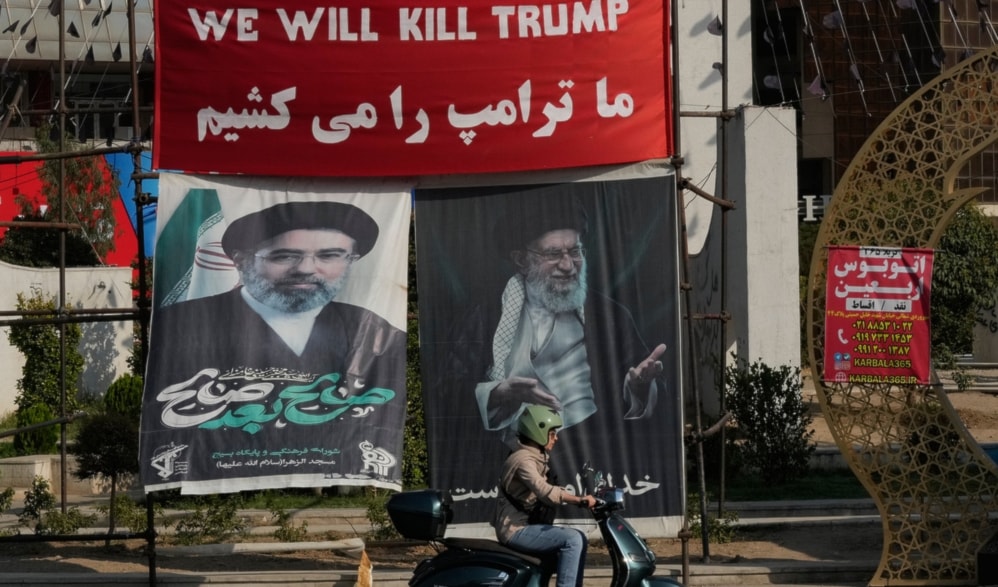
A motorbike drives past a banner reading in English and Farsi, "We will kill Trump," and banners showing portraits of the Iranian Leader Sayyed Ali Khamenei and his son Sayyed Mojtaba Khamenei in Tehran, Iran, Aug. 10, 2026. (AP)
The United States' war on Iran has exposed its strategic weakness, Brigadier General Hossein Mohebbi, spokesperson for the Islamic Revolution Guard Corps (IRGC), said on Tuesday, highlighting the impact of Iran's power across the military, economic, and political domains.
According to the top military official, "the strategic weapons that Washington desperately needs are depleted and declining, and cannot be replaced in the near future."
Similarly, Iranian Foreign Minister Abbas Araghchi said that Iran has demonstrated its military capability, proving that it is an "invincible power" capable of confronting the United States.
Araghchi said that US President Donald Trump initiated hostilities against Iran to force an unconditional surrender, but after 20 days of resistance and resilience, the US president requested negotiations with Tehran.
"No one expected Iran to be able to resist America in this way, which launched its war with the support of the Zionist entity and many other countries," Araghchi continued, asserting that Iran "stood firm and did not yield, and in the end forced the enemy to request negotiations."
Iran altered balance of power with US: Experts
The Iranian officials' remarks come as analysts increasingly assess the broader strategic implications of the conflict, particularly its impact on Iran’s position vis-à-vis the United States.
Johns Hopkins Professor Vali Nasr argued in an interview in Switzerland with Tom Switzer that Iran has fundamentally altered the balance of power with the United States and now has a narrow window to convert its position into lasting strategic and economic gains.
"There's a consensus that they have defeated the superpower, at least put it on its heels," Nasr said of the view inside Iran.
Nasr rejected arguments that Tehran is "overplaying its hand." "In reality, Iran is not overplaying its hands. It's just playing its hand," he said, adding that Iranian leaders believe they have a narrow window to secure maximum advantage from having "turned the table on the US."
On his part, University of Chicago political scientist John Mearsheimer offered an even sharper assessment. Asked why President Trump would accept Iranian control over the Strait of Hormuz, Mearsheimer replied, "He has no choice. He lost the war. This is a devastating defeat for the United States."
He added that Trump "has no cards here", citing depleted munitions and Gulf allies' fear of Iranian retaliation.
Read more: Iran boosts electricity, supplies water to 4,000+ villages despite war


