
Dollar at 4-year low: Gold surges on confidence crisis
 7 Min Read
The US dollar fell to its lowest level in four years as gold broke $5,200 per ounce. The twin moves reflect eroding confidence in American institutions amid policy chaos.
-
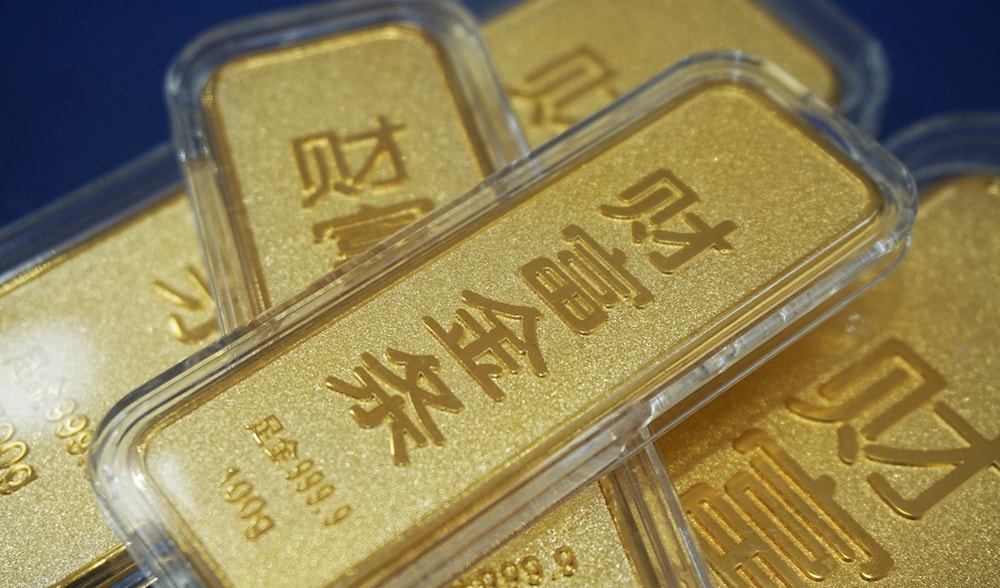
Gold bars with Chinese characters reading “Fortune Gold” are seen at a gold shop in Hangzhou, in China’s eastern Zhejiang province on January 26, 2026. (AFP photo)
The United States dollar crashed to its lowest level in four years this week, capping a dramatic slide that US President Donald Trump dismissed with nonchalance. "I think it's great," Trump told reporters in Iowa when asked if the currency had declined too much. "The dollar's doing great."
His words had the opposite effect. The ICE US Dollar Index, which measures the greenback against major currencies like the euro and yen, plunged as much as 1.5% in a single day, its worst performance since April's tariff-induced chaos. By late Tuesday, the dollar sat at levels unseen since early 2022.
Trump elaborated on his currency philosophy, saying he wanted the US dollar to "just seek its own level, which is the fair thing to do." He added, "I could have it go up or go down like a yo-yo," suggesting presidential control over currency markets that most economists would dispute.
The president invoked competitive devaluation practices by trading partners: "If you look at China and Japan, I used to fight like hell with them, because they always wanted to devalue their yen. It's hard to compete when they devalue. But they always want our dollars."
Meanwhile, gold shattered records, breaching $5,200 per ounce for the first time and extending gains past 20% for the year. The precious metal's blistering rally reveals that investors are fleeing dollar-denominated assets for tangible alternatives, betting against US institutional stability rather than mere currency fluctuations.
Forces behind the dollar's decline
Four forces converged to erode confidence in the world's reserve currency, each amplifying the others.
Tariff turbulence
Trump's "Liberation Day" tariffs in April, imposing a 104% levy on Chinese imports and 10% baseline rate on all trading partners, sparked what some analysts called a "sell America" trend. Foreign investors dumped $63 billion in US equities between March and April, the largest retrenchment in years.
Beyond the tariffs themselves, the administration's broader foreign policy moves compounded investor anxiety. Threats to annex Greenland, warnings of embargoes against Canada, and military aggression against Venezuela showed policy unpredictability, driving capital outflows.
Fed's interest rate cuts
The Federal Reserve has cut rates by 1.75 percentage points since September, bringing them to 3.5-3.75%. While still higher than Europe's 2% or the UK's 2-3%, but the gap has narrowed considerably.
When US interest rates are significantly higher, global investors park money in dollar assets to earn better returns. As that advantage shrinks, so does the dollar's appeal. The Fed's pivot also undermined the story that had kept the dollar strong through 2024, that American economic growth was exceptional compared to the rest of the world.
Intervention speculation
Reports emerged that the New York Fed conducted a "rate check" with currency dealers about the dollar-yen exchange rate, essentially testing the waters for potential intervention. While neither US nor Japanese officials confirmed anything, the signal showed that the administration might tolerate, or even encourage, further dollar decline.
Institutional erosion
The Justice Department's criminal investigation of Fed Chair Jerome Powell, ostensibly over building renovations, but transparently about monetary policy disagreements, has raised fears about central bank independence.
Combined with ballooning deficit concerns, this has fueled doubts about long-term US creditworthiness. Consumer confidence plummeted to an 11-year low in January, with households citing inflation, tariffs, and labor market anxieties.
Gold's textbook response
Gold's surge past $5,200 illustrates a well-established economic relationship where, as the dollar falls, gold typically rises. Gold trades globally in US dollars, so when the dollar depreciates against other major currencies, it takes more dollars to buy the same ounce of gold. A 10% dollar decline historically corresponds to a 3-8% increase in gold prices, though the exact relationship varies depending on market conditions.
But this rally transcends mechanical arithmetic. Analysts note that gold is now being traded as a macro hedge, not just a currency inverse, and it is being valued as protection against regime-level macro risk rather than short-term fluctuations. Incidentally, central banks worldwide have accelerated gold purchases as part of broader de-dollarization strategies, with BRICS nations exploring alternatives to dollar settlements in energy and commodity trade.
Deutsche Bank projects gold could reach $6,000 per ounce by year-end, citing "persistent investment demand as central banks and investors increase allocations to non-dollar and tangible assets." Silver has surged nearly 60% this year, extending the precious metals rally across the board.
In a provocative thought experiment, the investment management firm VanEck estimated that if gold entirely replaced the dollar as reserve currency, its implied price would be $39,210 per ounce based on central bank liabilities, underscoring gold's potential valuation in a world of diminished dollar confidence.
Winners and losers
The US Dollar's devaluation redistributes wealth across borders and economic sectors with brutal efficiency.
American consumers face an inflation tax. With the US importing $3.4 trillion in goods annually, a weaker dollar makes everything from electronics to food more expensive. The pass-through typically runs 50-70%, meaning a 10% dollar drop translates to 5-7% higher import prices over 12-18 months. For the 40% of Americans with limited financial buffers, this erosion of purchasing power constrains living standards immediately.
Meanwhile, US businesses experience a sharp divide. Exporters and multinationals like Levi Strauss, Netflix, and 3M report improved earnings as foreign revenue translates to more dollars. A 10% depreciation can boost S&P 500 earnings growth by roughly 2 percentage points. But importers and companies dependent on foreign inputs face compressed margins, with the National Retail Federation forecasting a 20% year-over-year decline in US imports during late 2025.
For emerging markets, dollar weakness typically brings relief. Many developing economies borrowed heavily in dollars during previous years. When the dollar falls, their debt becomes cheaper to repay in local currency terms, a windfall that strengthens government and corporate balance sheets. For example, Brazil's real gained 11% against the dollar in 2025, Taiwan's dollar rose 12%, and Mexico's peso climbed 10%.
Alternatively, advanced economies experience mixed outcomes. The euro climbed above $1.20 for the first time in four years, while the Swiss franc hit decade highs. For European and Swiss consumers, this means cheaper imported goods, everything from electronics to energy costs less. But their exporters face the opposite problem, since European products become more expensive for American buyers, eroding market share.
Trump's contradictory vision
Trump has repeatedly stated, "I'm the person that likes a strong dollar, but a weak dollar makes you a hell of a lot more money." He wants export competitiveness and manufacturing revival, goals served by devaluation. Trump's senior economic adviser Stephen Miran has articulated this through the "Mar-a-Lago Accord," proposing deliberate devaluation to create a multipolar currency system.
Yet Trump's policies work at cross-purposes. Tariffs mechanically strengthen the dollar, while his fiscal agenda would boost inflation and necessitate higher rates that appreciate the currency. Markets dismiss his ability to engineer sustained weakness, viewing the current decline as stemming from chaos rather than strategy.
The dollar's plunge crystallizes a fundamental contradiction: the US cannot simultaneously pursue a mercantilist trade policy and maintain reserve currency status. It also cannot subordinate monetary policy to political expediency while expecting global confidence in dollar assets. The 11% decline essentially reflects global reassessment of US institutional credibility, and gold's rally shows hedging against not temporary weakness but fundamental uncertainty.


