
Germany cuts growth outlook as war on Iran fuels inflation surge
 3 Min Read
Germany’s top economic institutes have sharply downgraded growth forecasts and raised inflation expectations for the next two years.
-
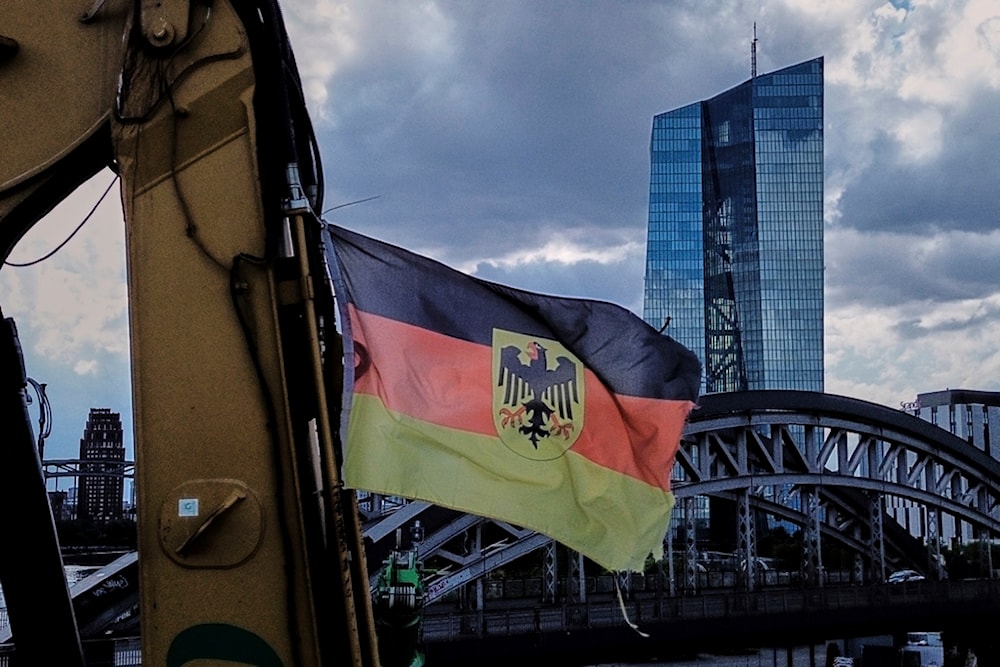
A German flag is fixed at a construction vehicle in Frankfurt, Germany, Monday, July 21, 2025. (AP Photo/Michael Probst)
Reuters on Wednesday reported that Germany’s leading economic institutes have downgraded their growth projections for the coming years while raising inflation forecasts, citing the economic fallout from the war on Iran and the resulting surge in energy prices.
According to sources familiar with the updated outlook, the institutes now expect Europe’s largest economy to grow by just 0.6% in 2026, down from a previous estimate of 1.3%. The projection for 2027 was also revised lower to 0.9% from 1.4%, reflecting mounting pressure on industrial activity and exports.
At the same time, inflation expectations have been revised upward. The institutes now anticipate inflation to reach 2.8% in both years, compared with earlier forecasts of 2.0% and 2.3%. The adjustment follows a rise in energy costs triggered by the ongoing war on Iran, which has already pushed German inflation to 2.8% in March.
Europe energy shock
The revisions come as Europe faces a widening energy shock linked to disruptions in global supply routes, particularly through the Strait of Hormuz, a key corridor for oil and gas flows. The war has driven sharp increases in energy costs across the continent, with European officials warning that the financial burden is mounting rapidly and is likely to persist.
German officials have already acknowledged the scale of the economic impact. Defense Minister Boris Pistorius previously described the war as “a catastrophe for the world's economies,” while stressing that Berlin does not view the conflict as its own and does not seek to be drawn into it.
The latest forecasts underscore how the economic consequences are now materializing domestically. Germany’s export-driven model, already under strain from post-pandemic stagnation, rising competition from China, and structurally high energy costs, is facing renewed pressure as input prices climb and external demand weakens.
Germany’s lower house of parliament has approved initial measures aimed at containing rising fuel prices, as policymakers attempt to cushion households and businesses from the effects of the energy surge.
Labour market strain
Labour market data also signals ongoing fragility. While the seasonally adjusted unemployment rate remained unchanged in March, the number of unemployed has stayed above 3 million for a third consecutive month.
“The economic situation remains tense, not least because of further international uncertainties,” Labour Minister Baerbel Bas said.
Industry sentiment has also deteriorated. A survey by the Ifo institute found that 90% of manufacturing firms expect the Iran war to affect their operations.
“The conflict impacts manufacturing directly but above all causes major uncertainty,” said Klaus Wohlrabe, head of surveys at Ifo.
German Chancellor Friedrich Merz has also voiced skepticism over the trajectory of the war, warning that it could drag on without a clear strategic outcome, further prolonging economic disruption across Europe.
The revised forecasts, prepared jointly by five major economic institutes, RWI, Ifo, IfW, IWH, and DIW, are set to be formally presented in Berlin and will inform the government’s economic planning, including tax revenue projections.
Read more: Iran war adds $16bln to Europe's energy bills as Hormuz remains shut


