
US gas prices hit record Labor Day high as Iran war drives costs
 3 Min Read
US gasoline prices are set to hit a record Labor Day high above $4 a gallon as the war on Iran drives up oil costs and strains household budgets.
-
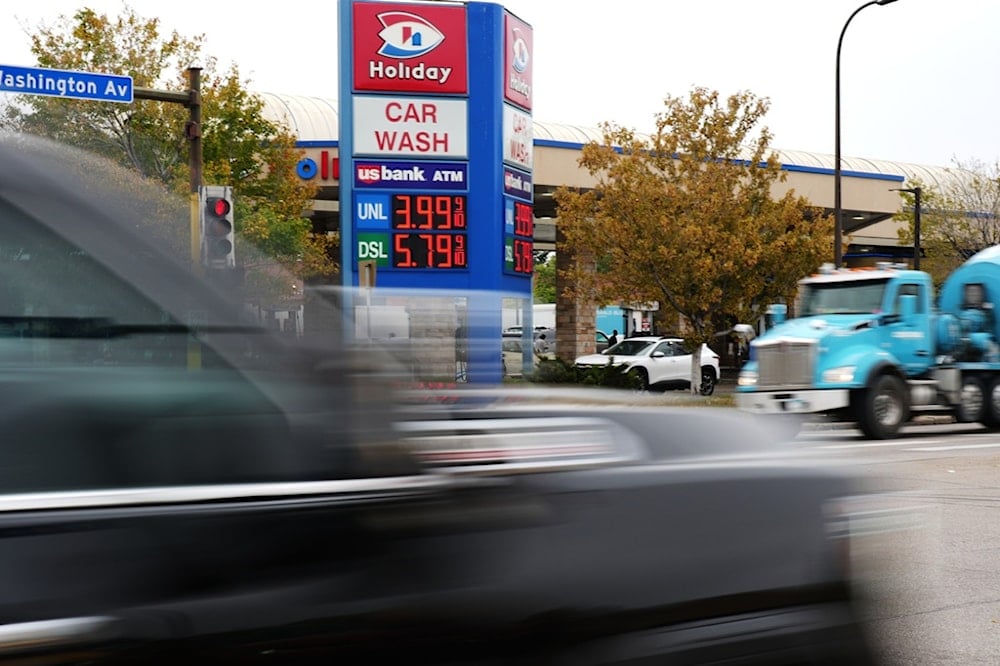
Diesel prices are displayed at a gas station, Friday, Sept. 4, 2026, in Minneapolis. (AP Photo/Ellen Schmidt)
Americans are facing record-high gasoline prices over the Labor Day weekend, with the national average expected to reach $4.03 per gallon as the US war on Iran continues to push up energy costs, Reuters reports.
The projected price would surpass the previous Labor Day record of $3.83 set in 2012, according to GasBuddy analyst Patrick De Haan, Reuters reports. The national average stood at around $4.13 per gallon on Thursday, nearly $1 higher than a year earlier.
The surge comes as crude oil prices climbed back above $90 a barrel following renewed US hostilities on Iran and concerns over disruptions to global energy supplies. Brent crude ended the week at $92.68 per barrel, while US West Texas Intermediate reached $91.48.
Read more: Iran shifts to offensive military stance amid US escalation: Exclusive
Higher fuel costs hit US households
Gasoline prices are becoming an increasingly visible burden for US households, particularly as Labor Day traditionally marks a major summer travel period.
Some drivers are already cutting back on travel and limiting how much fuel they purchase as household budgets come under pressure.
Randi O’Brien, a Colorado driver cited by Reuters, said she could afford only $15 worth of gasoline for her truck, while Houston resident Madison Moore said she was scaling back her Labor Day travel plans because of rising costs.
“It's completely out of control,” O'Brien said. "We have our own fuel here, yet we're sending it elsewhere."
US refined-product exports have also increased by more than 10% from a year earlier, according to the Energy Information Administration, adding to concerns among consumers over domestic fuel availability.
Limited room to ease fuel prices
US refineries are already operating at near-full capacity, with utilization reaching 98%, its highest level since 2018.
At the same time, US gasoline inventories fell by 1.2 million barrels last week to 205.7 million barrels, below the five-year August average of 217.6 million barrels.
Washington has already extended a waiver on the Jones Act and ended summer-blend gasoline requirements early in an effort to increase fuel availability and contain prices.
But analysts say disruptions linked to the Strait of Hormuz and attacks on Russian refineries continue to tighten energy supplies, leaving few immediate policy options to significantly reduce prices.
Trump faces pressure over energy costs
The gasoline surge also creates a political problem for US President Donald Trump, who campaigned on lowering energy costs.
Trump has increasingly blamed US refiners and fuel retailers for elevated pump prices and has accused companies of profiting from the increase. He has also said Americans should accept paying a “tiny little bit more” for gasoline to prevent Iran from obtaining a nuclear weapon.
The pressure comes as political campaigns begin ahead of the November congressional midterm elections, making fuel prices a particularly sensitive economic issue for the administration and the Republican Party.
The cost increases extend beyond gasoline. US diesel prices reached a record $5.85 per gallon this week, while air travelers are expected to pay 20% more for Labor Day flights than a year earlier, according to AAA.
Read more: Norway's sovereign wealth fund proposes cutting US Treasury holdings


