
Asia faces second wave of energy shocks from war on Iran
 5 Min Read
Asia is experiencing a second, more severe wave of energy shocks from the US‑Israeli war on Iran, with early government buffers exhausted, up to 8.8 million people at risk of poverty, and economic losses that could reach $299 billion across the region.
-
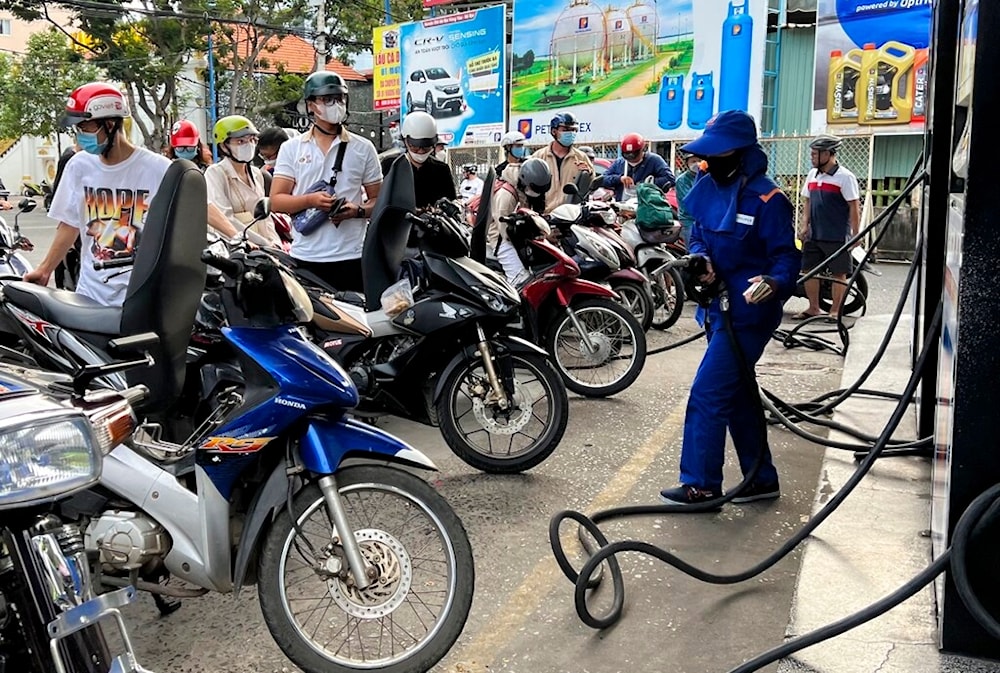
People wait for gas pump in Hanoi, Vietnam Sunday, June 19, 2022. (AP)
Asian nations that initially managed to weather the energy crisis triggered by the US-Israeli war on Iran are now facing a more severe second wave of impacts, as early buffers run dry and the prolonged closure of the Strait of Hormuz continues to choke fuel supplies, pushing millions toward poverty and threatening $299 billion in economic losses across the region, according to the United Nations Development Program.
When the US-Israeli aggression against Iran began on February 28, Asian governments scrambled to adapt to the sudden shutdown of the Strait of Hormuz, a vital artery for energy shipments to the continent. They imposed four‑day workweeks, redirected cooking gas to households, and dipped into emergency stockpiles. But these emergency measures were based on the assumption that the war would be brief and that energy flows would quickly resume. Instead, the war has dragged on for nearly three months, with no end in sight.
Today, the fuel crisis is rippling across Asian economies in ways that early planners did not anticipate. Airfares, shipping rates, and utility bills are climbing, slowing economic growth and eroding living standards. According to the United Nations Development Program, approximately 8.8 million people in the Asia‑Pacific region are at risk of being driven into poverty, and the war may cause up to $299 billion in economic losses.
“The countries with the least resources to respond, or the consumers who can least afford to pay, are the ones who feel everything first,” said Samantha Gross of the Brookings Institution, a US‑based think tank.
Governments face impossible choice between subsidies and backlash
Before the war, Asian governments planned their budgets assuming the price of oil would average around $70 a barrel, but the war pushed the price of Brent crude to as high as about $120 a barrel. Now, officials face a stark dilemma: maintain expensive subsidies at the cost of straining public finances, or cut them and pass higher prices to consumers, risking public outrage.
Ahmad Rafdi Endut, an independent energy analyst in Kuala Lumpur, described the situation as a potential “fiscal time bomb.” Once subsidies are exhausted and inflation begins to rise, governments may have no good options.
In India, early decisions to prioritize cooking gas for 330 million households cut supplies to fertilizer plants. Now, rising fertilizer prices and a forecast of weak monsoon rains threaten the country’s position as the world’s largest rice exporter. Over the weekend, Prime Minister Narendra Modi urged citizens to buy local goods, reduce foreign travel, work from home, use public transport, and asked farmers to halve fertilizer use.
The Philippines switched to a four‑day workweek and introduced targeted subsidies for poor households. Yet Fitch Ratings notes that most consumers are still paying higher energy costs, and business activity in Manila has already slowed. Thailand exhausted its diesel subsidies in less than a month, abandoned its price cap, and is now cutting other spending to manage higher oil prices.
Tourism and trade suffer as shortages spread
Vietnam extended a suspension of fuel taxes to ease domestic pressure, but jet fuel shortages have forced airlines to cut flights. Tourism accounts for nearly eight percent of Vietnam’s GDP, so the impact spreads across the entire economy.
“Business is not good right now,” Hanoi‑based tour guide Nguyen Manh Thang told the Associated Press. “There are already fewer tourists.”
Cash‑strapped nations such as Pakistan and Bangladesh have been forced to buy oil and gas at volatile spot market prices, raising import costs and putting additional pressure on their already depleted foreign exchange reserves.
No quick relief even after war ends
Even if the war were to end tomorrow, experts say Asia should not expect rapid relief. The global oil and gas trade will not bounce back immediately. Restarting production, repairing damaged infrastructure, and shipping fuel from West Asia to final markets will take weeks or months. Europe is expected to feel similar impacts, though with a lag of about four weeks.
While Americans are also feeling pain at the pump, analysts say Southeast Asia is currently the “biggest pain point.” “This fuel shortage situation is going to get worse,” warned Henning Gloystein of the Eurasia Group consultancy.
The crisis also threatens to undo decades of progress in building a middle class. Maria Monica Wihardja of the ISEAS‑Yusof Ishak Institute in Singapore noted that many people are at risk of slipping back into poverty. Over time, the energy shock will reshape job markets and force countries to rethink their long‑term energy strategies. Some are already exploring diversified fossil fuel suppliers, nuclear power, and renewable energy sources like solar.
Albert Park of the Asian Development Bank said the war is making geopolitical risk central to Southeast Asia’s economic outlook and is directly slowing regional growth. “The longer it lasts, the larger those negative effects would be,” he warned.
Read More: Asian markets fall sharply as oil fears shake global trade


