
Canada urges G7 to collectively back de-escalation of Iran war
 3 Min Read
Canada's foreign minister considers it would be a stronger response if there were a “common view” held across G7 nations.
-
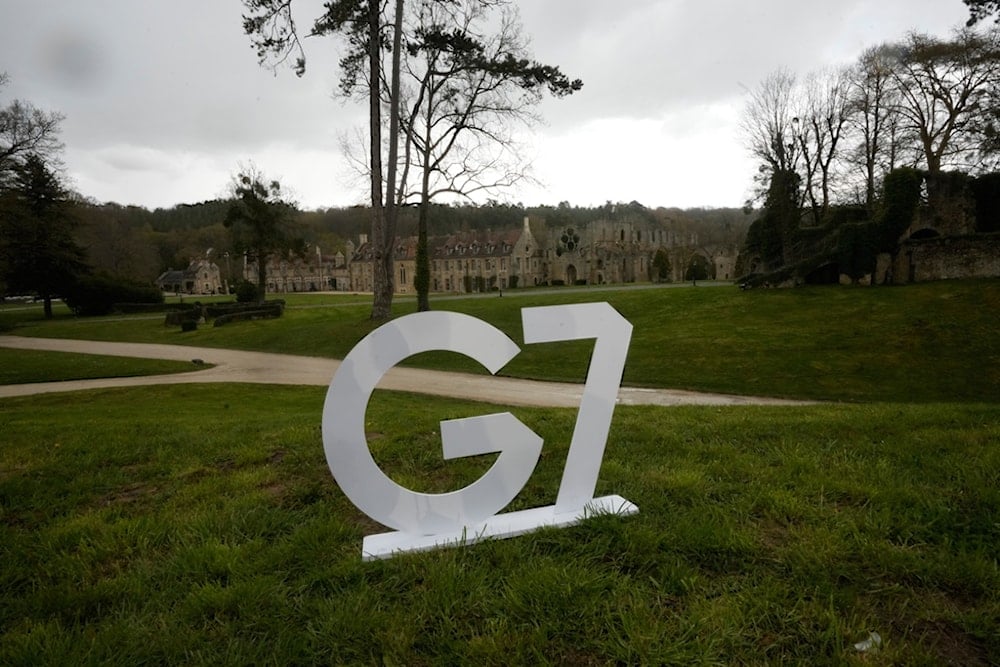
The G7 logo is pictured during the G7 Foreign Ministers' meeting with Partner Countries in Cernay-la-Ville outside Paris, France, Thursday, March 26, 2026 (AP)
Canada's foreign minister, Anita Anand, has urged the leaders of G7 countries to collectively back de-escalation of the US-Israeli war on Iran, calling for a unified response to the war that has disrupted global energy markets and threatened regional stability.
Anand told AFP she had spoken to all members of the political and economic group to advocate for "de-escalation and for the opening of the Strait of Hormuz and for a path forwards for the Iranian people that preserves their lives."
She added that it would be a stronger response if there was a "common view" held across G7 nations, who are meeting in France today.
US absence from summit
US Secretary of State Marco Rubio will make his first trip abroad since the war began to join representatives from Canada, Germany, Italy, France, Japan, and the United Kingdom for the G7 meeting.
However, he will only attend the second day of the summit, reflecting Washington's continued reliance on unilateral military action rather than multilateral diplomacy.
Anand's call for a unified G7 stance comes as Washington's allies grow increasingly concerned about the war's regional and global repercussions, with European nations pushing for de-escalation while the United States continues to deploy additional troops and threaten further aggression.
A war without an exit
Trump issued a 48-hour threat to Iran over the weekend, threatening to "obliterate" Iranian power plants if the Strait of Hormuz was not reopened.
Iran rejected the ultimatum and warned of reciprocal strikes. Hours before the deadline expired, Trump stepped back, citing unspecified "productive conversations", conversations Iran says never happened.
The broader picture, as assessed by multiple analysts, is of a war that is escalating faster than the US can manage, with fewer clear exit points. Iran has shown no indication of accepting conditions, including dismantling its nuclear facilities and reopening the Strait, that would amount to capitulation under fire. The US and "Israel," meanwhile, cannot achieve a decisive outcome through air power alone.
The Strait of Hormuz remains under pressure, European energy markets are in shock, and Rubio heads to Paris with no clear diplomatic breakthrough in sight, only the optics of a G7 that wants Iranian retaliation to stop, while staying silent on what caused it.
Read more: Rubio heads to France for G7 talks regarding war on Iran


