
CNN Analysis: Trump's talking points on Iran unchanged for months
 4 Min Read
CNN analyst Zachary B. Wolf writes that US President Trump's public statements on the war on Iran have remained frozen for months even as the war has evolved into a protracted blockade with no resolution in sight.
-
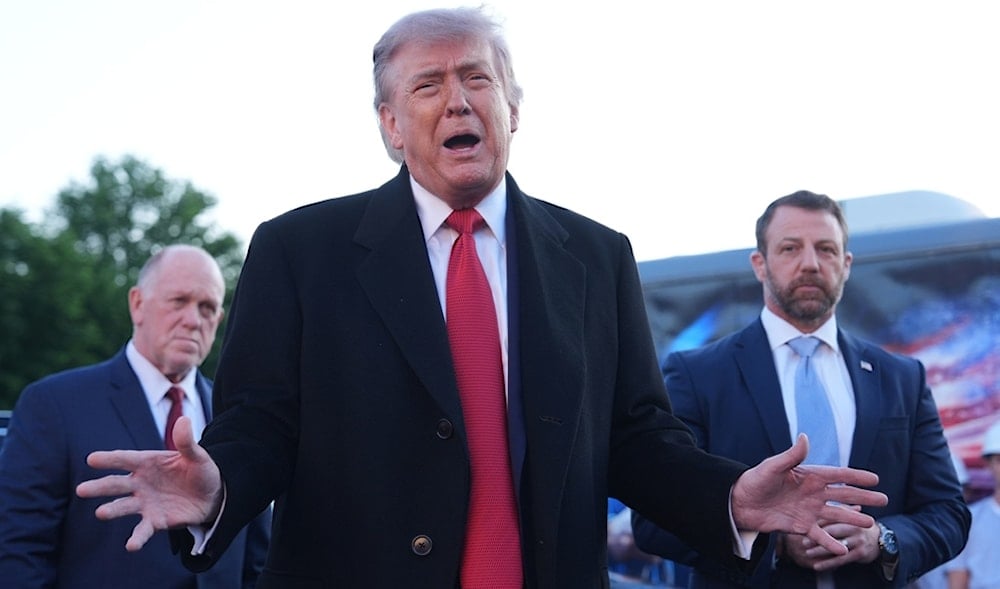
US President Donald Trump speaks as he visits the Lincoln Memorial Reflecting Pool to see the new blue protective coating being applied as part of a renovation project, Thursday, May 7, 2026, in Washington. (AP Photo/Mark Schiefelbein)
According to an analysis by CNN's Zachary B. Wolf, US President Donald Trump has continued to repeat the same talking points about the US‑Israeli war on Iran for months, even as the nature of the war has shifted from intense airstrikes to a protracted ceasefire and blockade, leaving his promises of a quick end increasingly detached from reality.
Wolf speaks of Trump's promises of an imminent resolution that never materializes. The analyst notes that this gap between the president's words and the war's actual course makes it extremely difficult to gauge when Trump is providing genuine information and when he is simply reciting a script.
Trump's shifting timeline for a 'quick end'
Wolf documents how Trump has repeatedly assured audiences that the war will conclude "very soon." In early March, the president predicted a rapid resolution. By mid‑April, he spoke of a four- to six-week timeline.
Now, as the war enters its third month, Trump continues to tell voters and reporters that "it'll be over quickly" without offering any concrete benchmarks.
The CNN analyst points out that Trump has attempted to minimize the scale of the war by calling it a "skirmish," a "little detour," or a "short excursion." These word choices, Wolf writes, are designed to downplay the war's gravity even as its economic and human costs mount.
Read More: Trump seeks speedy end to war on Iran as it drags on futilely
Claiming Iran's military has been 'wiped out'
One of Trump's most repeated claims, according to Wolf, is that Iran's armed forces have been completely destroyed. On May 5, the president declared that Tehran has "no navy — totally wiped out," no air force, no anti‑aircraft capability, no radar, and no remaining military leaders.
Wolf notes that Trump has repeated this assertion "ad nauseam" both before the April 7 ceasefire and since.
However, intelligence assessments cited by US officials indicate that Iran retains thousands of missiles, significant naval assets, and the ability to choke the Strait of Hormuz, directly contradicting the president's declarations of total victory.
Read More: Trump claims Iran 'obliterated', yet urges allies to secure Hormuz
'Iran wants a deal' – but no agreement emerges
Another staple of Trump's rhetoric, Wolf writes, is the claim that Iranian leaders are desperate to negotiate. The president has said repeatedly that Tehran wants an agreement more than Washington does.
Yet despite months of back‑channel talks mediated by Pakistan, no deal has been reached, and Iran has refused to capitulate to excessive US demands.
Wolf observes that Trump has also continued to attack the nuclear agreement struck under President Barack Obama, promising that his own deal with Iran will be "far better." The analyst notes that Trump's characterizations of the original JCPOA bend the facts, including false claims about cash shipments to Tehran.
Read More: 'False and baseless': Iran denies Trump ceasefire claim
Defending the war as necessary
Finally, Wolf notes that Trump defends the entire campaign of aggression by arguing it was essential to prevent Iran from obtaining a nuclear weapon. The president has warned that a nuclear‑armed Iran would threaten "Israel," Europe, and ultimately the United States.
However, the analyst points out that pre‑war intelligence assessments did not indicate Tehran was on the verge of building a bomb.
Wolf concludes that Trump's talking points have become a closed loop, unchanged by the shifting realities on the ground. As the war drags on and economic pain spreads across the globe, the distance between the president's assurances and the actual course of the war continues to widen.
Read More: US intelligence disputes 'imminent nuclear threat' from Iran


