
Democrats gain ground in four pivotal 2026 governor races
 7 Min Read
Democrats are gaining momentum in the 2026 gubernatorial races in Arizona, Ohio, Maine, and New Mexico.
-
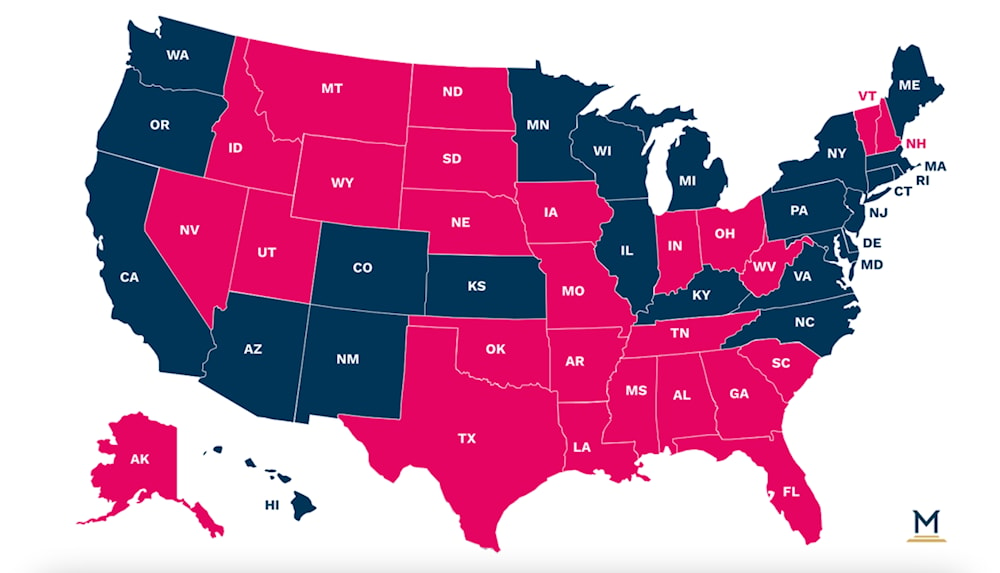
A map showing partisan control of US governorships, with Democratic-held states in blue and Republican-held states in pink, as several key 2026 races shift toward Democrats (Multistate)
Democrats’ prospects in several closely watched gubernatorial elections have improved as new polling and race assessments point to a more favorable environment for the party ahead of the November midterms, Newsweek reported.
The Cook Political Report recently moved four contests in the Democrats’ direction. Arizona shifted from a toss-up to “Lean Democratic,” while Ohio moved from “Lean Republican” to a toss-up. Maine and New Mexico are now rated “Solid Democratic.”
The changes suggest Democrats could protect governorships in the Southwest, remain dominant in two open-seat contests, and potentially capture the governor’s office in Ohio, a state that has moved significantly toward Republicans during the past decade.
The implications extend beyond the individual races. Governors can approve or veto legislation, appoint senior officials, and influence policies covering voting rules, healthcare, education, taxation, and reproductive rights.
Their power is especially significant when the same party also controls both chambers of the state legislature, creating what is commonly known as a governing trifecta.
Ohio emerges as a genuine battleground
The most consequential ratings change came in Ohio, where Republican nominee Vivek Ramaswamy is facing Democratic candidate Amy Acton for the seat being vacated by term-limited Governor Mike DeWine.
Although Republicans have dominated recent statewide elections in Ohio, several polls indicate that Ramaswamy has not established a clear advantage.
A New York Times/Siena survey conducted between June 15 and 28 found Acton and Ramaswamy tied at 47 percent among likely voters.
Other surveys have given Acton a narrow lead. An AARP poll of 800 likely voters, conducted from June 14 to 16, placed her ahead by 47 percent to 44 percent, with a margin of error of 3.5 percentage points.
A Fox News survey conducted between May 28 and June 1 also found a virtual tie, with Acton receiving 50 percent and Ramaswamy 49 percent.
The closeness of the race is particularly notable because Ramaswamy has substantial financial resources and the backing of President Donald Trump. However, Acton appears to be benefiting from dissatisfaction over the economy and healthcare costs, as well as stronger enthusiasm among Democratic voters.
Prediction markets still give Republicans a slight advantage in Ohio, reflecting the state’s recent electoral history and assumptions about Republican turnout. The polling, however, suggests neither candidate can currently be regarded as the clear favorite.
Hobbs strengthens her position in Arizona
Democratic Governor Katie Hobbs has also improved her standing as she seeks a second term in Arizona.
Polling averages have placed Hobbs several points ahead of Representative Andy Biggs, the leading contender in the Republican primary scheduled for July 21.
A RealClearPolitics average covering surveys conducted between November 2025 and early May 2026 showed Hobbs at 44.3 percent and Biggs at 39.3 percent.
Noble Predictive Insights similarly found Hobbs leading Biggs by 41 percent to 37 percent in a May survey of 996 registered voters.
Hobbs also holds a substantial advantage among Latino voters, an important constituency in a state where recent statewide elections have been decided by narrow margins. A UnidosUS survey published in June found her leading Biggs by 31 points among Arizona’s Latino electorate.
Arizona remains politically competitive, and Republicans could still improve their position once the primary is settled. For now, however, Hobbs benefits from incumbency, a divided Republican field, and polling that consistently places her ahead of her potential challengers.
Prediction markets have also moved sharply toward the Democrats, assigning the party roughly a four-in-five chance of retaining the governorship.
Democratic nominees favored in Maine and New Mexico
The two open-seat contests in Maine and New Mexico now appear considerably less competitive.
In Maine, former state House speaker Hannah Pingree secured the Democratic nomination after the state completed its ranked-choice count in June. She is seeking to succeed term-limited Democratic Governor Janet Mills.
Earlier polling showed a fragmented Democratic primary, with Troy Jackson and Nirav Shah initially tied near the front of the field. Those surveys also found large numbers of undecided voters, underscoring the uncertainty that existed before Pingree emerged as the nominee.
With the primary resolved, analysts expect Democratic voters to consolidate behind Pingree. Maine has regularly supported Democrats in statewide federal elections, while the party also holds substantial power in state government.
Prediction markets place the probability of a Democratic victory close to 90 percent, in line with Cook’s decision to classify the race as solidly Democratic.
New Mexico presents a similar picture.
Former US Interior Secretary Deb Haaland won the Democratic gubernatorial primary with approximately 72 percent of the vote, defeating Bernalillo County District Attorney Sam Bregman, who received about 28 percent.
Haaland had led throughout the primary campaign. An April survey by Research & Polling Inc. placed her ahead of Bregman by 52 percent to 30 percent, while an Emerson College poll gave her a 40 percent-to-24 percent advantage.
She will face Republican nominee Gregg Hull, the mayor of Rio Rancho, in November.
Democrats have consistently performed well in recent New Mexico statewide elections, and Haaland enters the general election with high name recognition, national fundraising connections, and a consolidated party base.
Election markets currently assign Democrats an overwhelming probability of holding the governorship.
Legislative contests raise the stakes
The changes in the gubernatorial landscape have also increased the importance of state legislative races.
Democrats are seeking to gain control of the Arizona Legislature, expand or protect their position in Maine and New Mexico, and weaken the Republican supermajority in Ohio.
“Momentum is building for Democratic candidates across the country up and down the ticket, and state legislative races just got even more important as key gubernatorial contests shift in their favor,” said Democratic Legislative Campaign Committee President Heather Williams.
She argued that gubernatorial victories would have limited value without legislative majorities capable of advancing the party’s agenda.
Republicans continue to hold the broader advantage in state legislatures. They control both chambers in 28 states, compared with 18 under complete Democratic control.
That imbalance has given Republicans considerable influence over election administration, congressional redistricting, labor regulations, taxation, and social policy.
Democrats see the 2026 elections as an opportunity to reduce that advantage, particularly in states where competitive legislative districts overlap with closely watched gubernatorial campaigns.
November outcome remains uncertain
The rating changes do not guarantee Democratic victories. Polls remain snapshots of voter opinion, while prediction markets can move rapidly in response to campaigning, economic developments, and political controversies.
Arizona’s Republican nominee has yet to be formally selected, Ohio remains essentially tied, and all four contests could be affected by national turnout patterns.
Nevertheless, the current trajectory is more favorable to Democrats than it was earlier in the election cycle.
Their strongest opportunities lie in defending Arizona, maintaining control in Maine and New Mexico, and turning Ohio into a genuine contest despite the state’s recent Republican shift.
Whether that momentum survives until Election Day on November 3 will depend on turnout, campaign spending, and the choices of voters who remain undecided.
Read more: Democratic primary turnout outpaces Republican's ahead of 2026 midterm


