
Diaz-Canel: US threatening to overthrow Cuba's constitutional order
 5 Min Read
Cuban President Miguel Diaz-Canel condemns daily US threats to overthrow the island's constitutional order, warning that any external aggressor will face "impregnable resistance" amid Washington's escalating economic war.
-
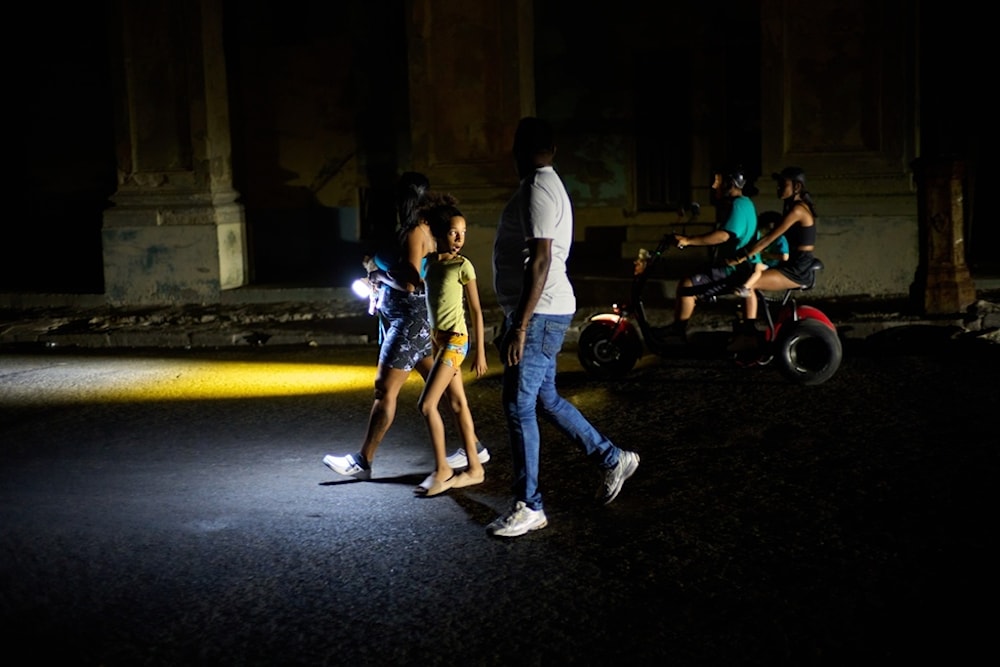
People walk on a street during a blackout in Havana, Monday, March 16, 2026 (AP)
Cuban President Miguel Diaz-Canel condemned the United States for its daily threats against the island nation, accusing Washington of seeking to overthrow the constitutional order by force under the pretext of targeting Cuba's weakened economy.
In a post on X, Diaz-Canel wrote that the US publicly threatens Cuba "almost daily, with overthrowing the constitutional order by force," describing the justification as an "outrageous pretext" built on the economic limitations Washington itself has inflicted through decades of attacks and isolation.
#EEUU amenaza públicamente a #Cuba, casi a diario, con derrocar por la fuerza el orden constitucional. Y usa un indignante pretexto: las duras limitaciones de la debilitada economía que ellos han agredido y pretendido aislar hace más de seis décadas.
— Miguel Díaz-Canel Bermúdez (@DiazCanelB) March 18, 2026
Pretenden y anuncian planes…
"They intend and announce plans to seize the country, its resources, its properties, and even the very economy they seek to strangle to make us surrender," the Cuban leader stated.
Diaz-Canel argued that only through this lens can Washington's "fierce economic war" be explained, which he characterized as "collective punishment against the entire people."
Despite the pressures, the President affirmed Cuba's resolve in the face of aggression.
"In the face of the worst scenario, Cuba is accompanied by a certainty: any external aggressor will clash with an impregnable resistance," he concluded.
Context: US escalates rhetoric and pressure on Cuba
The President's remarks come as Washington has intensified its hostile posture toward Havana, with US officials publicly floating the possibility of seizing the island nation.
US President Donald Trump said on Tuesday he could "take Cuba" as the island faces a nationwide power blackout, triggered by an ongoing US oil blockade and deepening economic crisis. Speaking at the White House, Trump suggested Washington has broad leverage over Havana, declaring he could "do anything I want" with the island nation amid ongoing talks regarding its future.
"You know, all my life I've been hearing about the United States and Cuba. When will the United States do it?" Trump told reporters. "I do believe I'll be … having the honor of taking Cuba. Whether I free it, take it, think I could do anything I want with it. You want to know the truth. They're a very weakened nation right now."
Trump's remarks came as Cuba plunged into a total power blackout, with its fragile electricity grid collapsing under severe fuel shortages induced by the US siege of the island. The crisis follows Washington's decision to cut off Venezuelan oil supplies to Cuba, a move that has significantly worsened the nation's energy situation and disrupted daily life across the country.
US demands for regime change
US officials have also increased pressure on Havana during negotiations, reportedly calling for the removal of Diaz-Canel as part of any agreement, according to multiple reports. Such demands are likely to be rejected by Cuba, which has repeatedly insisted that any talks must respect its sovereignty and political system.
US Secretary of State Marco Rubio has long advocated for political change in Cuba, while Trump has previously floated the idea of a "friendly takeover," though he recently warned it "may not be a friendly takeover."
On Tuesday, Rubio dismissed a New York Times article alleging the United States seeks to oust Diaz-Canel without altering the political system as fabricated. "The reason so many in US media keep putting out fake stories like this one is because they continue to rely on charlatans & liars claiming to be in the know as their sources," Rubio wrote on X.
Deepening economic crisis
Cuba had been receiving an average of 35,000 barrels of Venezuelan oil per day through late 2025, used both to power the island and generate export revenue for essential imports. That lifeline collapsed following the abduction of Venezuelan President Nicolas Maduro, a key ally and oil supplier to Havana. Analysts now warn Cuba could exhaust its remaining fuel reserves by mid- to late March, bringing life on the island to a standstill.
A 2025 survey by the Food Monitor Program found that 78% of respondents described the current crisis as the worst they had experienced in terms of food access, while seven in ten Cubans skipped at least one meal last year due to shortages or inability to pay. Fuel has grown so scarce that a tank of gas now fetches over $300 on the black market, more than most Cubans earn in a year.
Despite the pressure, Diaz-Canel has reiterated that any dialogue with Washington must be based on "equality and respect" for Cuba's sovereignty and self-determination.
Read More: Rubio denies US seeking to oust Cuban President Diaz-Canel


