
Orban calls using frozen Russian assets 'dead end', 'killed' proposal
 5 Min Read
EU leaders have yet again failed to agree on using frozen Russian assets amid legal concerns and divisions within the bloc.
-
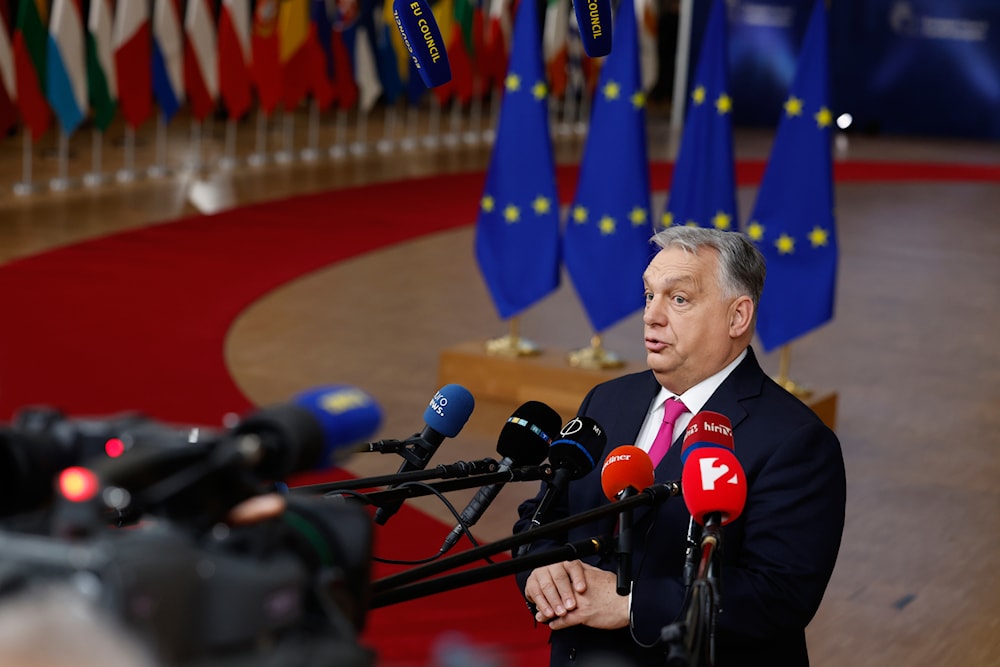
Hungary's Prime Minister Viktor Orban speaks with the media as he arrives for the EU Summit in Brussels, Thursday, Dec. 18, 2025 (AP)
There is no way forward for proposals to fund the rebuilding of Ukraine via frozen Russian assets, said Hungarian Prime Minister Viktor Orban.
Speaking to CNBC as officials arrived at a European Council meeting, Orban said proposals to use the immobilized assets as a means to assist Ukraine had been “killed".
“It’s [a] dead end. It’s over,” he said. “There is no sufficient level of support behind it.”
Orban has been a vocal critic of plans to use potentially hundreds of billions of euros of frozen assets to fund reparations loans for Kiev. Hungary isn’t alone in having doubts over the measures, however.
Belgium, too, has expressed concern over possible legal and financial risks. Italy and Bulgaria have also supported Belgium’s resistance to the proposals.
Asked ahead of Thursday’s meetings if he was acting in Europe’s or Russia’s interests by working to block the use of Russian assets by the EU, Orban said he was “just working for peace.”
“I think what we have to do [is] to make some steps to peace, not to war,” he said.
EU approves €90 billion loan to Ukraine
EU leaders have pledged a €90 billion loan to Ukraine to help meet its urgent financial needs, but failed to reach a consensus on a key proposal to secure the funding against Russia’s frozen assets within the bloc.
Following talks that concluded in the early hours of Friday, European Council President António Costa told reporters that the leaders had approved a decision to provide Ukraine with a €90 billion loan over the next two years, backed by the EU budget. Under the agreement, Kiev would only be required to repay the loan once Russia pays reparations.
“We committed and we delivered,” Costa said, adding that the European Union “reserves its right to make use of the immobilised assets to repay this loan.”
Blank check demands remain hurdle for using frozen Russian assets
EU leaders entered the summit on Thursday with growing pressure to tie the loan directly to Russia’s estimated €210 billion in frozen assets held across the bloc. However, the proposal stalled after Belgium, which hosts around 88% of those assets, demanded unlimited budget guarantees from other member states in the event that Moscow successfully pursued legal claims for damages.
Belgian Prime Minister Bart De Wever voiced strong reservations about the reparations-backed loan, saying the plan was flawed. “When we explained the text again, there were so many questions that I said, ‘I told you so, I told you so,’” he said, adding that the proposal contained “a lot of loose ends” that could cause it to collapse if scrutinized further.
Despite the lack of agreement on using frozen Russian assets as collateral, EU leaders maintained that the approved loan would ensure continued financial support for Ukraine amid ongoing economic pressures linked to the war.
How the loan moved forward
Supporters of the reparations-backed loan, including German opposition leader Friedrich Merz, had previously argued that financing Ukraine through the EU budget would be unworkable because it requires unanimous approval from all member states.
That obstacle was overcome after three governments in central Europe signaled they would back the use of the EU budget to fund Ukraine, provided that they were not required to contribute to loan guarantees. Hungary, Slovakia, and the Czech Republic agreed to the arrangement, with Hungarian Prime Minister Viktor Orbán sharing a photo of the three leaders in a trilateral meeting and writing on social media: “Back in business!”
According to the final agreement, EU guarantees linked to the €90 billion loan “will not have an impact on the financial obligations” of the three countries, effectively exempting them from financial liability.
Danish Prime Minister Mette Frederiksen welcomed the deal, describing it as a significant achievement to secure consensus among all 27 EU member states. “It is quite something to get 27 countries to agree on a €90 billion loan for another,” she said, warning that divisions within and outside the bloc were growing. “There are a lot of people outside the European Union and unfortunately, also inside the European Union who try to divide us. It is getting more and more difficult, and I think this will continue.”
The decision on financing Ukraine was framed in stark terms by Poland’s Prime Minister Donald Tusk, who warned EU leaders that the choice was “money today or blood tomorrow.”
EU officials had hoped that a move to use frozen Russian assets to support Ukraine would prompt other Western allies, including the United Kingdom, Canada, and Japan, to take similar steps. However, with no agreement reached on that option, it remains unclear how those countries will respond. Brussels has nonetheless urged non-EU partners to contribute around €45 billion to help cover the remainder of Ukraine’s estimated €136 billion in military and civilian financing needs for 2026 and 2027.
Earlier, Ukrainian President Volodymyr Zelensky told EU leaders that using Russia’s frozen assets to fund Ukraine’s defense would be “one of the clearest and most morally justified decisions that could ever be made.”
Despite the setback on frozen assets, Kiev is expected to welcome the agreement on EU funding. Zelensky has warned that Ukraine risks running out of funds to produce drones, a key element of its defence against Russia’s ongoing invasion.


