
Ex-Pentagon advisor says Trump 'desperate' as Iran leverages Hormuz
 3 Min Read
A former Pentagon advisor tells CNN that Iran is gaining leverage in negotiations as Trump’s aggressive and inconsistent rhetoric signals desperation.
-
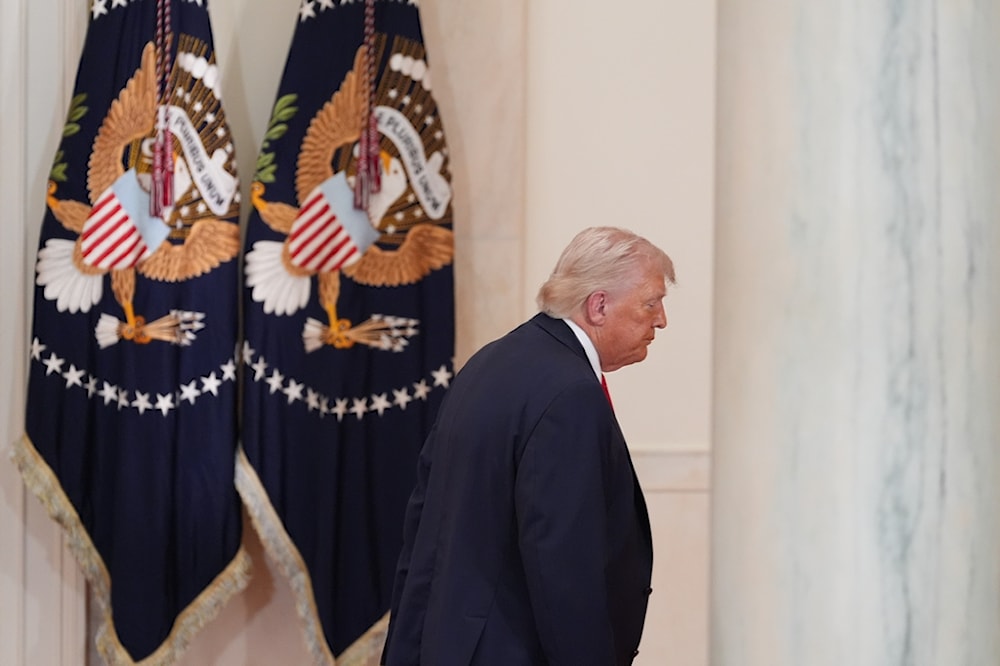
US President Donald Trump departs after speaking about the Iran war from the Cross Hall of the White House on Wednesday, April 1, 2026, in Washington (AP, Pool)
Iran could be gaining leverage in potential negotiations with the United States, as US President Donald Trump’s escalating rhetoric is being interpreted by some analysts as a sign of urgency to end the war, CNN reported.
Jasmine El-Gamal, a former Pentagon advisor, said Tehran is likely reading Trump’s statements as an indication that Washington is under pressure to reach a deal.
“What the Iranian regime is getting from President Trump’s speeches is that he is actually desperate to make a deal,” she told CNN. “They know that if they continue to impose these costs on the US, Gulf allies, global energy markets, they have a better chance of getting to the negotiating table on their terms.”
Her remarks come after Trump warned in a speech on Wednesday that the United States could “bring them (Iran) back to the stone ages,” reflecting a hardline stance even as calls for negotiations persist.
At the same time, the economic fallout of the war is becoming increasingly visible. Energy markets have been shaken by disruptions in the Strait of Hormuz, a key route for global oil shipments, pushing US gasoline prices above $4 a gallon for the first time since 2022.
US alternating approach complicating efforts for a deal
El-Gamal said the administration’s alternating approach, which involves combining threats of escalation with expressions of interest in diplomacy, is complicating efforts to reach an agreement.
“We’re not closer than we were last week because he (Trump) keeps doing the same thing, vacillate between these two positions. We want a deal but we’re also going to bomb you to the stone age if you don’t give it to us. That’s not the way you bring an adversary to the negotiating table.”
Tehran gains leverage
As the war continues to drive up costs and uncertainty, Tehran may be positioning itself to negotiate from a stronger footing, particularly if it maintains pressure on energy flows and regional stability.
This dynamic is reinforced by developments in recent weeks, as Iranian officials have consistently denied the existence of negotiations with Washington and framed US claims of talks as attempts to manipulate energy markets and buy time.
At the same time, the Strait of Hormuz has emerged as Tehran’s central leverage point, with Iran imposing controlled restrictions on maritime transit while allowing conditional passage for non-hostile vessels, tightening global supply without fully halting trade.
US officials have privately acknowledged that reopening the waterway could take weeks or even months, casting doubt on Washington’s ability to meet its own timeline for ending the war. The White House has also signaled that other countries may need to take the lead in securing maritime passage, while President Trump has at times indicated he is willing to end the war even if the strait remains closed.
Together, these developments point to a widening gap between US objectives and operational realities, as Iran’s sustained pressure on global energy flows continues to shape the balance of leverage in any potential negotiations.
Read more: France, Bahrain push UN bid for Hormuz intervention


