
Germany approves 2027 federal budget with higher defense spending
 4 Min Read
Germany's cabinet approved the 2027 federal budget, increasing defense spending, infrastructure investment, and borrowing while outlining fiscal reforms.
-
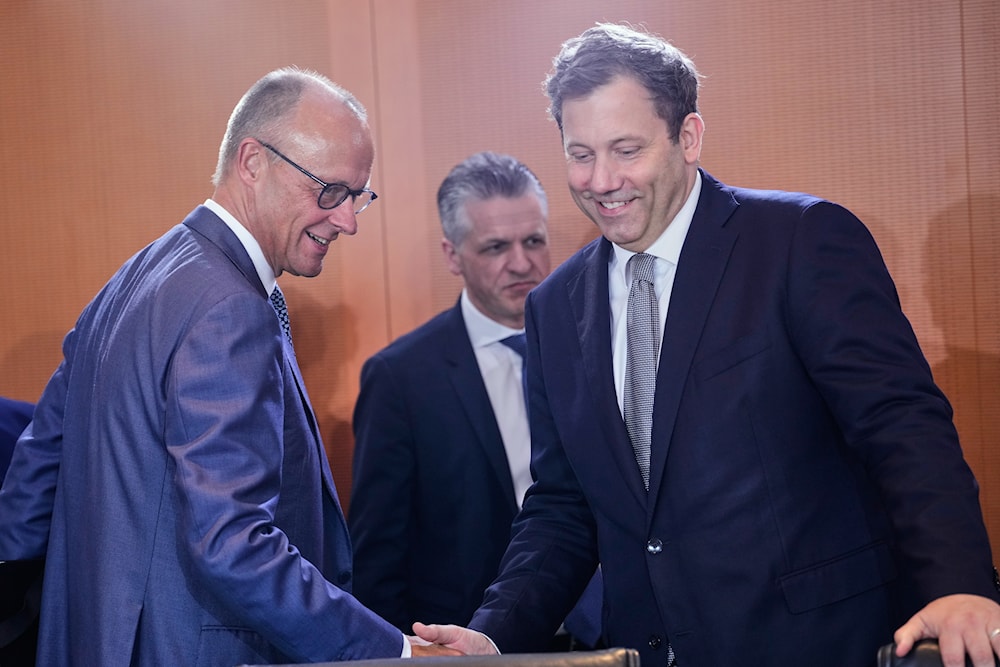
German Chancellor Friedrich Merz, left, and Vice Chancellor Lars Klingbeil attend the cabinet meeting at the chancellery in Berlin, Germany, July 6, 2026 (AP)
Germany’s cabinet approved the first draft of the 2027 federal budget on Monday, signalling a decisive shift toward increased investment and military spending as Europe’s largest economy grapples with energy shocks linked to the war in Ukraine and decades of underinvestment, Reuters reported on Tuesday.
The draft budget, which forms part of a medium-term financial framework extending to 2030, sets total expenditure at €555.4 billion ($634.16 billion), with overall borrowing projected at €203.6 billion. The figures confirm a Reuters report from last Friday.
Presenting the plan, Finance Minister Lars Klingbeil framed the budget as a roadmap for renewal and resilience. “We want Germany to be a strong and crisis-resilient country,” Klingbeil told reporters.
“That is why the priorities in the 2027 budget are clear: We want to put our country back on a growth path and create the jobs of the future in Germany.”
Borrowing surge to fund transformation
Under the proposed framework, Germany plans to accumulate total borrowing of €838.2 billion between 2027 and 2030. This sharp increase is made possible by a special infrastructure fund approved last year, alongside a relaxation of constitutional borrowing rules to accommodate higher defense outlays.
“We are investing in future viability and innovative strength, as well as in security and resilience,” Klingbeil added.
However, the debt-financed strategy comes with a high cost. Interest payments on the national debt are projected to nearly double by 2030, rising from €41.9 billion in 2027 to €80.7 billion - a trajectory that has drawn sharp criticism from key industry groups.
Both the BDI industry association and the German Mittelstand association (DMB) voiced strong concerns over the scale of new borrowing.
“By 2030, nearly one in five euros of tax revenue could be tied up in interest payments,” warned Tanja Goenner, chief executive of the BDI, underscoring the long-term fiscal strain the budget could impose on the economy.
Defense spending takes centre stage
The 2027 budget allocates €118.7 billion in core new borrowing, with an additional €54.9 billion drawn from the infrastructure fund and €30 billion from a dedicated defense fund. Total investment is set to surge to €117.5 billion in 2027, up from €78.9 billion in 2025 under the previous government, a leap driven largely by the €500 billion infrastructure fund and looser borrowing caps for defense.
Core defense spending alone will climb to €109 billion in 2027, compared with €82.2 billion in 2026. Including support for Ukraine and other security-related expenditures, total defense outlay reaches €130.1 billion.
Justifying the military buildup, Klingbeil invoked the threat posed by Russia: "We cannot defend Germany against Putin with a balanced-budget policy. We must make up, in the shortest possible time, for three decades in which no investment was made in our defense capability".
Thanks to last year’s reform of Germany’s constitutional "debt brake", which now exempts defense spending from the borrowing cap, the country is set to commit a total of €783.8 billion to defense-related expenditure between 2026 and 2030.
Ukraine support and fiscal consolidation
The budget earmarks €11.6 billion for Ukraine in 2027, with €8.5 billion allocated annually from 2028 to 2030. The finance ministry projects that defense spending as a share of GDP will rise from 2.8% in 2026 to 3.5% in 2029.
Despite the difficult economic climate, Klingbeil said the government had made significant progress on fiscal consolidation, fully closing a €34 billion shortfall for 2027. To achieve this, the administration plans to raise taxes on alcohol and cut social benefits, according to the draft budget seen by Reuters. The plan also calls for reductions in pension subsidies.
“We are putting the budget in order,” Klingbeil said. “That is my duty as finance minister.”
While the 2027 gap has been closed, the need for cuts in 2028 has been reduced to around €22 billion. Nevertheless, a funding shortfall of roughly €109 billion remains for the years from 2028 onward, signalling that tough negotiations lie ahead.
Following cabinet approval, parliamentary discussions on the draft budget are set to begin in September, with final passage expected by the end of the year.


