
GOP senators turn on Hegseth as war on Iran drags on
 7 Min Read
Pete Hegseth's leadership is beign questioned as the prolonged war on Iran exposes strategic miscalculations, rising costs, military discontent, and weakening political support.
-
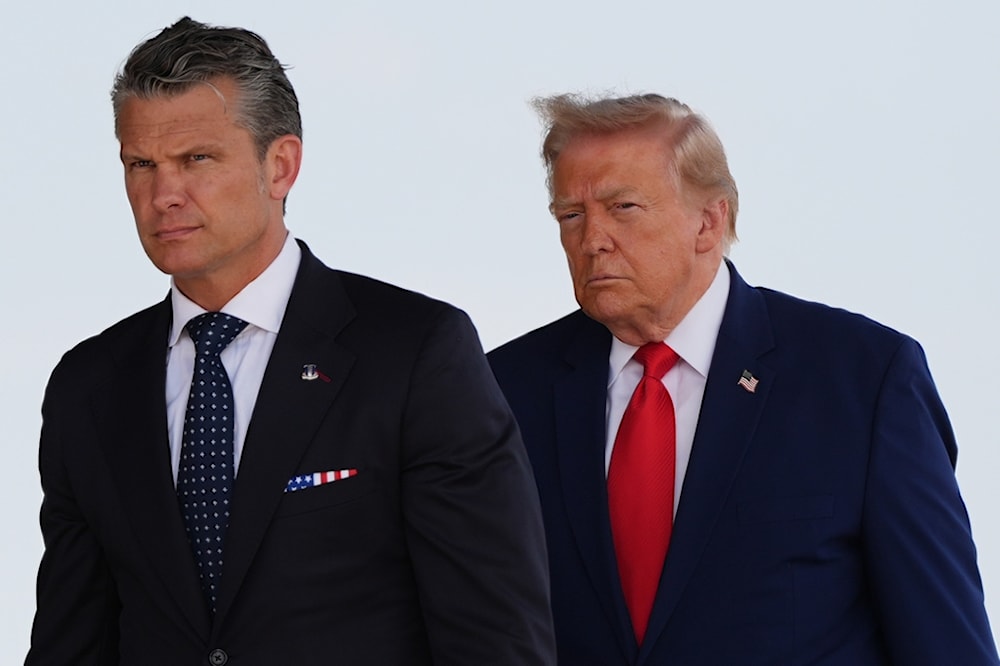
US Secretary of War Pete Hegseth and President Donald Trump attend the dignified transfer of four US service members recently killed in the Middle East, Wednesday, July 22, 2026, at Dover Air Force Base, Del. (AP)
Republican unease over US Secretary of War Pete Hegseth is intensifying as the nearly five-month war on Iran continues to strain Washington’s military posture, drive up energy prices, and expose divisions within President Donald Trump’s party.
According to a report by The Hill, several GOP senators are questioning whether Hegseth and the Pentagon adequately prepared for Iran’s response to the US war, including Tehran’s disruption of shipping through the Strait of Hormuz and attacks targeting Washington’s regional allies.
Lawmakers have also raised concerns about the spread of the confrontation into the Red Sea, where the Yemeni Resistance has targeted Saudi-linked oil shipments, further threatening major maritime trade routes.
Tillis declares loss of confidence
Senator Thom Tillis of North Carolina delivered one of the strongest public rebukes of Hegseth, accusing the War Secretary of weakening the Pentagon by removing experienced commanders and attempting to exercise excessive control over the department.
“I don’t have any confidence in him anymore. I think he’s all over the place — he’s accelerating the retirement or forcing out some of the most distinguished leaders in the DOD that we have,” Tillis told The Hill.
“I think he’s got a massive insecurity complex, he has a lack of experience in large organizations, he micromanages too much. He’s lost my confidence,” he added.
Tillis said other Republican senators may be close to publicly expressing similar concerns.
“I think there are other people that are probably one decision or another” away from speaking out critically about the leadership of the Pentagon, he said.
His criticism carries additional weight as the Senate prepares to consider a budget framework that would pave the way for a $95 billion reconciliation package, including $73 billion for the Pentagon and US intelligence agencies.
Republicans may struggle to approve the additional funding before the August recess, particularly with Senator Mitch McConnell absent from voting since June 11 because of a health issue.
Concerns emerge inside Pentagon
One Republican senator familiar with defense discussions on Capitol Hill said dissatisfaction with Hegseth was also spreading among senior military officials.
“I have heard out of the Pentagon that there’s a loss of confidence — within the Pentagon. And of course then everyone here on the Hill hears those same concerns,” the senator said anonymously.
Questions surrounding Hegseth’s leadership deepened following the forced retirement of Chris Donahue, the US Army’s highest-ranking commander in Europe.
Senate Appropriations Committee Chair Susan Collins criticized the removal of senior officers during a hearing on the administration’s request for emergency military funding.
“I find this deeply troubling,” Collins said. “These are men and women who volunteered to serve our country and swore an oath to support and defend our Constitution.”
After the hearing, Collins said she still needed “more information” regarding “the strategy and endgame for the war.”
“I thought the hearing yesterday was somewhat helpful, but questions remain,” she said.
Senators acknowledge strategic miscalculations
Other Republicans have privately questioned why the administration appeared unprepared for Iran’s ability to keep the Strait of Hormuz closed for an extended period.
The disruption has sharply increased oil and gasoline prices since the war began in February, while Iranian retaliatory operations on Jordan, Kuwait, and Saudi Arabia have demonstrated Tehran’s capacity to widen the confrontation.
A second anonymous Republican senator said the war had lasted far longer than anticipated and suggested the administration had underestimated Iran’s regional options.
“I think there’s a sense it’s taken longer than what we thought and that maybe our strategy didn’t factor in the Strait of Hormuz or [Iran’s] ability to be willing to hit their neighbors. I think there was some miscalculations maybe,” the senator said.
Tillis also questioned whether the removal of senior military leaders had damaged the Pentagon’s ability to plan for Iran’s response.
“Everybody knows about some of the Game of Thrones stuff going on with some of the other service secretaries and Hegseth. It seems like he wants to run the whole place,” he said.
“When you’re a leader, you better damn sure have people smarter than you in the room. You’re supposed to be air traffic control for all these brilliant people and he’s undermining the DOD’s success by undermining these brilliant people who spent their career in uniform,” Tillis added.
He argued that commanders pushed out under Hegseth may have been better positioned to warn Trump that Iran could disrupt Hormuz for months and use allied forces in Yemen to pressure shipping in the Red Sea.
Republican hawks demand escalation
Despite growing criticism of the administration’s handling of the war, several Republican war hawks continue to argue that Washington can achieve its objectives through a major escalation.
Senate Armed Services Committee Chair Roger Wicker has called on Trump to “finish the job” by intensifying US attacks.
Senator John Cornyn of Texas similarly argued that the United States should use its military advantage to forcibly reopen the Strait of Hormuz.
“I think we just need to demonstrate our decisive military edge and reopen the Strait of Hormuz because we can’t depend on the Iranian regime,” Cornyn said. “If anybody can do it, the United States can.”
“The problem of endless wars, in my view, is gradual escalation. Until then, you are stuck and there is no way out other than just sort of capitulation,” he added. “So I think a decisive outcome by opening the Strait of Hormuz should be the goal.”
The calls for escalation come despite growing public fatigue over a war Trump initially predicted would last only four or five weeks.
“I do think that the American public’s growing weary,” Senator Shelley Moore Capito told NewsNation.
War costs fuel funding dispute
The financial burden of the war has become another major source of tension between the Pentagon and Congress.
Hegseth said the war had cost $37.5 billion, but independent estimates cited by lawmakers place the economic impact much higher. Moody Analytics has estimated the cost at no less than $132 billion.
Senator Joni Ernst said lawmakers remained concerned about both the scale of the spending and the lack of detailed information provided by the administration.
“Collectively those of us in Congress are worried about the costs associated with the Department of War and the transparency,” Ernst said.
“I think … why they’ve asked him to come to the Hill and present the numbers, and I still don’t know that there’s a lot of clarity on that. I think that’s what a lot of people are concerned about,” she added.
The mounting criticism leaves Trump and Hegseth facing pressure from two directions: Republicans demanding greater accountability and a clear exit strategy, and party hawks insisting that only a large-scale military escalation can reverse Washington’s setbacks and restore support for the war.
Read more: Hegseth faces lawmakers over war on Iran costs, US military casualties


