
Hegseth’s military shakeup claims top Europe commander
 4 Min Read
General CD Donahue, the top US Army officer in Europe, will retire as War Secretary Pete Hegseth continues a sweeping overhaul of senior US military leadership.
-
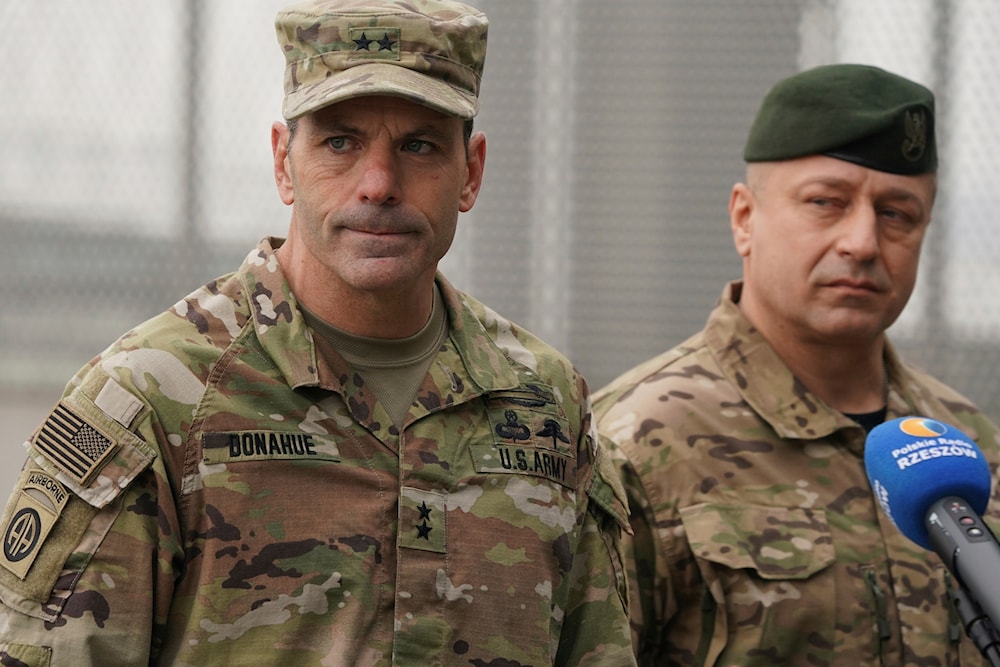
US Army General Christopher Donahue, left, commanding general of the 82nd Airborne Division, and Polish General Wojciech Marchwica speak to journalists in southeastern Poland, on Feb. 6, 2022 (AP)
The top US Army officer in Europe, General CD Donahue, will retire early from the military, becoming the latest senior leader ousted by War Secretary Pete Hegseth in an ongoing shakeup of the armed services’ highest ranks, the Financial Times reported, citing people familiar with the matter.
Donahue, a four-star general and decorated special forces veteran who played a pivotal role in coordinating US assistance to Ukraine following the outbreak of the war, is expected to announce his retirement on Wednesday.
His departure comes just two months after Hegseth fired Army Chief of Staff General Randy George, a move that sources say fueled widespread resentment among uniformed officers across all branches.
The forced retirement coincides with a broader Pentagon review that is expected to downgrade the US European Command’s structure and with President Donald Trump escalating pressure on NATO allies to assume greater responsibility for their own defense and for the war in Ukraine.
A West Point graduate with decades of combat experience in Iraq, Syria, and other conflict zones, Donahue was widely recognized as the last American soldier to leave Afghanistan during the chaotic US withdrawal in August 2021, ordered by then-President Joe Biden. He also previously commanded US Army forces in Africa.
Another decorated US general ousted by Hegseth
While the Pentagon has not publicly explained the rationale behind Donahue’s ouster, Hegseth has been an outspoken critic of the Biden administration’s handling of the Kabul withdrawal and has launched an official investigation into the events surrounding it.
“As an officer who proved himself in combat leading the Army’s most elite troops during the toughest years of the wars in Iraq and Afghanistan, Donahue is widely respected across both the special operations and conventional parts of the military,” said Sean Naylor, an expert on US special operations and intelligence for The High Side newsletter.
The dismissal is expected to send another shockwave through the US military. Several former senior officers told the Financial Times that Hegseth has fostered a climate of fear that is affecting the entire chain of command, from junior personnel up to the joint chiefs.
Over the past 18 months, Hegseth has fired dozens of officers, including General CQ Brown, chairman of the Joint Chiefs of Staff, and Admiral Lisa Franchetti, the first female chief of US Naval Operations. He also removed Air Force General Timothy Haugh, who ran the National Security Agency and US Cyber Command, and has blocked promotions for multiple senior officers without providing reasons for those decisions.
House puts Hegseth's firing spree on hold
The House Armed Services Committee has adopted a bipartisan provision that would compel the Pentagon to notify Congress within five days of any senior military officer being fired or dismissed, along with a written justification for the decision, according to The Hill.
The measure, introduced by Representative Pat Ryan, a New York Democrat, was approved by voice vote on June 5 with no objections, signaling rare bipartisan unity on an issue that has increasingly strained relations between lawmakers and defense leadership.
Lawmakers from both parties have voiced growing frustration over a lack of transparency, arguing that experienced commanders are being pushed out without adequate explanation to Congress.
If enacted, the provision would formalize a statutory reporting requirement, ensuring that lawmakers are informed of senior-level firings and provided with a clear rationale within a strict five-day window.
The measure still faces further legislative hurdles. It must pass the full House and Senate as part of the broader National Defense Authorization Act (NDAA) before it can be sent to the president for signature into law. If finalized, it would mark a significant expansion of congressional oversight over Pentagon personnel actions at the highest command levels.


