
IAEA board to consider new anti-Iran resolution with UNSC referral
 5 Min Read
The IAEA Board of Governors is considering a resolution on Iran that could refer future Director General reports to the UN Security Council.
-
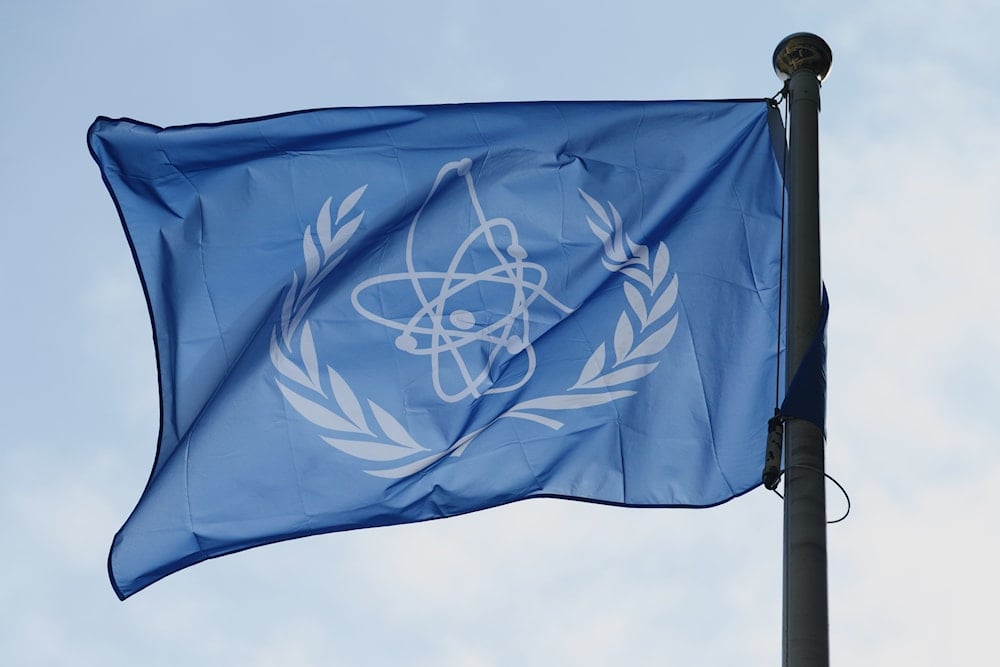
The flag of the International Atomic Energy Agency (IAEA) flies during a special session of an IAEA Board of Governors meeting in Vienna, Austria, March 2, 2026 (AP)
The Board of Governors of the International Atomic Energy Agency (IAEA) is set to discuss a draft resolution that includes a provision calling for the referral of the Director General's reports to the United Nations Security Council.
The draft text, submitted by Germany, France, the United Kingdom, and the United States, is scheduled for a vote possibly later today or tomorrow.
The resolution is being considered as part of ongoing board proceedings regarding Iran's nuclear activities and its safeguards obligations.
Previous board decisions on Iran recalled
The draft resolution acknowledges the professional and independent work of the agency's Secretariat in implementing the Safeguards Agreement with Iran, which operates under the Treaty on the Non-Proliferation of Nuclear Weapons, as documented in INFCIRC/214.
It also reaffirms the agency's role in verifying compliance and providing objective technical reports to both the board and, where appropriate, the Security Council.
The proposed text references two earlier board findings on Iran's alleged non-compliance with its safeguards obligations, adopted on June 12, 2025, as contained in document GOV/2025/38, and on July 10, 2026, as contained in document GOV/2026/40, as well as a separate decision from November 21, 2025, as contained in document GOV/2025/71. The current draft reiterates the conclusions set out in those previous resolutions.
Board members are now weighing whether to build on those prior determinations with additional measures, including the referral of future reports to the Security Council.
Agency reports claims 'continued non-compliance'
According to the draft resolution, the board notes with serious concern the latest report from the Director General, as contained in document GOV/2026/50, which documents Iran's so-called "failure to meet its safeguards obligations." The text states that the agency currently lacks sufficient information on previously declared nuclear materials and faces restricted access to facilities needed for verification.
The board views these gaps as matters of proliferation and compliance concern that require urgent attention, according to the draft. The resolution also reiterates the board's support for a diplomatic solution and urges Iran to enter into serious, precondition-free talks aimed at building international confidence in the peaceful nature of its nuclear program.
Officials familiar with the discussions indicated that the board's concerns have deepened over successive reporting cycles, as the agency has been unable to close outstanding verification issues. The proposed referral to the Security Council is seen as a significant escalation in the board's response.
Board reiterates call for Iran to address safeguard issues
Under the operative sections of the draft, the board would call on Iran to urgently address what it regards as "non-compliance" by taking all steps that the agency and the board deem necessary. The goal, according to the text, is to enable the Director General to provide the required assurances that Iran's declarations are correct and complete and that no nuclear material subject to safeguards has been diverted.
If adopted, the resolution would also direct the Director General to transmit the current resolution, along with the two previous board resolutions contained in documents GOV/2025/38 and GOV/2026/40, and the Director General's report contained in document GOV/2026/50, to all IAEA member states, the Security Council, and the UN General Assembly.
The Director General would additionally be required to continue submitting regular quarterly reports on Iran's safeguards implementation and verification activities to both the board and the Security Council.
Iran refuses compliance under fire
Iran's decision to curtail cooperation with the International Atomic Energy Agency (IAEA) followed a series of military strikes on its nuclear facilities, amid ongoing diplomatic talks. On June 13, 2025, "Israel" and the US launched a major aggression on Iranian nuclear and military sites, with the United States bombing three key nuclear facilities at Fordow, Natanz, and Isfahan on June 22, 2025.
In response, Iran's parliament voted overwhelmingly on June 25, 2025, to suspend cooperation with the agency, a bill that was formally ratified the following month. The legislation stipulated that cooperation would remain suspended until the IAEA condemned the attacks on Iran's nuclear sites and provided formal guarantees regarding the security of the country's nuclear industry.
Tehran has cited safety concerns following the bombings, with Iranian officials stating that the IAEA cannot request inspections of damaged facilities until specific protocols for inspecting sites subjected to military attack are drafted and approved. Officials have also accused the agency of failing to fulfill its legal duty by refusing to condemn the attacks.
As of September 2026, IAEA Director General Rafael Grossi confirmed the agency has lost continuity of knowledge regarding Iran's nuclear program and remains unable to verify declared nuclear materials. Iranian officials have maintained that restrictions on inspectors are a direct consequence of the US and Israeli attacks, arguing that it is unreasonable to blame Tehran for the resulting loss of access.


