
Invisible wires, visible impact: Hezbollah FPVs keep 'Israel' on edge
 5 Min Read
Hezbollah’s use of fiber-optic guided drones in southern Lebanon is challenging Israeli counter-drone defenses, exposing new battlefield vulnerabilities.
-
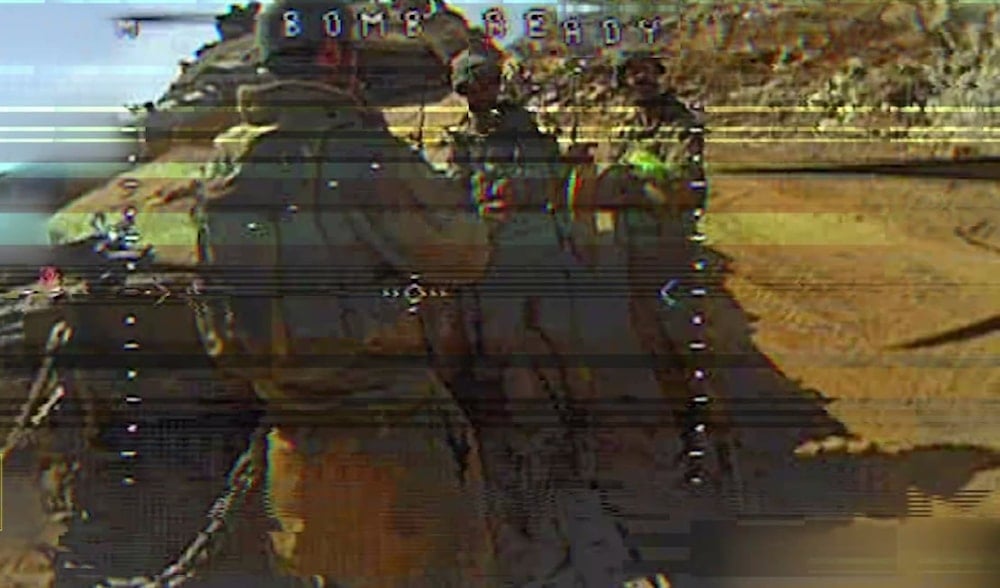
Footage from a Hezbollah-operated FPV drone shows Israeli troops seconds before exploding among them in al-Taybeh, southern Lebanon, April 26, 2026 (Islamic Resistance Military media)
Hezbollah’s growing use of fiber-optic guided drones is presenting a new operational challenge for Israeli occupation forces in southern Lebanon, as recent battlefield incidents highlight the limitations of conventional counter-drone systems.
In one such attack, a small explosive-laden quadcopter struck an Israeli tank and nearby soldiers after approaching undetected at low altitude. Footage released by Hezbollah showed the drone navigating between damaged buildings before locking onto its target, with the words “BOMB READY” displayed on the operator’s screen.
According to the Israeli military, the strike killed Sgt. Idan Fooks and wounded several others. The group subsequently launched additional drones toward a rescue helicopter dispatched to evacuate the injured.
Fiber-optic drones reshape battlefield dynamics
Military analysts say the drone used in the operation is likely a fiber-optic guided system, a type of weapon Hezbollah has increasingly deployed with precision. Unlike conventional drones that rely on radio signals, these systems are physically tethered to their operators via a thin fiber-optic cable, allowing real-time control without emitting electronic signals.
This feature makes them particularly difficult to counter. “Immune to communication jamming, and in the absence of an electronic signature, it is also impossible to discover the location from which they were launched,” wrote Yehoshua Kalisky, INSS senior researcher.
The cable, which is lightweight and nearly invisible, can extend for long distances, up to 15 kilometers or more, enabling operators to remain far from the target while maintaining a high-resolution, first-person view of the battlefield.
"Israel" has traditionally relied on electronic warfare systems to disrupt drone operations by jamming control frequencies. However, the absence of a signal in fiber-optic systems renders such defenses ineffective and complicates early detection.
“Beyond physical barriers like nets, there is little that can be done,” an Israeli military source said, according to CNN. “It’s a low-tech system adapted for asymmetric warfare.”
Evolving tactics and limited countermeasures
Hezbollah’s use of these drones reflects a shift in its targeting strategy. With Israeli forces operating close to their own supply lines in southern Lebanon, the group has instead focused on direct attacks against troops both in the border area and northern "Israel".
“This is a capable system that, in the right hands with an experienced operator against a force that’s not expecting such a drone to attack, it can be quite effective,” Samuel Bendett, an adjunct senior fellow at the Center for New American Security, told CNN. “Even against a force that knows about this and is taking precautions, it can still be deadly.”
Israeli officials claim that Hezbollah acquires commercial drone platforms from countries such as China or Iran, modifying them by attaching explosive payloads. Beijing has previously denied supplying weapons to any parties involved in the war, stating it adheres to its international obligations.
In contrast to Israeli claims, Hezbollah published a video on May 2nd showcasing their homegrown drone manufacturing capabilities, showing the process of assembling a one-way attack drone using workshop tools in a secret, fully-equipped facility. '
It is worth noting that the late Hezbollah leader martyr Sayyed Hassan Nasrallah asserted the group's domestic production numerous times in his speeches.
The Islamic Resistance in Lebanon - Hezbollah published a video entitled "Proudly made in Lebanon," showcasing the manufacturing of the UAVs used against the Israeli occupation, which have proven to be extremely difficult to counter, inflicting heavy casualties on the Israeli… pic.twitter.com/YPNLRCFpxT
— Al Mayadeen English (@MayadeenEnglish) May 2, 2026
Despite their relatively small payloads, the drones’ low cost and precision make them a significant threat. “Hezbollah already has a fairly sophisticated drone arsenal,” Bendett said. “It has a lot of experienced people with a lot of different experience in UAVs.”
In response, Israeli forces have begun deploying physical countermeasures, including protective nets, to intercept incoming drones, an approach also seen in other conflict zones such as Ukraine. However, military officials acknowledge these measures are not fully reliable.
“It’s not foolproof, not as much as we would like,” an Israeli official claimed, adding that efforts are underway to develop more effective countermeasures in coordination with intelligence units, according to CNN.
Earlier on May 2, Hezbollah published a video of an FPV drone strike targeting a netted Merkava tank, exposing the fragility of Israeli countermeasures. In the video, the drone can be seen hitting the tank, before an ammo cookoff takes place shortly after, completely destroying the tank and setting it ablaze.
#WATCH | The Islamic Resistance in Lebanon released footage of an operation targeting an Israeli Merkava tank in the town of al-Qantara in South Lebanon with an FPV drone. #SouthLebanon #Lebanon #AlQantara #LebanonUnderAttack pic.twitter.com/E7NvjzDQlE
— Al Mayadeen English (@MayadeenEnglish) May 1, 2026
For now, Israeli officials say the threat continues to evolve, particularly as Hezbollah experiments with coordinated drone attacks.
“It’s a threat that we are still adapting to,” the official said. “Hezbollah is learning fast. They are trying to coordinate attacks, so it’s a threat.”


