
Iran urges UNSC action over US threats, attacks on civilians
 3 Min Read
Iran’s UN envoy urged the Security Council to condemn US threats and alleged war crimes during the recent US-Israeli war on Iran, warning against global silence.
-
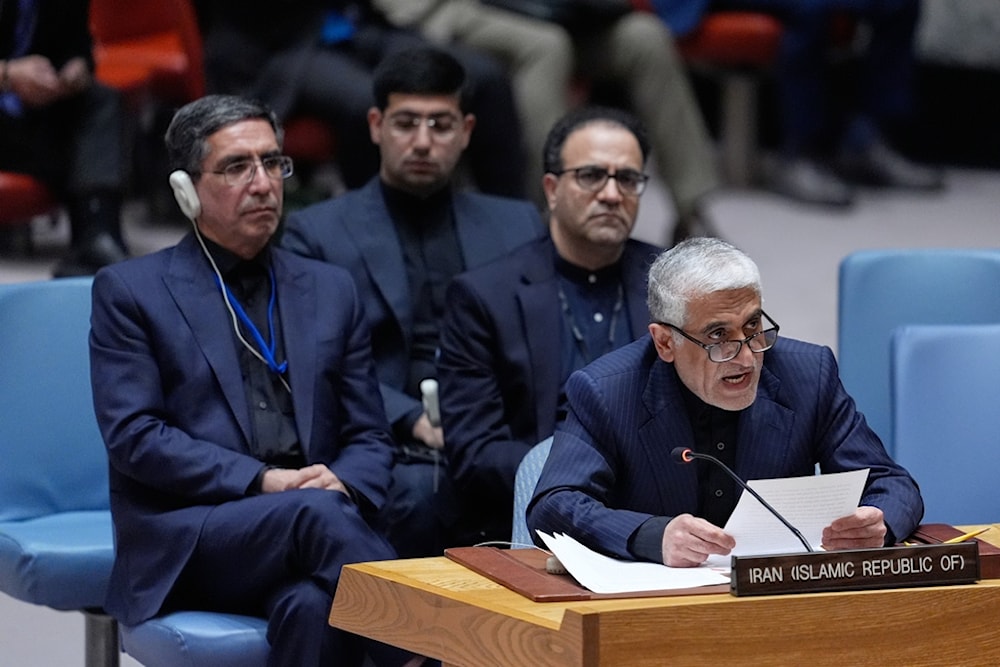
Iranian ambassador to the United Nations Amir-Saeid Iravani speaks during a Security Council meeting at United Nations headquarters, Wednesday, March 11, 2026. (AP Photo/Seth Wenig)
Iran’s ambassador and permanent representative to the United Nations, Amir-Saeid Iravani, called on the UN Security Council to break its silence over US threats and violations of international humanitarian law during the recent war on Iran.
Speaking on Wednesday during a UN Security Council open debate on the “Protection of the Civilians,” Iravani criticized the council for its failure to uphold its responsibilities in the face of attacks carried out by the United States and the Israeli regime.
He accused both governments of deliberately targeting civilians and civilian infrastructure during the war, including the Shajareh Tayebeh School in the southern Iranian city of Minab, which led to over 170 teachers and students being martyred.
Iranian envoy condemns threats by US president
“The Security Council must not remain silent or indifferent to the repeated and daily basis threats made by the President of the United States against Iran,” Iravani said during his address.
He referenced explicit threats to bomb Iran “back to the Stone Age,” alongside threats against the country’s infrastructure, nuclear scientists, and senior officials.
“The normalization of such threats of force, acts of aggression, and inflammatory rhetoric by a permanent member of the Security Council sets a dangerous precedent,” he added.
Iravani further stated that the United States, "Israel" and those who “assisted and facilitated” the attacks “must bear full legal and international responsibility” for actions taken during the war.
“No state should be permitted to shield itself behind political protection while violating the [UN] Charter and targeting civilians with impunity,” he said.
Read more: Iran rejects US CENTCOM claim over Minab school strike
Tehran defends military response as self-defense
The Iranian envoy also defended Tehran’s retaliatory actions during the war, saying measures taken by Iran were consistent with its “legitimate right to self-defense.”
He also rejected politically motivated attempts to distort developments during the war.
Iravani additionally called on the international community to recommit to principles outlined in the UN Charter, including state sovereignty, territorial integrity, and the peaceful settlement of disputes.
UN Security Council divisions after 2026 escalation
Following the outbreak of the war on Iran, the joint US–Israeli attacks that initiated the conflict were widely debated within UN forums, with the Secretary-General warning early in the war that the escalation represented a serious threat to international peace and security and calling for an immediate return to negotiations under the UN Charter framework.
The UNSC's response has been politically skewed, shielding the US and "Israel" from accountability despite attacks on civilians, civilian infrastructure, and violations of Iran's sovereignty.


