
Mechanism change not matter of direct 'Israel'-Lebanon talks: Excl.
 6 Min Read
The French envoy calls for "Israel's" withdrawal and respect for Lebanon’s sovereignty, reaffirming support for UN Resolution 1701.
-
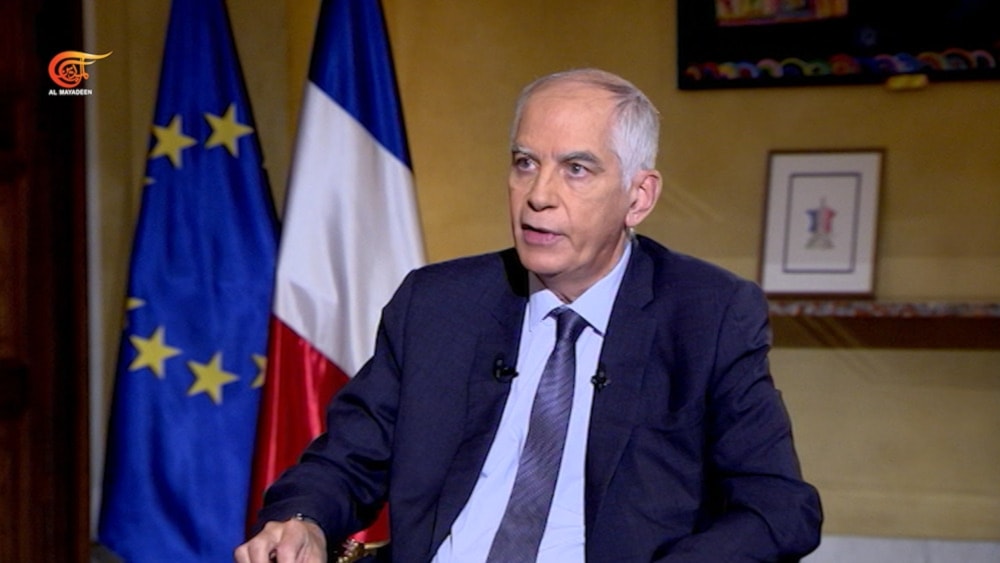
French ambassador to Lebanon, Hervé Magro, in an interview for Al Mayadeen, December 4, 2025 (Al Mayadeen)
Ensuring "Israel’s" withdrawal from occupied positions along the Lebanese border and ending violations of Lebanese sovereignty remain critical priorities, the French ambassador to Lebanon, Hervé Magro, stated on Thursday.
In an interview for Al Mayadeen, Magro emphasized the importance of clearly distinguishing between political negotiations between "Israel" and Lebanon and the work of the “Mechanism”, a committee monitoring the cessation of hostilities. He explained that “what is happening today is simply that discussions previously held at the military and technical levels necessarily have political dimensions" that need to be addressed.
Magro highlighted that the inclusion of civilians in the Lebanese delegation within the mechanism “does not fall outside the framework initially adopted for this process,” noting that civilian participation in its activities has been consistent from the start.
"So this does not constitute direct negotiations between the countries concerned," he asserted.
The French diplomat reaffirmed to Al Mayadeen that the exchanges witnessed at the military level, involving civilian representatives from different countries, remain within the mechanism’s normal scope. Magro stressed that France has always advocated for including a political dimension in what is primarily a military discussion, stating that civil engagement is essential for exchanging perspectives.
France long believed 'Mechanism' must include civilians
Regarding France’s role in introducing Lebanese civilians into the Mechanism, Magro said Paris has long believed that “this process must include more civil dimensions,” as military authorities alone cannot address all the issues at hand. He recalled the monitoring mechanism established after the 1996 Qana massacre, noting that it included both military and political dimensions through ambassadorial meetings in Cyprus, which lasted for several years to address complex challenges politically as well as militarily.
Magro reiterated, when asked whether his country hopes the negotiations will move beyond technical issues, that “we are not discussing a different phase of the mechanism’s work,” noting that “if a new phase of negotiations emerges, it will undoubtedly take place in a different manner.” Once this happens, he explained, Lebanese authorities and other parties must consider the format any different negotiations would take. For now, the ambassador continued, the mechanism continues its work normally while ensuring that its political dimension is fully integrated into its work.
'Israel' must withdraw from the five occupied points
On "Israel’s" compliance with the ceasefire and UN Security Council Resolution 1701, Magro stressed that "Israel" withdraw from the five points it has under occupation along the Lebanese border and called for an end to any violations of Lebanese sovereignty, be it through airstrikes or incursions. He also emphasized the need for the Lebanese government to regain full control over all weapons on its territory and for continued efforts to enforce its authority across the country.
Magro reiterated the importance of fully activating the Mechanism, allowing the Lebanese army, with the UNIFIL's support, to play its full role in overseeing the disarmament process. He expressed concern that, to date, there has been no clear confirmation of progress on disarmament in South Lebanon and emphasized close follow-up at both the Mechanism and official levels.
On French support for Lebanon and its army, Magro affirmed Paris’ steadfast commitment to the Lebanese people, highlighting France’s involvement in organizing humanitarian assistance and military support following last year’s ceasefire. He stressed the importance of strengthening the Internal Security Forces to enable the Lebanese Army to fully manage its responsibilities.
Regarding the upcoming economic conference, Magro said the international community awaits reforms across various sectors. He clarified that engagement with the IMF is not about imposing a foreign plan but supporting a Lebanese-led program that meets international standards.
The conference, he added, is essential to mobilize donor support while ensuring conditions are met for collective assistance to Lebanon.
'Israel' admits to striking Lebanon hundreds of times since ceasefire
Since the November 2024 ceasefire, "Israel" has carried out a total of 669 airstrikes across Lebanon, with an average of roughly two strikes per day, according to data released on November 28 by the Israeli Alma Research and Education Center.
Alma's assessment concluded that "Israel" launched 669 airstrikes across Lebanon in one year, claiming Hezbollah infrastructure was the primary target. 47% of the strikes hit areas south of the Litani River, while 38.4% hit areas north of it. Eastern Bekaa accounted for 13% of the attacks, while 11 strikes targeted Beirut and its outskirts.
The report highlighted that the frequency of attacks was at its peak during the initial months of the truce, averaging 51 strikes per month, with December 2024 and March 2025 experiencing the highest concentration of airstrikes according to the data.
In a related development, Israeli occupation forces stated that they have maintained operations inside Lebanon despite the declared ceasefire, reporting that in addition to the hundreds of airstrikes, their ground units conducted more than 1,200 raids and “small-scale operations” in southern Lebanon, particularly in the areas surrounding the five so-called “strategic” posts located just across the border.
5,163 violations as of November 3, 2025
New data covering the period from November 27, 2024, to November 3, 2025, thoroughly documented thousands of Israeli violations in Lebanon by air, land, and sea; all unfolding under total impunity.
The total number of violations recorded stood at 5,163, divided as follows;
- Aerial: 2,850 attacks
- Ground: 2,150 attacks
- Maritime: 163 attacks
309 Lebanese citizens were martyred, and 598 others were injured in these attacks.
It is worth noting that recent attacks targeted residential areas and private businesses, damaging infrastructure and heightening tensions. These violations reflect a pattern of disregard for international agreements and contribute to ongoing instability in Lebanon’s southern and border regions, undermining efforts to maintain peace.


