
Mexico, EU expand trade pact to reduce dependence on US
 4 Min Read
Mexico and the European Union signed an updated trade agreement lowering tariffs and expanding market access as both sides seek to reduce dependence on US trade policies and supply chains.
-
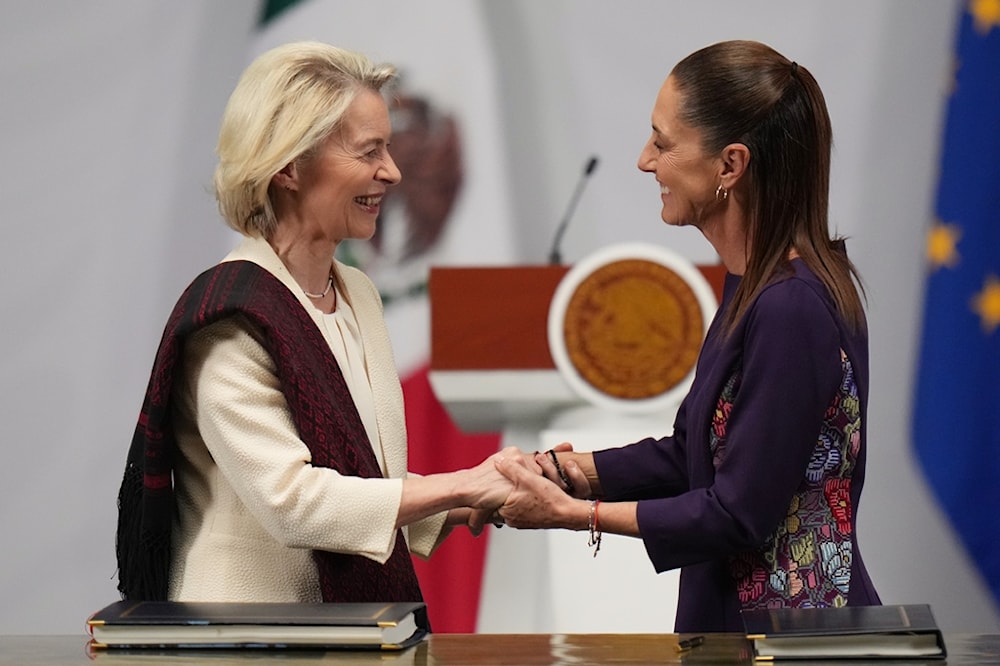
Mexican President Claudia Sheinbaum, right, and European Commission President Ursula von der Leyen, shake hands during a press conference at the National Palace in Mexico City, Friday, May 22, 2026 (AP)
Mexico and the European Union signed an updated trade agreement on Friday aimed at lowering tariffs and expanding investment access, as both sides seek to reduce their dependence on the United States and strengthen alternative economic partnerships.
The updated Mexico-EU trade deal, signed during the eighth EU-Mexico Summit by Mexican President Claudia Sheinbaum and European Commission President Ursula von der Leyen, expands a trade accord originally established in 2000.
The agreement comes as Mexico works to preserve the United States-Mexico-Canada Agreement (USMCA), which remains central to North American trade, while simultaneously diversifying its economic partnerships beyond the US market.
Mexico’s government has increasingly stressed the need to “open other horizons” as both Mexico and the EU face the impact of US President Donald Trump’s tariff policies.
A joint statement issued after the summit said both sides had chosen to “expand, deepen and update” their strategic partnership at a time of global economic turbulence and geopolitical transformation.
Updated pact lowers tariffs on key products
The revised agreement removes most remaining barriers to trade and investment between the EU and Mexico, including measures affecting auto parts, one of the sectors most impacted by Trump-era tariffs.
Mexico also agreed to recognize hundreds of European regional food and beverage products, including Parma ham and Roquefort cheese.
Under the updated accord, tariffs will be reduced on additional goods, while duty-free access will be granted for products including pasta, chocolate, potatoes, canned peaches, eggs, and certain poultry products.
“Mexico wants to reduce its dependence on its northern neighbor, but also on Asian, or rather, Chinese, supply chains, and in Europe, we are pursuing the same objectives,” the official said.
EU and Mexico seek broader economic diversification
During a visit to Mexico City on Thursday, EU foreign policy chief Kaja Kallas said the agreement would create new opportunities for both economies to compete globally.
Trade between the EU and Mexico has increased by 75% over the past decade, according to European officials.
Earlier this week, the European Union also moved to ease trade tensions with Washington by implementing a deal that sets tariffs on most European goods entering the US at 15%.
Average US tariffs on Mexican goods remain significantly lower, with many products continuing to avoid levies under the USMCA framework.
Mexican President Claudia Sheinbaum rejected suggestions that closer economic cooperation with Europe could undermine Mexico’s ties with Washington. “On the contrary, they strengthen Mexico, strengthen Europe, and strengthen the United States,” she said during a press conference.
EU finalizes US trade pact under pressure
European Union lawmakers and member states reached a final agreement early Wednesday to implement the bloc’s trade pact with the United States, nearly a year after the deal was first signed.
The breakthrough came following sustained pressure from US President Donald Trump, who had threatened new tariff increases if the agreement was not ratified before July 4.
The accord, reached last July between Washington and the European Commission, set tariffs on most European exports to the United States at 15% while requiring the EU to gradually remove duties on most US imports.
However, implementation had stalled for months amid political disputes inside Europe and mounting tensions with Washington.
Negotiators from the European Parliament and EU member states reportedly held overnight talks before finalizing the agreement several hours after midnight.
EU includes safeguards against future US measures
The final agreement includes provisions allowing the European Commission to suspend preferential tariff arrangements if Washington violates the deal or adopts measures targeting European industries.
According to the finalized text, Brussels can activate a suspension mechanism if the United States disrupts trade and investment relations or discriminates against EU economic operators.
The agreement also contains safeguards allowing the EU to respond to sudden increases in US imports deemed harmful to domestic European producers.
However, European negotiators reportedly softened several earlier demands that Washington had opposed.
One key concession gives the United States until the end of the year to remove additional tariffs exceeding 15% on steel components, instead of requiring immediate removal as a condition for implementation.


