
RSF chief advisor Hamid Ali Abubakar killed in Zalingei drone strike
 3 Min Read
Hamid Ali Abubakar, a top advisor to RSF commander Mohammed Hamdan Dagalo, was killed in a Sudanese army drone strike near Zalingei.
-
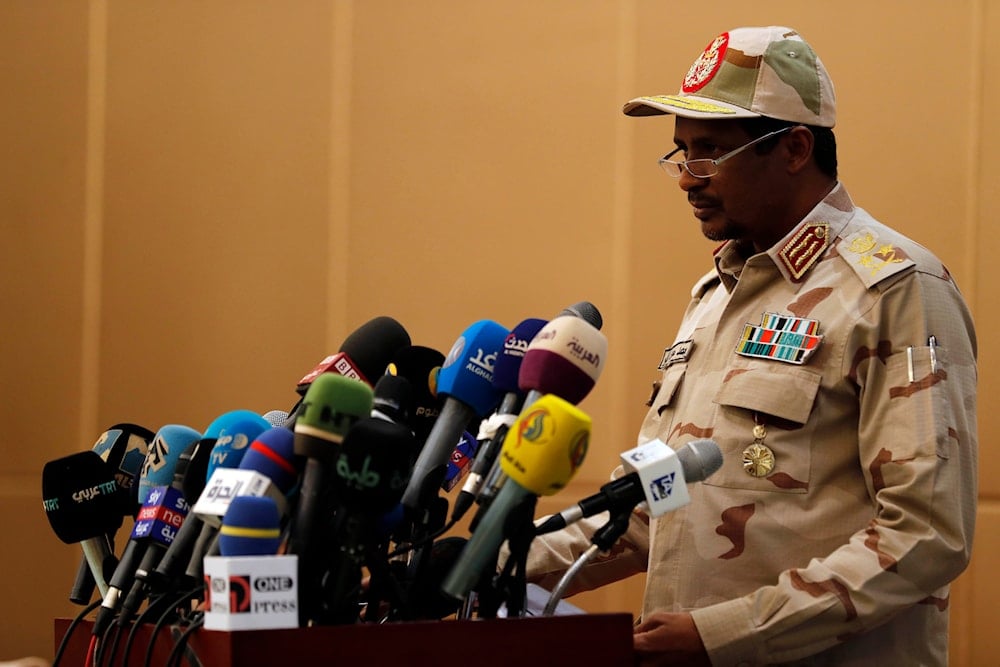
Gen. Mohammed Hamdan Dagalo, the deputy head of the military council, speaks at a ceremony in the capital Khartoum, Sudan, on Aug. 4, 2019 (AP)
Hamid Ali Abubakar, a security advisor to Rapid Support Forces (RSF) commander Mohammed Hamdan Dagalo, was killed along with several aides in a drone strike carried out by the Sudanese army near the city of Zalingei, the capital of Central Darfur state, according to RSF officials.
The announcement was made on Thursday evening by RSF security advisor Al-Basha Tabiq in a post on the social media platform Facebook, in which he confirmed the death of “Commander Advisor Hamid Ali Abubakar.” Tabiq said Abubakar also headed the RSF’s Al-Saif Al-Battar military unit, which operates primarily across northern, central, and western areas of the Darfur region.
Tabiq accused the Sudanese army of “assassinating” Abubakar and warned that it would “pay a heavy price for this crime,” underscoring escalating tensions between the two rival forces.
Local sources said the drone strike targeted a meeting of RSF forces in the village of al-Firdous, located in the Waranga area near Zalingei in western Sudan. According to the sources, Abubakar served both as a senior advisor to Dagalo and as a field commander leading the Al-Saif Al-Battar unit, which comprises hundreds of RSF fighters.
The sources added that Abubakar played a key role in mobilizing tribal groups and traditional leaders in support of the RSF, highlighting his influence within the paramilitary organization as fighting continues across Darfur and other parts of Sudan.
Sudan continues to reel under the yoke of war
On December 30, 2025, UNICEF reported that nearly half of the children in parts of Darfur are suffering from acute malnutrition. The UN renewed calls for an immediate ceasefire and unimpeded humanitarian access as conflict zones expanded.
Between December 22 and 25, over 10,000 civilians were displaced in South Kordofan and West Darfur, according to the International Organization for Migration. Aid groups warned of deteriorating humanitarian conditions as fighting spread to new areas.
On December 20, 2025, a United Nations humanitarian team entered El Fasher, the capital of North Darfur, for the first time since the city came under the control of the Rapid Support Forces (RSF). The visit revealed catastrophic damage, with entire neighborhoods destroyed and public infrastructure severely compromised.
Residents described mass displacement, widespread looting, and a near-total breakdown of essential services, including water, electricity, and medical care. Humanitarian agencies expressed alarm at the scale of the devastation and warned that access to the region remains dangerously restricted.


