
The war on Iran is creating risks for the US far beyond West Asia: CNN
 8 Min Read
The prolonged war on Iran is affecting US weapons stockpiles, military readiness and Washington’s position across Ukraine, the Korean Peninsula and the Pacific.
-
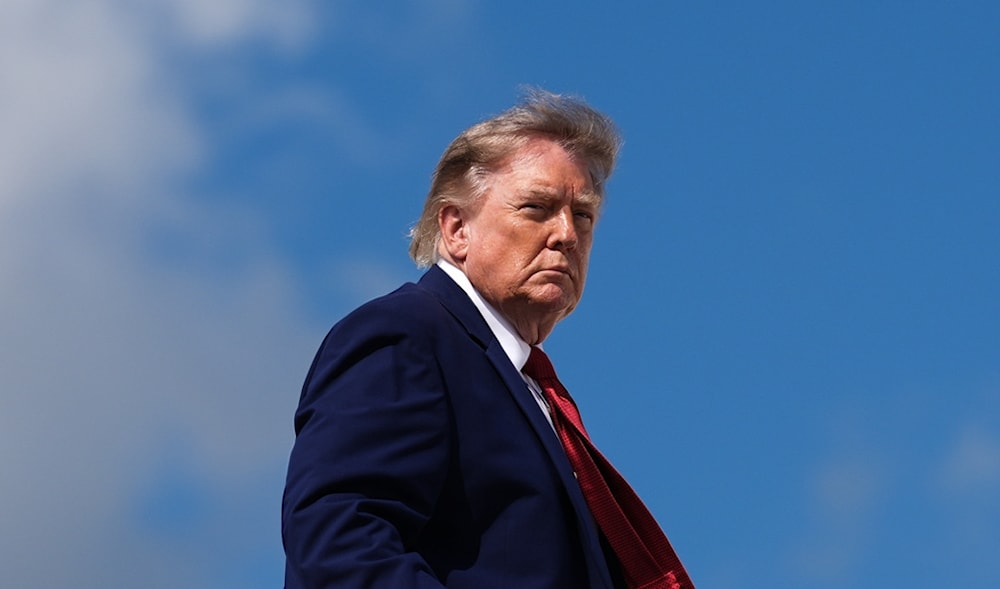
President Donald Trump boards Air Force One, Aug. 7, 2026, at Joint Base Andrews, Md. (AP)
US President Donald Trump launched the war on Iran under the pretext of an “excursion” that he claimed would last only a few weeks. Six months later, the war has developed into a crisis whose consequences are being felt far beyond West Asia.
According to a CNN report, the war has inflicted severe costs on the Iranian people, populations across the region and consumers worldwide facing higher prices. At the same time, Trump's original objectives remain unmet, despite repeated changes in Washington's demands.
The administration initially called for Iran's complete surrender, regime change and the abandonment of its nuclear ambitions. Its more recent priorities have centered on reopening the Strait of Hormuz and restricting Tehran's peaceful nuclear program.
CNN noted that the consequences of the war on Iran extend into global security and US military readiness, while potentially creating openings for Washington's rivals. As the Trump administration concentrates on the war, attention and resources have increasingly been diverted from other potential flashpoints, including Ukraine, the Korean Peninsula, Taiwan and the South China Sea.
Emily Harding, vice president of the Defense and Security Department at the Center for Strategic and International Studies, told CNN that none of these potential crises has yet reached the point of becoming a full-scale conflict, but the weakening of US military foundations could create vulnerabilities.
“This is the kind of thing where the global adversaries are going to be taking note of the situation and learning more about how the US reacts in certain moments and then folding that into their planning. But we haven’t seen anybody take advantage of it yet,” she said.
“It’s more that some foundations are being weakened, not that we’re actually seeing the building start to shake.”
Ukraine faces growing pressure as US stocks dwindle
The war on Iran has placed additional pressure on US and allied weapons stockpiles. Iranian drones, ballistic missiles and other projectiles have targeted US bases across West Asia, while Washington and its partners consumed large quantities of ammunition. Some weapons originally intended for Ukraine have consequently been redirected.
Ukrainian President Volodymyr Zelensky told CNN this month that Kiev had only one-tenth of the interceptor missiles it urgently needed to counter increasingly intense Russian ballistic missile operations.
The war has also complicated Washington's economic pressure campaign against Moscow. Iran's effective closure of the Strait of Hormuz triggered a global oil crisis, pushing up fuel costs and prompting Trump to lift some sanctions on Russian oil exports to stabilize prices in the US.
The decision effectively allowed Russia to generate additional revenue for the operation in Ukraine. Disruptions to oil, gas and fertilizer markets have also enabled Moscow to expand its search for new customers.
Alexander Gabuev, director of the Carnegie Russia Eurasia Center in Berlin, pointed to Russian President Vladimir Putin's June meeting with Southeast Asian leaders in Kazan as an example of the shifting geopolitical environment.
“The turnout in Kazan was impressive: Nine of 11 heads of state from ASEAN were present, along with the Indonesian foreign minister and a special representative from Myanmar. Above all, these men decided to make the long journey to Russia because of US and Israeli attacks on Iran causing higher prices for energy and fertilizer,” he said.
CNN also highlighted one benefit for Ukraine: the war has underscored the military capabilities Kiev developed during more than four years of conflict, particularly in drone warfare, while encouraging other countries to expand security cooperation and ammunition commitments with Ukraine.
War on Iran raises concerns on the Korean Peninsula
The US war is also affecting calculations on the Korean Peninsula, where South Korea and the DPRK remain technically at war more than seven decades after the 1950-1953 conflict.
The US maintains around 28,500 troops in South Korea, but CNN reported that Trump sharply reduced the annual Ulchi Freedom Shield exercises with Seoul this year, partly citing South Korea's limited support for the war on Iran. He has simultaneously signaled openness to talks with DPRK leader Kim Jong Un as Pyongyang continues developing its nuclear arsenal and conducting missile launches.
Analysts told CNN that reducing military exercises could weaken short-term readiness and potentially complicate longer-term efforts for Seoul to assume wartime operational control of its forces. South Korean officials also said this week that a September amphibious exercise was canceled in June. The drill was expected to involve US Marines based on Okinawa, some of whom had participated in operations connected to the blockade of Iranian ports.
The confrontation has raised additional concerns over military supplies. Some US missile interceptors were moved from South Korea to West Asia, although the Pentagon has not disclosed the quantity. Analysts have warned that prolonged shortages of systems such as Patriot interceptors could create lasting problems.
US absence from Pacific raises questions
Meanwhile, the deployment of the Japan-based USS George Washington to the Arabian Sea to relieve the USS Abraham Lincoln has left the US without an aircraft carrier in the Pacific for an indeterminate period, CNN reported.
The US has maintained a continuous carrier presence in the Pacific for more than two decades, apart from several weeks in 2024. The absence of a carrier from the 7th Fleet's area of responsibility could concern regional allies, particularly the Philippines, as tensions with China continue around disputed South China Sea features.
Scarborough Shoal and Second Thomas Shoal have both been sites of confrontations between Chinese and Filipino personnel. Because a mutual defense treaty binds Washington and Manila, any escalation could place greater demands on US forces.
Harding told CNN that the depletion of US ammunition stocks is particularly concerning in the event of a future confrontation with China.
“The big thing that I’m worried about is what it looks like for the US in a potential conflict with China,” Harding said. “We’re not seeing that turn up anytime soon … but if there were to be a conflict with China, we would be in a state of ammunition shortage, specifically the ones that we’re going to need for that conflict.”
Strait of Hormuz crisis exposes wider risks
CNN also reported that the war on Iran could establish a dangerous precedent if other states eventually seek to exploit international shipping chokepoints as strategic weapons.
“We’re not yet seeing this, but if it got to a point later on where one of those countries wanted to, they could certainly point to this as a (precedent),” Harding said.
Harding believes the ultimate scale of the confrontation's consequences will depend largely on how long Washington continues fighting.
“The Trump administration has to decide what’s good enough for an outcome here and if the only thing that’s good enough is a complete destruction of the nuclear program and, what Israel wants, which is an Iran that’s internally broken and divided, then that is a long commitment of both blood and treasure and the world economy is going to feel the consequences of that long term,” she said.
Trump, she stated, could instead settle for rendering Iran's nuclear program “unusable,” while dealing with the consequences of the Strait of Hormuz's closure.
“That’s not a great solution, but it’s a workable solution. And if that’s enough, and if (Iran’s) weakened proxy network is enough, then what you really have to deal with is the Strait of Hormuz, and that’s hard and a little bit expensive, but nowhere near as expensive as what (the US is) doing right now,” she said.
For Iran, Harding said, survival itself could be enough to sustain the war. “From the Iranian perspective, all they have to do is survive, and they’re doing that. So they can kind of keep this going for as long as they want.”
During Thursday's episode of The Grand Standoff: Iran and the World, Professor Mohammad Marandi emphasized that Iran remains resolute: normal operations through the SoH will not resume until Washington fulfills all commitments outlined in the signed MoU.@s_m_marandi #Iran pic.twitter.com/QNOAySmzw1
— Al Mayadeen English (@MayadeenEnglish) August 28, 2026


