
Trump delays China summit as war on Iran disrupts US focus
 4 Min Read
Trump postpones his China visit on accounts of the war on Iran, underscoring how West Asia conflicts continue to divert US attention from Beijing.
-
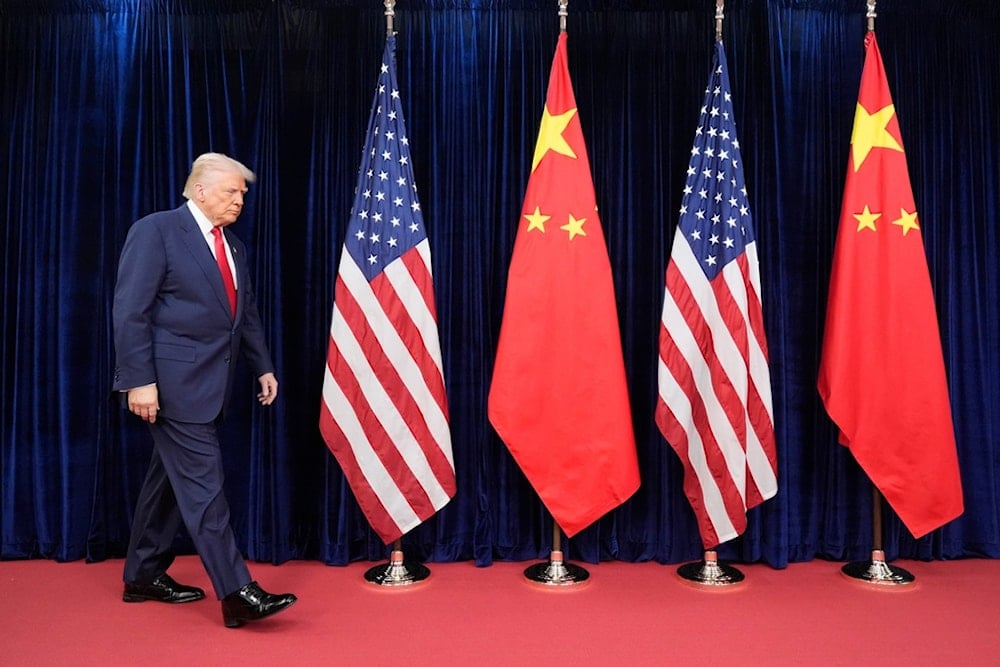
US President Donald Trump walking in for his meeting with Chinese President Xi Jinping at Gimhae International Airport in Busan, South Korea, Thursday, October 30, 2025. (AP Photo/Mark Schiefelbein)
The planned summit between US President Donald Trump and Chinese President Xi Jinping has been delayed, as Washington shifts its focus toward the ongoing war on Iran, once again highlighting how conflicts in West Asia disrupt US strategic priorities.
For years, successive US administrations have pledged to concentrate on managing competition with China. However, recurring conflicts elsewhere have repeatedly diverted attention, with the current war on Iran emerging as the latest example.
Trump had been expected to travel to Beijing from March 31 to April 2. However, he told reporters that he intends to delay the visit by five to six weeks as he focuses on the Iran war, adding that China was “fine” with the postponement.
“I look forward to seeing President Xi. He looks forward to seeing me, I think,” Trump said.
A spokesperson for China’s Foreign Ministry stated that both sides would remain in contact regarding the visit, though no revised timeline was provided.
Beijing balances frustration and strategic caution
For Beijing, the delay brings mixed implications. The visit remains a priority, as it could help secure a new trade agreement, following multiple roadblocks related to Trump's aggressive tariff policies.
At the same time, postponing the summit avoids the optics of hosting a US president actively engaged in military operations against Iran, one of China’s closest partners in the region.
Chinese Foreign Minister Wang Yi signaled continued openness to engagement, stating earlier this month, “It is heartening to see that the presidents of the two countries have led by example.”
Wang also described 2026 as a potential “landmark” year for US-China relations.
Iran war disrupts US strategic pivot to China
The US-Israeli war on Iran reflects a broader pattern in US foreign policy, where efforts to prioritize competition with China are repeatedly interrupted by military engagements elsewhere.
Wars over the past decades, including those in Afghanistan and Ukraine, have reduced the capacity of US policymakers to maintain sustained focus on the Asia-Pacific region.
Read more: Mankind stands between war and peace: Xi Jinping
The war has also heightened tensions around the Strait of Hormuz, a critical maritime route for global energy supplies.
Iran’s closing of the Strait has contributed to rising oil prices since the conflict began. As the world’s largest oil importer, China could face economic pressure from sustained increases in energy costs, despite maintaining stockpiles that may cushion short-term impacts.
Military strain and strategic consequences
The escalation has drawn US military resources into the region, including warships and aircraft that could otherwise be allocated to other strategic theaters.
The conflict has also depleted US munitions stockpiles, raising concerns among defense strategists about the risks of overstretch, particularly in the context of potential confrontation with China.
According to Ali Wyne of the International Crisis Group, the decision to delay the summit highlights misjudgments surrounding the consequences of military escalation.
Trump’s move to postpone the meeting “underscores how significantly he underestimated the fallout” of attacks against Iran, Wyne said.
China-US ties remain cautiously engaged
Despite tensions, both Washington and Beijing continue to signal interest in maintaining dialogue, particularly on trade.
Following recent negotiations in Paris, representatives from both countries described the talks as constructive, suggesting that working-level engagement remains intact even as broader geopolitical tensions persist.
Analysts note that the delay is unlikely to trigger a sharp deterioration in bilateral relations. As Shi Yinhong of Renmin University stated, “If Trump insists on a delay, China has to accept it.”
Similarly, Jeremy Chan of Eurasia Group emphasized that the postponement is not rooted in US-China tensions, “Beijing knows deep down that this isn’t about China at all ... He can’t be seen hobnobbing with Xi while Hormuz burns.”
Read more: US Israeli lobby to blame for war on Iran: Foreign Policy


