
Trump no longer backs Israeli narrative on Iran, Leb: Israeli media
 5 Min Read
An Israeli Channel 12 analyst said Donald Trump no longer adopts the Israeli narrative on Iran and Lebanon, calling his remarks on Hezbollah and Syria "a real blow."
-
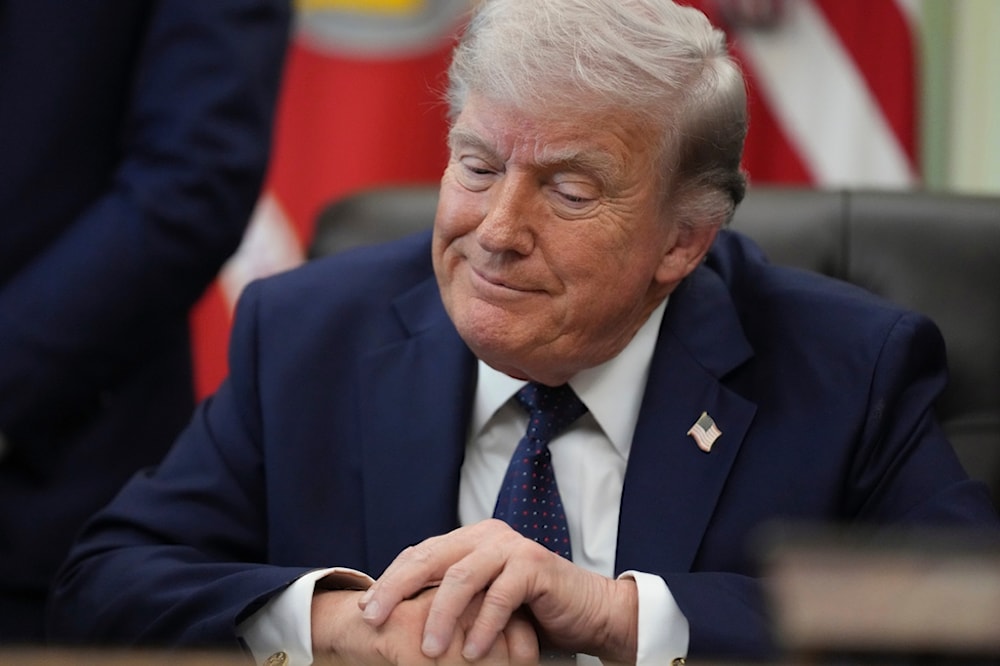
US President Donald Trump speaks during a meeting between the ambassadors of Israel and Lebanon in the Oval Office at the White House, Thursday, April 23, 2026, in Washington. (AP Photo/Mark Schiefelbein)
An Israeli political analyst has warned that US President Donald Trump no longer appears to embrace the Israeli narrative regarding Iran and Lebanon, saying his recent remarks on Hezbollah and Syria were "a real blow" to "Israel".
Speaking during a live briefing on "Israel's" Channel 12, political analyst Dana Weiss said disagreements have emerged between Washington and Tel Aviv as the United States advances an understanding with Iran that does not fully align with the Israeli position.
Weiss said there is now an understanding of what the memorandum of understanding between the United States and Iran contains, despite "Israel" not having officially seen the final version of the document. The analyst noted that "Israel" had requested access to the final text, but its request was rejected by Washington.
'Significant concessions to Iran'
According to Weiss, "the first and most important clause" of the memorandum commits the United States, Iran, and their allies to an immediate ceasefire. The analyst added that the agreement also includes language referring to Iran and Lebanon, saying it would be important to see whether Trump later publicly confirms that interpretation.
The analyst further said that, under the emerging understandings, the Strait of Hormuz would be reopened and that there could also be a US withdrawal within 30 days. The memorandum also reportedly includes a mechanism allowing Iran to recover its frozen assets and receive $300 billion in compensation. Weiss noted that all these provisions remain conditional on future implementation.
Regarding Iran's nuclear program, Weiss said the memorandum envisages Iran reaffirming its commitment not to acquire nuclear weapons, noting that Tehran had previously made similar commitments, including under the 2015 Joint Comprehensive Plan of Action (JCPOA).
The analyst added that all issues related to uranium, including whether Iranian uranium would be removed or retained, as well as broader nuclear questions, would be addressed during a dedicated 60-day negotiation period that could be extended with the agreement of both sides.
Weiss argued that the overall arrangement appears to provide Iran with significant concessions from the outset, while on the nuclear issue, which the report described as the most important matter, there is "nothing concrete" and all substantive issues are left for the upcoming negotiations.
'Trump no longer adopts Netanyahu's narrative'
The Israeli analyst said a major question remains whether Washington has effectively agreed to sign a document stipulating that a halt in hostilities would also include a complete cessation of fighting in Lebanon.
The report described Trump's recent comments on Lebanon as "a real blow," pointing to his remarks that Syria could deal with Hezbollah more effectively than "Israel."
Trump had earlier said, "I suggested to Israel that it let Syria handle Hezbollah because, frankly, I think they do it better."
Weiss said the fact that Trump was telling Prime Minister Benjamin Netanyahu, "his partner who fought alongside him just three months ago" and with whom he was said to share a strong military and political alliance, that Syria would handle Lebanon better than "Israel" and its military represented a significant shift in messaging.
"It is very clear that Trump no longer adopts Netanyahu's point of view," Weiss said. "We know there are continuous phone calls between Trump and Netanyahu, and Netanyahu is trying to convey the message as he sees it, but in practice we see that Trump is not embracing Netanyahu's narrative and is not embracing the Israeli narrative."
Trump is 'Israel's last friend'
Weiss argued that Netanyahu now faces two political options: either break with Trump and present himself domestically as defending "Israel's" principles even against "Israel's best friend," or continue attempting to maneuver between positions. However, the report warned that confronting Trump could carry unpredictable consequences.
The analyst further cautioned that Trump is effectively "Israel's last friend," particularly given the political climate in the United States and "Israel's" broader international position. The analyst argued that Netanyahu's dilemma is not merely personal but also affects "Israel's" strategic standing in West Asia.
"When the president of the United States sits and speaks in this way about Netanyahu, and implicitly about Israel and the Israeli army, it is a very severe blow," the analyst concluded.
Speaking to reporters on the sidelines of the G7 summit on Tuesday, Trump said Syria could do "a better job" than "Israel" when it comes to confronting Hezbollah in Lebanon.
"The man running Syria now," Trump said, referring to Syrian transitional President Ahmad al-Sharaa, "is capable of dealing with Hezbollah very well."
Trump added that "Israel has been fighting Hezbollah for a very long time. Too many people are being killed."
"You don't have to knock down a residential building every time you're looking for somebody because there are a lot of people in those buildings, and they're not all Hezbollah," he said.
Asked about his relationship with Netanyahu, Trump said, "I had a good relationship with him, but now he has to be more responsible regarding Lebanon."
Read more: Trump's Iran deal leaves Netanyahu balancing Washington and allies


