
Trump using international law selectively over Hormuz, analysis says
 4 Min Read
FPIF argues the Trump administration selectively invokes international law in the Strait of Hormuz while pressuring Iran and rejecting global legal norms.
-
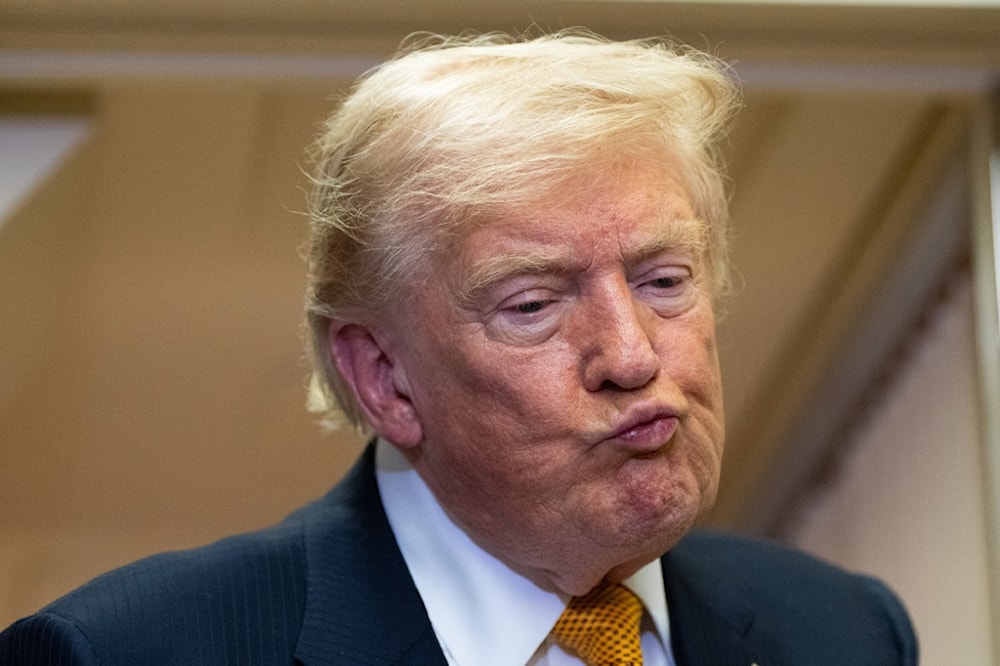
US President Donald Trump listens to a question as he speaks with reporters in flight on Air Force One after landing at U.S. Air Force Base at RAF Mildenhall, in Suffolk, Eastern England, Wednesday, July 8, 2026 (AP)
The Foreign Policy in Focus (FPIF) has argued that the Trump administration is pursuing what it describes as an "imperial" application of international law in its efforts to reopen the Strait of Hormuz, accusing Washington of demanding Iranian compliance with legal norms while rejecting them in its own foreign policy.
In an analysis published by the organization, the outlet said the administration has portrayed the Strait of Hormuz as an international waterway that must remain open to navigation in response to Iran's efforts to impose transit fees on vessels passing through the strategic chokepoint.
The administration has adopted a position that requires other states to follow international rules as interpreted by Washington, despite senior US officials repeatedly dismissing the concept of a rules-based international order, the piece said.
The report cited President Donald Trump's social media warning that Iran could cease to exist if the US were forced to escalate military action, presenting the statement as evidence of Washington's coercive approach toward Tehran.
Trump relying on military force
FPIF argued that the second Trump administration has consistently relied on military force in international affairs, citing US actions in Venezuela, Iran, and support for the Israeli war on Gaza as examples of what it characterized as violations of international law.
According to the think tank, Washington's reliance on coercive policies has nevertheless encountered limits in Iran following the US-backed Israeli aggression earlier this year.
The analysis further claimed that Iran's continued influence over the Strait of Hormuz has complicated oil and natural gas exports from US allies in West Asia, contributing to higher energy prices and supply shortages, particularly in Asia.
International law?
Washington ultimately sought a ceasefire and the reopening of the waterway but failed to restore the pre-war status quo, leaving Iran with significant leverage over shipping through the strait, it said.
The analysis argued that Washington's legal position is weakened by the fact that neither Iran nor the US has ratified the United Nations Convention on the Law of the Sea (UNCLOS), the treaty governing navigation through international straits.
It also noted that the United States has challenged or ignored aspects of the convention in other regions, including freedom of navigation provisions and seabed mining regulations, while simultaneously invoking international law in the case of the Strait of Hormuz.
FPIF argued that the Trump administration is not seeking to revive the rules-based international order but is instead using international law selectively to pressure Iran while continuing to threaten military action and unilateral measures against Tehran.
Iran warns of higher oil prices
An Iranian security source told Al Mayadeen that Tehran would respond immediately and on a broader scale to any further US attacks, warning that Iran had already conveyed its position before the latest escalation.
"If US President Donald Trump wants higher oil prices, we welcome that," the source said, stressing the impact of US aggression on global energy markets.
The source stressed that Iran had previously warned that any aggression against the country would face an immediate and wider response.
Largest US attacks since MoU
The remarks came after Al Mayadeen's correspondent in Tehran reported that the latest US aggression against Iran was the largest since the signing of the memorandum of understanding.
According to the correspondent, the heaviest US strikes targeted Chabahar Port in southern Iran.
Iranian media reported that the attacks struck civilian infrastructure, including two maritime piers and a navigation control tower at Chabahar Port, while shrapnel from US projectiles hit Imam Ali Hospital.
Additional attacks were reported in Konarak, Sirik, Jask, Bushehr Province, Abu Musa Island, and transport infrastructure in northern Iran.
The military escalation came after a US official told CNN that the ceasefire with Iran had "at least temporarily ceased" and that additional US strikes had not been ruled out.
Trump also announced that the memorandum of understanding with Tehran was "over," while saying negotiations could continue.


