
US turns to economic siege after failing to break Iran: Economist
 3 Min Read
Washington unveils Operation Economic Outcast after military strikes and diplomacy failed to break Iran, risking escalation over negotiations.
-
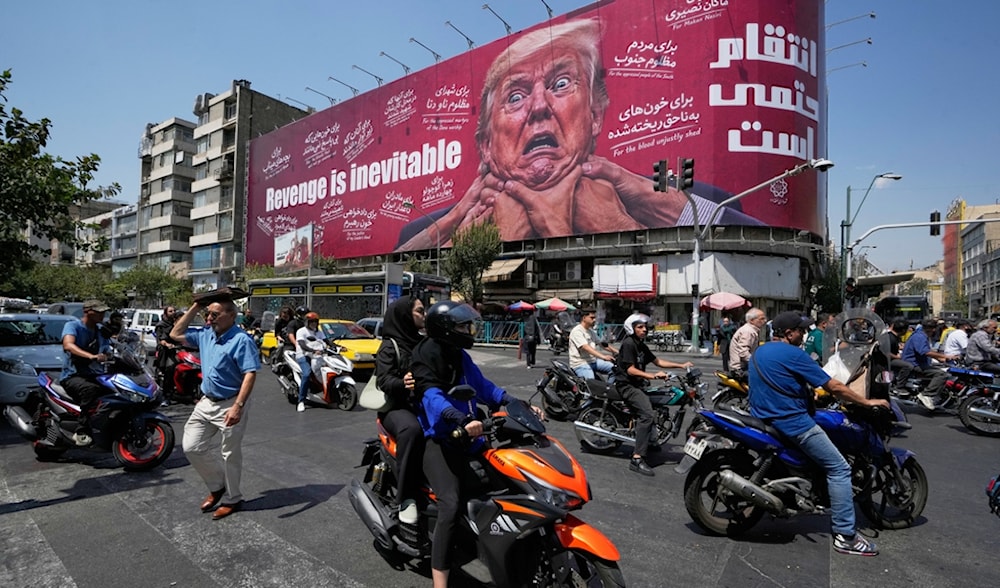
Motorcyclists pass a billboard depicting US President Donald Trump with hands around his neck beneath the words Revenge is inevitable in Tehran, Iran, Monday, Aug. 24, 2026. (AP)
Washington has turned to economic warfare against Iran after its military campaign and diplomatic outreach both failed to force concessions, and the new pressure risks pushing Iran toward escalation rather than the negotiating table, The Economist says.
US Treasury Secretary Scott Bessent announced the effort, dubbed "Operation Economic Outcast," on August 24, describing it as an onslaught aimed at severing Iran's financial connections around the world.
The campaign builds on Washington's existing blockade of Iranian oil exports and expands pressure on the countries and institutions that help Iran move money.
This marks Washington's third approach in the US war on Iran, explains The Economist. The first, "Operation Epic Fury," relied on military attacks intended to crush the republic. When that failed, the US pivoted in June to an offer of sanctions relief and investment, tied to a memorandum of understanding, in hopes that Iran would open the Strait of Hormuz and abandon its nuclear program. That, too, did not produce concessions. Economic strangulation is now Washington's fallback.
Read more: Iran war reveals limits of US coercion: Foreign Affairs
Where the pressure lands
China buys roughly 90% of Iran's crude exports at a discount, income that reportedly provided nearly half of Iran's budget last year, The Economist reports.
The United Arab Emirates supplied about 30% of Iran's imports in 2024 and hosts exchange houses that help Iran evade sanctions. On August 18, however, the UAE said it would halt trade and financial dealings with Iran after Iranian strikes on Emirati ships.
Iran's central bank chief said on August 20 that oil exports had fallen to zero, though roughly 80 million barrels remain stranded on tankers outside the strait, according to trade-intelligence firm Kpler.
Iran defiantly holds its ground
Iranian officials have dismissed the new pressure. Mohsen Rezaei, Iran's national security adviser, called Washington's economic warfare propaganda and warned that any country cooperating with the US would be treated as an enemy.
Iran has also threatened to fine or seize nearly 50 ships in the Strait of Hormuz after they refused to use the authorized route. President Masoud Pezeshkian has instead called on Washington to return to the June memorandum of understanding as a path toward reopening the Strait of Hormuz.
The new campaign is framed as an attempt to avoid renewed fighting, but it could just as easily provoke it, The Economist warns. The piece claims that Iran retains leverage over neighbors such as Iraq, which depends on Iranian gas and hosts allied armed groups, and could target Gulf military or energy facilities in response to further pressure.
Washington has misjudged Iran's resilience before, The Economist notes. In April, Bessent predicted the Hormuz blockade would quickly cripple Iran's oil industry. That has not happened.
Whether the latest pressure campaign forces Tehran to the table or pushes the region back toward open conflict remains an open question, The Economist concludes.


