Washington sanctions regime reaches its breaking point
-
 Samuel Geddes
- 1 Sep 2026 12:28
- 1 Shares
 5 Min Read
Trump’s escalating sanctions campaign against Iran risks backfiring, weakening US economic leverage and accelerating a global shift away from the dollar-centered financial system.
-
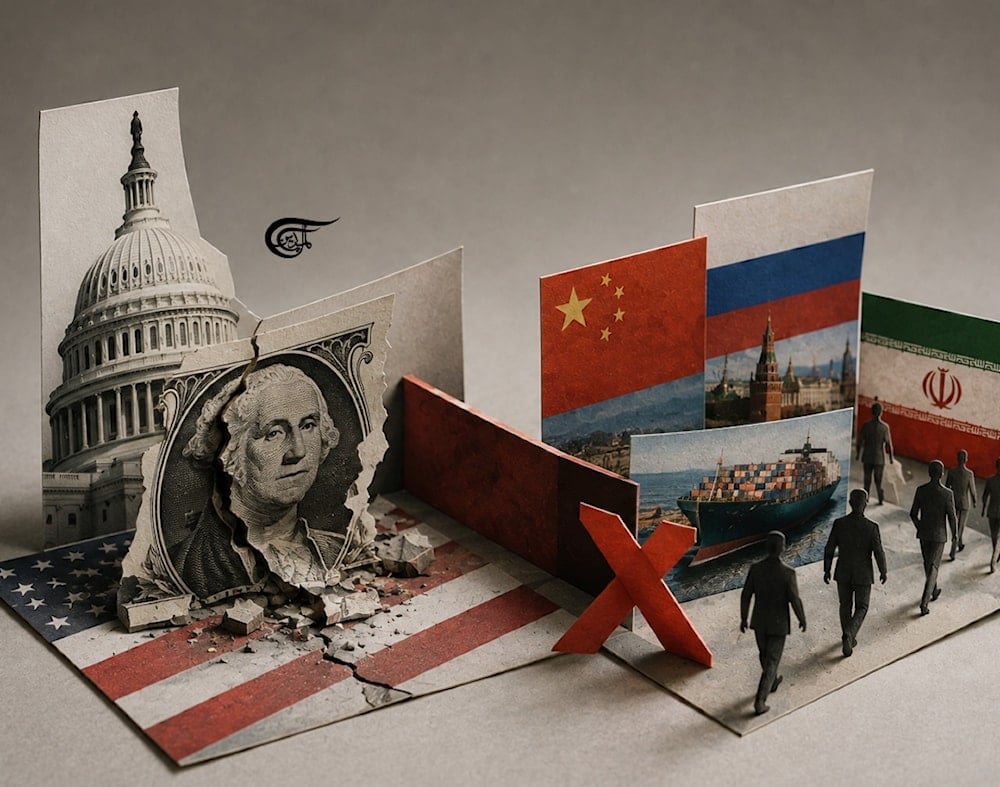
Washington sanctions regime reaches its breaking point. (Illustrated by: Al Mayadeen English/Batoul Chamas)
Trump’s desperate bid to crush Iran’s economy without military escalation places the US’ sanctions regime against Iran, Russia, China and all its other adversaries at existential risk.
So far, 2026 has been the most sobering year in living memory for the American self-image. Having at long last achieved the war against Tehran that has been sought since 1979, the Washington establishment is confronted not with the Islamic Republic’s collapse but its solidification.
Far from regaining its unquestioned dominion over the Persian Gulf region, it must now accept perpetual management by Tehran of the most critical waterway on Earth, or else face a global economic calamity. Instead of weakening Iranian leverage, the US-Israeli aggression has magnified it exponentially, needlessly handing it a level of global power and influence undreamt of in the more than five centuries of the Western world’s dominance.
As the administration flails ahead of the midterms and the imminent exhaustion of the Strategic Petroleum Reserve, which cushioned the true magnitude of the energy shock, it is soon to witness yet another previously unchallenged instrument of its power vaporize alongside its dwindling munitions stocks. That instrument is its economic sanctions policy.
This week ushered in the so-called "Operation Economic Outcast", through which Washington hopes to throttle every avenue of economic contact between Iran and the outside world. Announced by the hapless Treasury Secretary Scott Bessent, who, along with his bemusement at the rising price of oil in response to the US’ actions, is also contending with the failure of the naval blockade of Iran’s southern coast, which has still not caused either Tehran’s collapse or capitulation. By switching back to tactics of blunt economic coercion, the Trump administration signaled an unprecedented escalation in the intensity of its secondary sanctions policy, namely that any company or state engaging in economic activity of any kind with Iran will share in its exclusion from the economic and financial system underpinned by the US dollar.


This threat, in addition to being levelled against regional and small-to-medium-sized economic partners of the Islamic Republic, is also explicitly aimed at China and Russia. In its desperation to force Iranian submission, Washington is escalating the war to the level of global economic blackmail, including against its only near-peer economy and potential challenger. Even Bessent, by his own admission, acknowledged that actual imposition of such sanctions would "blow up" the global financial system.
In addition to threatening every state that engages in any way with the Iranian economy, the Trump administration has, at "Israel’s" encouragement, also taken to the idea of imposing a total land blockade as well. This would require strong-arming systemically important regional actors such as Turkey, Iraq and Pakistan into sacrificing their own natural economic ties with their neighbor, to achieve the objectives of the very foreign power that has thrown their economic present and future into chaos.
Before the so-called “Economic D-Day” was even launched, Beijing called Trump and Bessent’s bluffs, assuring that any US sanctions against entities facilitating Chinese-Iranian exchange would trigger "all necessary measures" in response. The effects of increasing Chinese-US decoupling, the accumulating poison of the US tariff war against the rest of the world and now the apparent collapse of the North American economic bloc (formerly NAFTA), leave Washington in no position to incur the true costs of such retaliation, let alone the simultaneous countersanctions from the likes of Russia, Turkey, India, Pakistan and any other country that depends more on the reopening of the Strait of Hormuz than on trade with the US.
Neither are the Iranians anywhere near as bereft of economic weapons of their own, certainly not in comparison to the first Trump administration’s economic strangulation. Tehran has correctly greeted the US economic campaign as the desperate gamble that it is- and met it with an ultimatum of its own: that any participating state in this economic siege will be treated as an enemy.
Trump may believe that the US’ relative lesser exposure to the Strait gives him some sort of leverage. In fact, for the majority of states in the world whose economies run in whole or part due to the 20 percent of oil and natural gas, 30 percent of industrial helium, 40 percent of sulfur and 50 percent of fertilizer inputs that annually transit Hormuz, this reality gives them far more reason to accommodate the Islamic Republic than to join Washington and Tel-Aviv’s attempts to bring it to its knees.
This stunning level of economic hubris, if acted upon, will either fail and demonstrate the economic limits of US power along with those of its military, or it will succeed and split the globe into separate economic world-systems. Like almost every gambit of this unhinged presidency, success would be more damaging than failure. Washington will have so antagonized even its closest partners that whatever remains of the “global economy” centered around the Dollar will be very much less than “global” in its scope, compared to the parallel world economy its hostility will have birthed through sheer obstinate stupidity.