
134 US lawmakers tie Syria sanctions relief to minorities protection
 5 Min Read
Sanctions on Syria may be lifted in 2026 if minority rights are protected, US lawmakers say in new NDAA-linked policy.
-
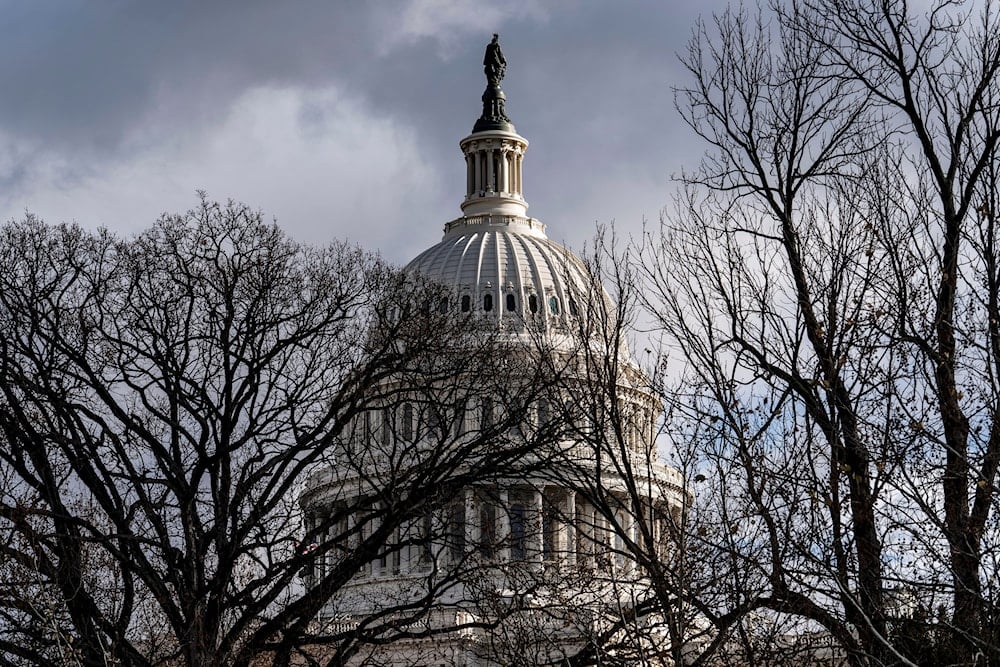
The Capitol is seen in Washington, Friday, Dec. 19, 2025, after the House and Senate adjourned for the year (AP)
A large group of US lawmakers has signed a policy document making the lifting of sanctions on Syria under the 2026 National Defense Authorization Act conditional on the protection of religious and ethnic minorities, with sanctions to be automatically reimposed if the conditions are breached.
The signatories said the move followed coordination with President Donald Trump’s administration and House leadership and is intended to support prospects for peace and stability in Syria, provided that longstanding abuses against minorities, including Christians, Druze, Alawites, Kurds, and other religious and ethnic groups, are brought to an end, according to the document.
Lawmakers said they would closely monitor the performance of the new government led by Ahmad al-Sharaa to ensure the creation of a safe environment that respects minority rights, stressing that mass crimes and violations against these communities must become a thing of the past.
Lawmakers announce plans to visit Syria
They also announced plans to visit Syria in the coming months at the invitation of the Syrian government to verify compliance with US conditions on the ground, with particular attention to the southern province of Sweida, the lawmakers said.
In the same context, the House Foreign Affairs Committee said it intends to hold a hearing in early 2026 to examine documented changes in the treatment of religious minorities in Syria, with the backing of House Speaker Mike Johnson and committee chairman Brian Mast.
The lawmakers concluded by stressing that Damascus’ full adherence to the conditions outlined in the NDAA is essential to achieving lasting peace in the Middle East and a necessary prerequisite for Syria’s return to a path of stability and prosperity, according to the statement.
Congress repeals Caesar Act
The US Congress approved the repeal of broad sanctions on Syria under the 2019 Caesar Civilian Protection Act on December 17; a law originally aimed at the former Bashar al-Assad government but now seen by US officials as hindering Syria’s fragile postwar recovery.
The repeal was included in the US government’s annual defense policy bill, a $900 billion package covering defense, foreign policy, and intelligence spending. The House of Representatives passed the legislation last week, followed by Senate approval on Wednesday. President Donald Trump is expected to sign the bill into law.
Caesar Act intensifies civilian suffering in Syria
The Caesar Act had imposed extensive sanctions on any entity providing goods or services to the Syrian government. While the Trump administration issued two six-month waivers on enforcement, including one last month after Syrian interim President Ahmad al-Sharaa visited Washington, officials said temporary waivers created uncertainty that discouraged long-term investment.
Although intended to protect civilians, the Caesar sanctions largely worsened their suffering. By targeting nearly all state-linked economic activity, the measures drove away banks, aid groups, and investors, stalling reconstruction and basic services. Hospitals struggled to import equipment, infrastructure remained damaged, and prices of food, fuel, and medicine soared, pushing millions into poverty while political elites found ways around the restrictions.
US allies and Syrian officials warn that unclear sanctions threaten Syria’s post-war recovery, estimated at $200B. Congress repealed sanctions to encourage investment and curb Iran and ISIS influence, despite opposition from "Israel" and some Republican lawmakers wary of reducing US leverage over President al-Sharaa.
Massacres plague Syria since the fall of al-Assad
Since the fall of Bashar al‑Assad’s regime on December 8, 2024, numerous violations against religious and ethnic minorities have been documented across Syria. A national inquiry found that between March 6 and 9, at least 1,426 people, mostly Alawite civilians, were killed in Latakia, Tartus, and Hama provinces, with many deaths involving murder, arson, and torture amid reprisals after clashes with former regime forces.
Human rights monitors reported further abuses in the spring and summer of 2025, including indiscriminate killings, summary executions, and tribal violence affecting Druze communities around Sweida province, where clashes after July 13 resulted in over 1,300 deaths according to the Syrian Observatory for Human Rights.
Throughout 2025, reports also highlighted ongoing discrimination and violent incidents targeting Christians, Druze, Shi’a Muslims, and other groups by non‑state actors and armed groups, with documented cases of church attacks, such as the 25 June 2025 bombing of the Mar Elias Greek Orthodox Church that killed 25 worshippers and wounded over 60.
Independent rights organizations have noted widespread kidnappings, arbitrary detention, and violence against minorities, including Kurds and Yazidis, amid the broader conflict and power struggles since late 2024, underscoring the fragile security situation for religious minorities in Syria.


