
EU calls emergency summit over Ceuta migration influx
 6 Min Read
The EU has called an emergency meeting after the Ceuta migrant crisis left dozens dead and sparked sharp disagreements among member states.
-
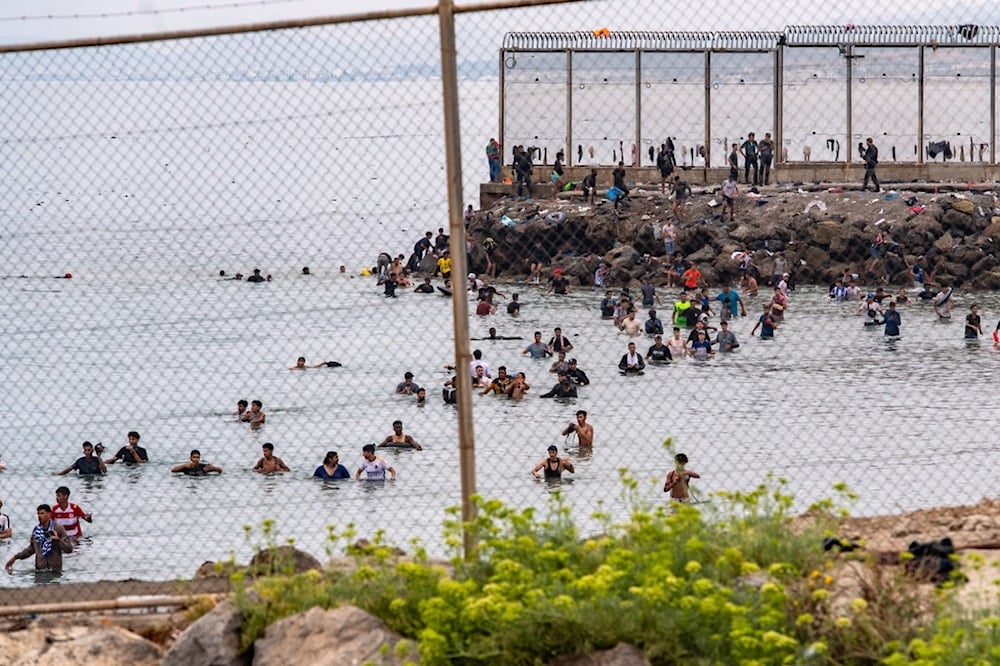
Migrants try to cross from Morocco into the Spanish enclave of Ceuta, Friday, July 31, 2026 (AP Photo/Antonio Sempere)
The European Union will convene an emergency meeting of interior ministers on Tuesday following the arrival of more than 50,000 migrants in the Spanish enclave of Ceuta, as divisions deepen among member states over the bloc's response to the crisis.
The decision, as reported by The Guardian, was reached during a meeting on Saturday between officials representing EU member states and experts from the Frontex border agency, amid growing concerns over migration management and political unity across the bloc.
Spanish authorities said at least 67 people died during attempts to cross into Ceuta, with some drowning and others being crushed while trying to pass a breakwater barrier.
EU seeks united response as member states clash
The emergency summit was unanimously approved as European leaders attempt to restore a coordinated approach to migration after sharp disagreements emerged over Spain's handling of the situation.
While migrant crossings into Ceuta reportedly stopped overnight, Spanish authorities began installing a 500-meter floating barrier along the maritime border with Morocco in an effort to prevent further crossings.
El Gobierno garantizará la seguridad de los vecinos y vecinas de Ceuta, intensificando la presencia de las Fuerzas y Cuerpos de Seguridad en las calles de la ciudad.
— Pedro Sánchez (@sanchezcastejon) July 31, 2026
Además, vamos a desplegar una barrera física de contención en el mar para facilitar la repatriación en frontera,… pic.twitter.com/Mj2LrcoBV9
British Prime Minister Andy Burnham said he had contacted Spanish Prime Minister Pedro Sánchez to offer assistance.
However, Saturday's meeting exposed significant political divisions within the EU, with Italy and Denmark, backed in part by Poland and Sweden, criticizing Spain's response to the crisis.
Spain rejects criticism, warns against disinformation
In a strongly worded letter addressed to European Commission President Ursula von der Leyen, European Council President António Costa, and Irish Prime Minister Micheál Martin, whose country currently holds the rotating EU presidency, Sánchez condemned "disinformation surrounding the events."
He said "virtually all" migrants had already been returned to Morocco after Spanish military intervention on Friday, which he said prevented "any unauthorised onward movement towards continental Europe."
Madrid has expressed frustration that previous migration incidents involving Belarus and Poland, as well as Russia and Finland, were widely characterized by the EU as "hybrid attacks" and received broad European solidarity, while Spain has faced criticism instead.
Political tensions deepen over Schengen
Although more than 48,000 migrants had voluntarily returned to Morocco by Friday evening, the mass crossings triggered a political crisis for the Spanish government, with some EU countries calling for Spain's temporary suspension from the Schengen free-movement zone.
Ceuta President Juan Jesús Vivas said thousands of people remained in the enclave despite the large number of returns.
"We’re not back to normal because there are several thousand people who need to be returned, and there is still an atmosphere marked by unease and concern," Vivas said, calling for security measures to remain in place.
Italy escalated tensions on Friday by announcing it would suspend its Schengen arrangements with Spain for one month, despite Ceuta and Melilla operating under special Schengen rules that already restrict onward movement into mainland Europe.
Italian Foreign Minister Antonio Tajani blamed the crisis on Spain's recently closed migrant regularization program, arguing that it encouraged human trafficking and describing the policy as "profoundly wrong."
Sánchez defends Spain's border management
Responding to criticism from fellow member states, Sánchez argued that Spain had received support from most EU governments but accused others of exploiting the situation.
"Such an attitude – driven by prejudice, fake news, ignorance or political interest – is … contrary to European law, humanitarian law and the principles of solidarity that bind us together," he wrote.
He also cited Frontex data, saying Spain remains "one of the least porous external borders of the European Union," with irregular arrivals significantly lower than those recorded in Italy in recent years.
La solidaridad y la empatía son opcionales.
— Pedro Sánchez (@sanchezcastejon) July 31, 2026
El respeto a los tratados europeos y a los datos, no.
👇🏼
Número de entradas irregulares entre 2021 y 2026 según Frontex:
Por Italia: 478.600
Por los Balcanes occidentales: 340.600
Por Grecia: 259.800
Por España: 234.760
Por la…
EU leaders express support ahead of Tuesday summit
Senior EU officials met on Saturday under a political crisis response mechanism coordinated by Ireland's EU presidency.
Irish Prime Minister Micheál Martin confirmed that Justice and Home Affairs ministers would meet on Tuesday under the chairmanship of Irish Justice Minister Jim O'Callaghan to discuss developments in Ceuta.
"We remain in close contact with all member states and the institutions and continue to monitor the situation," Martin said.
O'Callaghan said he had spoken with Spanish Interior Minister Fernando Grande-Marlaska to express solidarity.
European Commission President Ursula von der Leyen welcomed Sánchez's proposal for a videoconference to assess the situation, stressing that "Fighting illegal migration requires solidarity and a united European response."
French Interior Minister Laurent Nuñez also rejected calls to suspend Spain from the Schengen area, saying, "It's absolutely not on the table. We have great cooperation with Spain."
Spain reinforces border as migration pressures persist
Spanish authorities said the situation in Ceuta remained calm on Saturday as security forces strengthened their presence and continued installing floating barriers and anchored buoys along the Tarajal beach breakwater.
Many migrants returned voluntarily to Morocco throughout the day, although others remained inside the enclave awaiting processing.
"We hope to go to Europe to work and earn a living – that's it," Souleil Boyan, a 19-year-old from Senegal, told Agence France-Presse outside a migrant center in Ceuta.
"We all know that in Africa there isn't much opportunity," he added.
Ceuta crossing surpasses previous migration surges
The latest influx far exceeds the previous major crossing in May 2021, when approximately 10,000 people entered Ceuta after Morocco eased border controls during a diplomatic dispute with Spain over Western Sahara.
That crisis subsided after Madrid shifted its long-standing position and backed Morocco's autonomy proposal for Western Sahara in 2022, a move that strained Spain's relations with Algeria.
Spanish officials have attributed the latest crossings to human trafficking networks exploiting a recent Supreme Court ruling limiting the summary return of migrants intercepted while attempting to enter Ceuta or Melilla by sea.
Mauricio Valiente, director general of the Spanish Refugee Aid Commission, said the Ceuta route differs significantly from the Atlantic migration route to the Canary Islands, arguing that attributing the surge solely to the court ruling or organized crime is "completely unfounded."
Meanwhile, Reform UK home affairs spokesperson Zia Yusuf, who visited Ceuta on Saturday, said he had spoken with migrants who told him they intended to continue their journey to Britain.
Read more: Trump exploits Spain migration crisis to stoke fear ahead of midterms


