
House to vote on war powers resolution on Trump Iran policy Monday
 4 Min Read
House Democrats plan a new vote to limit Trump’s war powers on Iran, as support grows among members previously opposed.
-
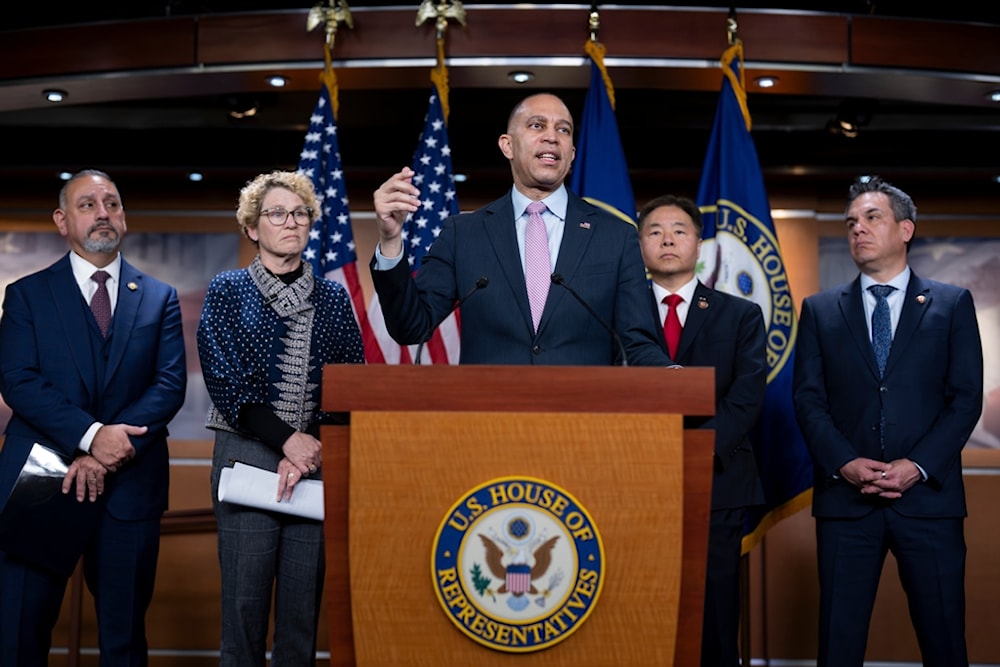
House Minority Leader Hakeem Jeffries, D-N.Y., and other Democrats, from left, Rep. Gil Cisneros, D-Calif., Rep. Chrissy Houlahan, D-Pa., Rep. Ted Lieu, D-Calif., and Rep. Pete Aguilar, D-Calif., demand congressional approval for embarking on a war on Iran, during a news conference at the Capitol in Washington, March 4, 2026 (AP)
House Democratic Leader Hakeem Jeffries announced that the US House of Representatives will bring back a war powers resolution aimed at limiting US President Donald Trump’s authority to conduct military operations in Iran once lawmakers return to session on Monday. Jeffries framed the effort as a necessary check on executive military power.
“We brought a war powers resolution to the floor of Congress that fell a few votes short when we were in session earlier this month. Upon our return, we’ll continue to do the same thing,” Jeffries said in an interview for MS NOW.
The earlier resolution sought to constrain the president’s ability to engage in military operations against Iran without a formal approval from Congress. While that initial effort did not pass, Democratic leadership described a shift in support among some members who previously voted against it.
Shifts in congressional support
Jeffries indicated that several Democrats who opposed the earlier resolution have since expressed a willingness to back a renewed vote. “Several of them have indicated that the next time we bring such a resolution to the floor, they will be prepared to support it,” he said.
Four House Democrats voted against the previous war powers measure, underscoring the narrow margin by which congressional efforts have fallen short.
The planned vote is positioned by Democratic leadership as a response to what they and other critics characterize as unchecked executive authority in conducting hostilities against Iran without explicit congressional authorization.
Read more: Trump's war on Iran exposes American failure: The Guardian
Intersecting congressional actions and debates
While the House prepares a fresh vote, tensions over curbing war powers have also played out in the US Senate. A war powers resolution intended to restrict the president’s ability to continue military action against Iran was recently defeated there on a 47–53 procedural vote, largely along party lines.
Republicans opposed advancing the measure, allowing executive military operations to continue without additional legislative restraints.
In parallel with the war powers debate, a group of Democratic US senators has called for immediate public hearings on the ongoing war, demanding answers from senior administration officials about the legal and strategic basis for the strikes and the broader conduct of the engagement.
War powers in legal and historical context
The legislative tool at the center of these efforts, the War Powers Resolution of 1973, was designed to define and limit presidential authority to commit US forces without congressional oversight. Under the law, the president may only introduce forces into hostilities under limited conditions: a formal declaration of war by Congress, a specific statutory authorization, or in response to an imminent attack on US territory or forces.
Because the US Constitution vests the authority to declare war in Congress, lawmakers such as Jeffries argue that executive military initiatives without clear authorization erode constitutional balance. Opponents of restrictive war powers resolutions contend that such actions could constrain commanders and reduce flexibility in active conflict situations.
With the House scheduled to return to session on Monday, Democrats appear poised to force another vote on the war powers resolution. The outcome will hinge on both party discipline and the willingness of previously hesitant members to support stronger legislative checks on presidential military authority.
Whether the renewed resolution will pass remains uncertain, but Democrats leading the effort portray it as a necessary assertion of congressional prerogative in matters of war and peace.
Read more: Trump's wars reinforce China's distrust of US power: WSJ


