
Iran reviewing US response as key differences remain in talks
 4 Min Read
Tehran is reviewing Washington’s response to its proposal to end the war, with the Strait of Hormuz and US naval blockade among key issues in talks.
-
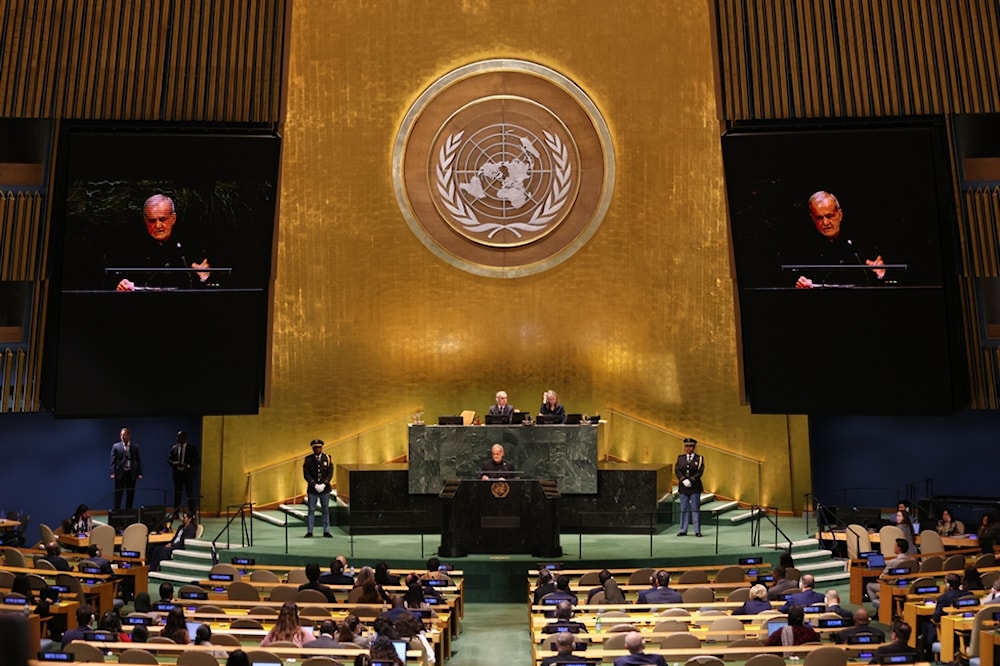
Iran's President Masoud Pezeshkian speaks during the 81st session of the United Nations General Assembly at United Nations headquarters, Wednesday, September 23, 2026 (AP)
Iran is reviewing the United States’ response to a proposal aimed at ending the war, while significant differences remain between Tehran and Washington, a senior Iranian official told Reuters on Wednesday.
The official said discussions over reopening the Strait of Hormuz and lifting the US naval blockade on Iran were held during indirect talks between the two sides on Tuesday.
The comments indicate that diplomatic efforts continued on the sidelines of the 81st United Nations General Assembly in New York, with Tehran assessing Washington’s response while maintaining conditions for any further negotiations. Reuters reported that Iran had submitted its latest proposal through mediators earlier this month and had authorized its delegation in New York to pursue diplomacy.
Tehran reviews US response to proposal
The senior Iranian official told Reuters that Tehran was examining Washington’s response to its proposal to end hostilities, but that substantial differences remained between the two sides.
The development follows a round of mediated exchanges in New York, where messages were passed between the Iranian and US delegations.
Iranian Foreign Ministry spokesperson Esmaeil Baghaei said the latest communication with Washington took place through Qatari mediation and was intended to convey Tehran’s conditions for reviving diplomacy.
دیروز در حاشیه نشست مجمع عمومی سازمان ملل متحد، در ادامه گفتگوهایی که توسط کشورهای میانجی بین ایران و آمریکا در جریان بوده است، دور دیگری از تبادل و تبیین پیام از طریق میانجی قطری بین ایران و آمريکا صورت گرفت.
— Esmaeil Baqaei (@IRIMFA_SPOX) September 23, 2026
در این فرآیند که حدود دو ساعت به طول انجامید مواضع و شروط ایران برای…
Those conditions include halting US hostile actions, ending the war on all fronts, lifting the US naval blockade and economic warfare, and releasing Iranian assets, according to Iranian statements carried by state media.
Baghaei also said Iran had communicated its conditions clearly to the US side through the Qatari mediator.
The Iranian position comes as Washington and Tehran continue diplomatic contacts despite major disagreements over the terms of any agreement. US special envoy Steve Witkoff said mediators had moved between the two delegations during lengthy discussions on Tuesday, describing the exchanges as constructive.
Hormuz reopening remains central to talks
The Strait of Hormuz has emerged as one of the principal issues in the negotiations.
The senior Iranian official told Reuters that reopening the strategic waterway and lifting the US naval blockade were discussed during Tuesday’s talks. Tehran had previously indicated that it could reopen the strait if Washington eased military pressure and lifted its blockade on Iranian ports.
Iranian officials have linked the reopening of the waterway to the implementation of conditions set by Tehran for ending the war.
Iranian Supreme National Security Council Secretary Mohsen Rezaei said the United States had sought to “destroy Iran” during the ongoing war but instead, in his assessment, had helped turn Iran into the world’s fourth-largest power.
Rezaei said Iran had not changed its fundamental positions but maintained that the next phase of diplomacy would differ from previous negotiations.
He said Iranian President Masoud Pezeshkian would respond to Trump’s misconceptions, adding that Tehran’s approach to negotiations had entered a new stage.
Rezaei warns against US military moves
Rezaei said Tehran did not welcome an expansion of wars in the region and continued to support peaceful solutions, while warning that Iran would respond to any US military demonstrations.
“Iran will never tolerate any US military show of force,” he said, referring to warnings previously issued to countries in the region.
Rezaei further warned neighboring states against cooperating with Washington to restrict Iranian air traffic, saying such cooperation could have consequences for their own airports.
He also asserted that Iran had been the first country to bring down US F-35 aircraft and AWACS aircraft, arguing that developments during the war had changed perceptions of Washington’s military power.
Rezaei said US losses resulting from the policies of the Trump administration had also affected the prominence given to Trump by US media.
His comments reflect Tehran’s broader argument that the war has altered the balance of power in the region. Iranian officials have repeatedly said that military pressure has not compelled Iran to abandon its positions and have continued to link any diplomatic process to guarantees and concrete conditions.


