
Iran's nuclear policy will not bend to Western pressure: Exclusive
 8 Min Read
Professor Mohammad Marandi says Western pressure at the IAEA will not alter Iran's nuclear policy, while discussing Yemen, the Axis of Resistance and US-Iran tensions.
-
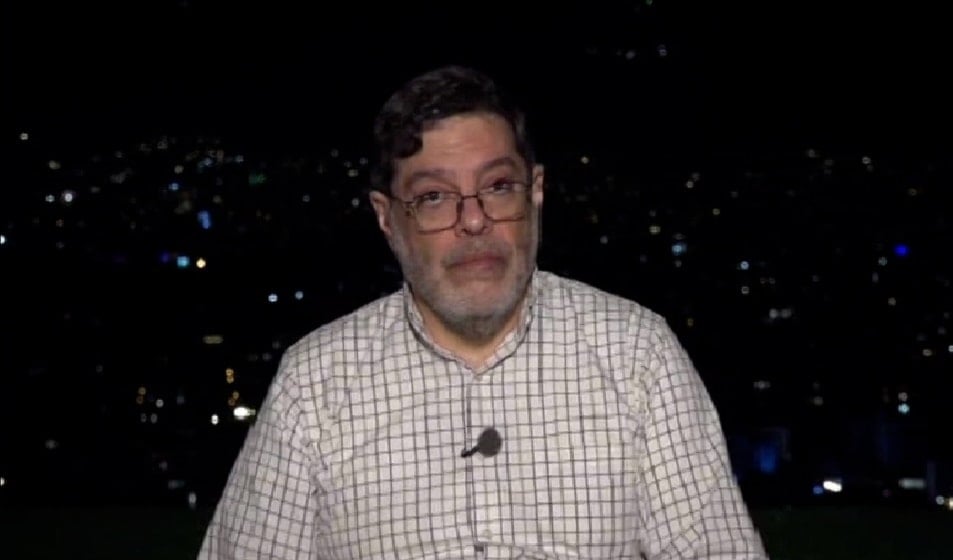
Iranian professor of English literature and Orientalism at the University of Tehran speaking to Al Mayadeen during the program The Grand Standoff: Iran and the World, Tehran, Iran, September 11, 2026 (Screengrab/ Al Mayadeen TV)
Iran's position on its nuclear program will not be altered by Western pressure at the International Atomic Energy Agency, according to Professor Mohammad Marandi, who said moves against Tehran at the UN Security Council are futile because Russia and China have made clear they will veto any such attempt.
Speaking on The Grand Standoff: Iran and The World, Marandi said the IAEA's Board of Governors is dominated by Western countries, which he said control all major international bodies created after the Second World War. "The Board of Governors in the IAEA, the majority is Western countries," he said, adding that the body "is not a democratic body that democratically represents the global community."
Marandi said the chair of Iran's Supreme National Security Council recently stated that the IAEA's behavior only encourages countries to leave the Nuclear Non-Proliferation Treaty. He added that threats to attack Iran will convince ordinary Iranians and many politicians that Iran must take a different position regarding the NPT.
He also cited the case of the Organization for the Prohibition of Chemical Weapons (OPCW) in Syria, saying experts who rejected claims that chemical weapons were used by the Syrian government were sidelined after the United States pressured the organization.
Speaking on Al Mayadeen's The Grand Standoff: Iran and the World show, Professor Mohammad Marandi argued that Western pressure through the #IAEA will do little to alter Iran’s nuclear posture, accusing the West of "politicizing" an institution whose governing board, he asserted,… pic.twitter.com/eu8Y6Og6ry
— Al Mayadeen English (@MayadeenEnglish) September 12, 2026
US on back foot as Ansar Allah gain strength in Yemen
Marandi said the United States is not in a strong position on the battlefield, pointing to the victories by Ansar Allah in Yemen, noting that the Bab al-Mandab is now under Ansar Allah's full control and that the group's strength in Yemen has been greatly enhanced.
He also noted the situation in the Gulf is clear and that the United States is not in a good position to pressure members of the Axis of Resistance because "on the battlefield, they're on the back foot." He also said Saudi Arabia's oil exports have collapsed for the time being.
Marandi also explained that the war on Yemen began more than a decade ago and intensified from 2015 onward, likening the conduct of that campaign to criminal and resembling the Zionist regime's actions in Gaza.
"The extraordinary victory that we see today in Yemen is stunning for anyone to see," he said, adding that the conflicts in Yemen and the Strait of Hormuz are linked because all members of the Axis of Resistance are allies.
"When the State of Hormuz is closed or partially closed, depending on what the Iranians decide, that gives the Yemeni armed forces more power when they control the Red Sea, because the Red Sea becomes more critical," he said. "Yemen uses Iran's success. Iran uses Yemen's success. Both want to help each other."
Marandi: Iran does not dictate decisions of regional allies
Marandi rejected the suggestion that Iran controls the decisions of its regional allies, saying Iran "would never do that" and has not done so in the past. He said this applies to Hezbollah and Lebanon, Ansar Allah, Hamas, Palestinian Islamic Jihad, and the resistance in Iraq.
"That's not the way the alliance works...These are groups that have a brotherhood. It's an alliance. And Yemen makes its own decisions." He added that "Iran will always support Sana'a in its decisions."
He also said the Bab al-Mandab is a key waterway for Western economies and that Ansar Allah became widely known for closing it to the Israeli regime during the genocide in Gaza, and that this made the group more popular across the world and that the Axis of Resistance has become significantly more powerful than ever before.
Iran open to rapprochement if Gulf states distance themselves from US
Marandi highlighted that countries in the region that assisted the United States in the war are complicit in crimes carried out by the Trump administration and Netanyahu. He said that during the 12-day war, these countries allowed US jets to refuel Israeli and American aircraft using their own jet fuel, which they provided to the Americans for free, and used their bases to help the United States bomb Yemen.
"These countries are complicit in crimes carried out by the Trump regime and Netanyahu," he said, adding that "these regimes are all guilty."
Iran is open to rapprochement if these countries change their policy and behave reasonably toward Iran, Marandi posited, adding they must distance themselves from Washington. "That is the only solution," he said.
Marandi warned that if these countries continue to allow their territory to be used to kill Iranians, they will become more isolated, weaker, and more fragile, and that if the war lasts much longer, "these regimes will collapse."
Iran prepared for prolonged war, military doctrine has shifted
Marandi said Iran has moved toward a wartime economy and is prepared to continue fighting through the end of Trump's presidency. He said Iran's military doctrine has shifted from defensive to offensive and that it will put sustained pressure on the United States regardless of how long the war lasts.
"Iran is prepared for a very long war, and Iran's military doctrine has shifted from defensive to offensive because Iran is going to put sustained pressure on the United States from here onwards, regardless of how long this war lasts," he said.
He said Iran possesses large numbers of missiles and drones and is continuing to produce them during the war. He credited the martyred Iranian Leader Sayyed Ali Khamenei with preparing Iran for the possibility of a US aggression, describing him as a leader with exceptional foresight.
Marandi also said Iran captured an unmanned submarine through electronic warfare, stating that this demonstrates Iranian military capabilities. "The fact that the Iranians were able to capture this unmanned submarine through electronic warfare shows how capable the Iranians are," he said.
Marandi Says US, Western agencies seeking instability inside Iran
Marandi stated that US and Western intelligence agencies are conducting efforts inside Iran to encourage unrest, infiltration, and terrorism as part of a broader campaign involving economic pressure, sanctions, military attacks, and attempts to create instability.
"That is why they are trying to weaken the economy so that there will be unrest and so that they can infiltrate that unrest," he said.
Marandi raises disputed claims about September 11 attacks
Toward the end of the program, Marandi raised a series of disputed claims concerning the September 11, 2001, attacks in the United States.
He referred to a September 12, 2012, email that he said Jake Sullivan, who later became US national security advisor, sent to then-Secretary of State Hillary Clinton while serving as her advisor. Marandi cited the email as stating that "al-Qaeda is on our side" in Syria.
He argued that US cooperation with al-Qaeda-linked forces in Syria and Libya raised questions about the group's relationship with Western intelligence agencies.
Marandi also cited relevant reports concerning "dancing Israelis" in New York and the collapse of a building that he said was not struck.
He cited former US General Wesley Clark's account that Washington had a plan to take out seven countries within five years, with Iran reportedly being the final target.
Marandi questions Washington's plan
With the other six "taken out," he questioned, "Was this the plan from the very beginning?" and "Was 9-11 carried out so that the United States would carry out these wars on behalf of the Israeli regime?"
Marandi said he was not "100% sure" that the September 11 attacks had been carried out as part of such a plan but argued that questions about the attacks warranted further examination. "I'm not saying I'm 100% sure about this, but there are important documentaries that have been produced in this regard," he said.
He cited a documentary by Tucker Carlson as raising serious questions about the events of September 11.
Marandi ultimately expressed his personal belief that al-Qaeda is a proxy of the United States and Israel, stating "I personally think that al-Qaeda was a proxy, and has always been a proxy, and will remain a proxy, like ISIS, of the United States and the Israeli regime."


