
Merz voices doubts to Trump over Iran war escalation
 3 Min Read
German Chancellor Friedrich Merz expresses doubts to Trump over the war on Iran, warning of economic fallout and prolonged escalation impacting Europe.
-
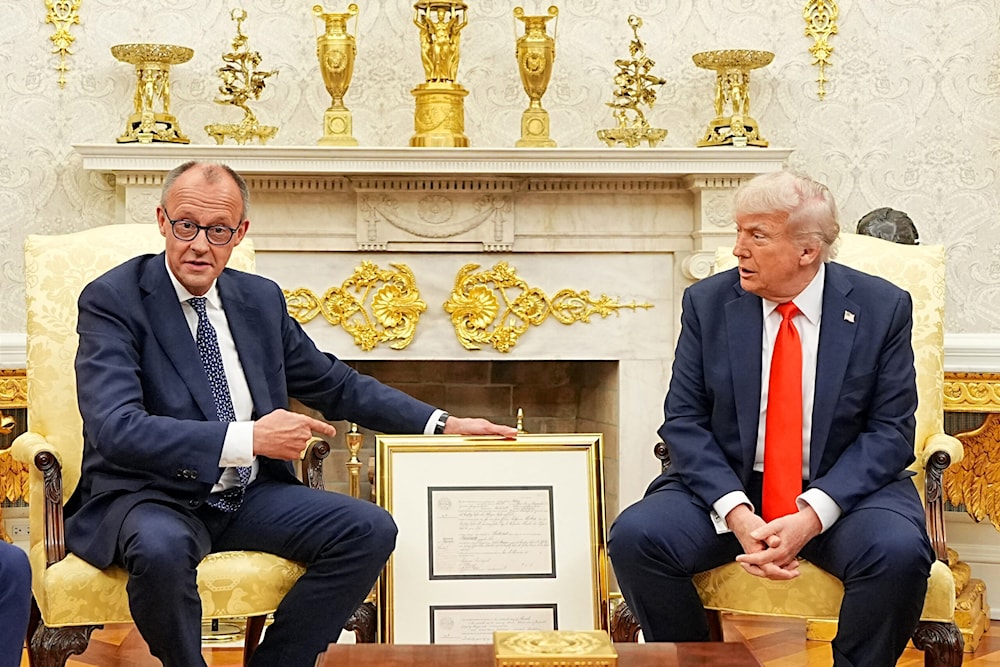
German Chancellor Friedrich Merz gives US President Donald Trump a copy of Friedrich (later Frederick) Trump's birth certificate in the Oval Office of the White House in Washington, D.C., on June 5, 2025. (Photo by Michael Kappeler / POOL / AFP)
German Chancellor Friedrich Merz stated on Wednesday that he has conveyed clear reservations to US President Donald Trump regarding ongoing aggressions against Iran.
Speaking at a press conference in Berlin, Merz emphasized that while personal relations between the two leaders remain stable, he has maintained a critical stance towards escalation.
“The personal relationship between the US president and me, at least from my point of view, remains consistently good. I simply had doubts from the very beginning about what started there in connection with the war with Iran, and therefore I expressed this view,” he said.
His remarks reflect growing unease within European political circles over the trajectory of the confrontation.
Europe impacted by Hormuz disruptions
Merz underscored the economic repercussions of escalating tensions, particularly the disruption linked to the Strait of Hormuz, a critical artery for global energy flows.
He warned that Germany and Europe are already experiencing significant consequences, citing impacts on energy supply chains and overall economic efficiency. The closure or instability of the maritime route has amplified concerns about long-term economic strain across the continent.
“That is why I insist that this conflict must be resolved. We continue to maintain constructive dialogue with each other,” Merz added, emphasizing the urgency of de-escalation.
Read more: US, Iran are not far apart in talks to end war: CNN
Western miscalculations on Iran acknowledged
Earlier this week, during remarks to students in North Rhine-Westphalia, Merz acknowledged that Western governments had underestimated Iran’s capabilities within the broader regional confrontation.
He suggested that Washington risks becoming entrenched in a prolonged conflict, warning that Iran has demonstrated greater effectiveness in the negotiation process.
This assessment points to a reassessment within parts of Europe regarding the balance of power and diplomatic leverage in the region.
Strains in transatlantic messaging
Despite maintaining what he described as a “consistently good” personal relationship with Trump, Merz’s comments highlight underlying divergences in strategic outlook between Washington and key European capitals.
Trump has previously criticized the German chancellor over his positions on Iran and the nuclear file, stating that Merz does not understand what he is talking about. The exchange reflects a broader difference in approaches to dealing with Tehran.
These tensions suggest that while coordination continues, policy alignment is far from uniform.
Read more: Efforts to achieve peace in West Asia will not end: Pakistan PM
Risk of prolonged conflict
Merz’s warning about the risk of a drawn-out confrontation aligns with broader European concerns about instability in West Asia and its spillover effects.
A prolonged conflict would likely deepen economic disruptions, exacerbate energy insecurity, and complicate diplomatic efforts aimed at restoring negotiations.
His call for resolution indicates a preference within Europe for diplomatic pathways, even as escalation continues on multiple fronts.


