
Trump seeks renewed talks with Kim Jong Un: WSJ
 6 Min Read
Trump is seeking renewed talks with DPRK leader Kim Jong Un as Pyongyang enters any potential negotiations with a stronger nuclear deterrent, deeper regional ties, and greater leverage over Washington.
-
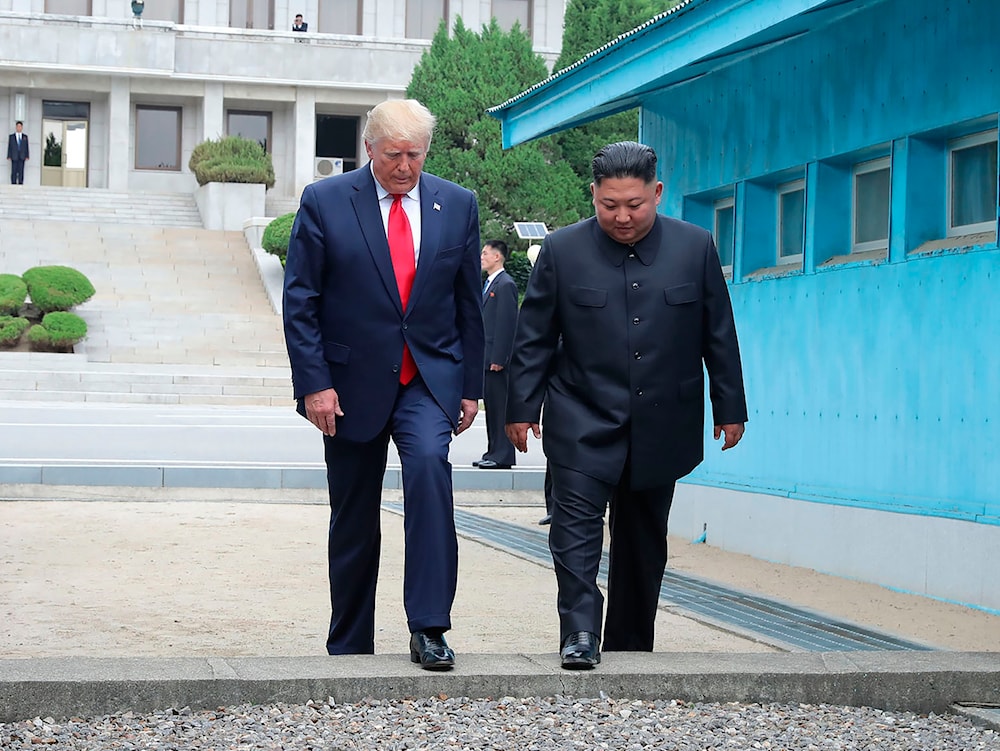
In this Sunday, June 30, 2019, photo provided by the North Korean government, North Korean leader Kim Jong Un, right, and U.S. President Donald Trump cross the border line at the border village of Panmunjom in Demilitarized Zone. The content of this image is as provided and cannot be independently verified (KCNA via AP)
US President Donald Trump is seeking another meeting with DPRK leader Kim Jong Un before the end of the year, the Wall Street Journal reported, as Washington looks to revive direct diplomacy with Pyongyang after years of military pressure and sanctions failed to compel the country to abandon its strategic deterrent.
US officials told the newspaper that Trump has privately raised the possibility of meeting Kim during an upcoming visit to Asia, potentially around the Asia-Pacific Economic Cooperation summit scheduled for November in Shenzhen, China.
No formal preparations for such a meeting are currently underway, according to the report, but Trump's renewed interest comes as the DPRK finds itself in a considerably stronger strategic position than during their previous rounds of talks.
A White House official said Trump and Kim would meet at an appropriate time.
Trump signals readiness to reopen dialogue
Trump has repeatedly spoken positively about his personal relationship with Kim and has recently taken steps aimed at facilitating renewed contact with Pyongyang.
On Sunday, he ordered a reduction in joint US-South Korean military exercises, saying the decision was partly “based on my very good relationship with Kim Jong Un.”
Trump later said the DPRK leader had responded to his overtures, though he did not provide details.
“He’s made clear that he wants to meet Kim again,” said Victor Cha, an expert on the DPRK at the Center for Strategic and International Studies.
“These exercises presented him an opportunity to do something concrete to show Kim he is serious about meeting.”
Pyongyang has long denounced large-scale US-South Korean military drills on the Korean Peninsula as hostile actions and rehearsals for war, repeatedly warning that Washington's military buildup necessitates strengthening the country's defensive capabilities.
Trump similarly suspended or reduced some joint exercises during his first term as Washington and Pyongyang entered an unprecedented period of direct leader-level diplomacy.
The US president also attempted to arrange another meeting with Kim during a previous trip to Asia, according to the WSJ. Pyongyang reportedly indicated privately that it was open to an encounter, but logistical obstacles prevented it from being organized on short notice.
Trump later said holding such a meeting alongside talks with Chinese President Xi Jinping could have been “maybe disrespectful,” adding, “I’d come back, with respect to Kim Jong Un.”
DPRK enters potential talks from stronger position
Any renewed negotiations would take place under circumstances substantially different from those surrounding the Trump-Kim summits of 2018 and 2019.
Years of US sanctions, military exercises and diplomatic isolation have failed to halt the DPRK's strategic weapons development.
Instead, Pyongyang has continued expanding its nuclear and missile capabilities while repeatedly maintaining that its deterrent is necessary to protect the country from US military threats.
The WSJ acknowledged that the DPRK's nuclear arsenal is now considerably larger and more advanced than it was during Trump's first presidency.
Jeffrey Lewis, an expert on Pyongyang's nuclear program at Stanford University's Center for International Security and Cooperation, said previous estimates of the DPRK arsenal may now substantially underestimate its actual size.
“North Korea’s arsenal is probably in the low hundreds at this point, based on the hundreds of missile launchers it has displayed and the growing amount of plutonium and highly enriched uranium it produces every year,” Lewis said.
The US intelligence community likewise acknowledged in March that “North Korea remains committed to expanding its strategic weapons programs, including missiles and nuclear warheads, and to solidifying its deterrent capability.”
The DPRK has consistently rejected demands that it unilaterally disarm while US military forces remain deployed throughout the region and Washington maintains its extended nuclear deterrence commitments to South Korea and Japan.
Washington nevertheless continues to formally demand the DPRK's denuclearization and refuses to recognize the country as a nuclear-armed state.
“Ideationally, that’s very important for North Korea,” Cha said. “They’ve always wanted the U.S. to give up on denuclearization and just accept them as a nuclear weapon state.”
Previous negotiations collapsed over US-DPRK differences
Trump and Kim held their first summit in Singapore in 2018, opening the first direct negotiations between a sitting US president and a DPRK leader.
A second summit in Hanoi in February 2019 ended without an agreement after Washington and Pyongyang failed to resolve fundamental disagreements over sanctions relief and the scope of measures concerning the DPRK's nuclear program.
Trump and Kim subsequently met at the Demilitarized Zone later that year, though negotiations did not regain momentum.
The Biden administration largely abandoned leader-level engagement with Pyongyang and instead strengthened military coordination with South Korea and Japan.
During the same period, the DPRK continued advancing its strategic capabilities and significantly expanded cooperation with Russia and China.
Kim recently reaffirmed Pyongyang's growing relationship with Moscow, saying the two countries had “carried forward the history of common struggle for justice and precious traditions of friendship.”
The strengthening of those partnerships has further reduced Washington's ability to isolate Pyongyang politically or economically.
Seoul backs dialogue as Trump pressures ally
South Korea has publicly welcomed the possibility of renewed Washington-Pyongyang dialogue.
Its embassy in Washington said it hoped the “friendly relationship” between Trump and Kim would result in “meaningful dialogue” and greater stability on the Korean Peninsula.
At the same time, Trump's decision to reduce joint military exercises has exposed friction between Washington and Seoul.
South Korean officials said they were not informed in advance of Trump's announcement, while the US president has also connected his dissatisfaction with Seoul to its refusal to support Washington's policies surrounding the war on Iran.
South Korean President Lee Jae Myung has meanwhile called for greater military independence from Washington and a faster transfer of wartime operational control to Seoul.
The emerging diplomatic environment therefore differs sharply from Trump's first engagement with Kim.
Rather than entering negotiations under mounting international isolation, Pyongyang now possesses a more developed strategic deterrent, stronger relations with Moscow and Beijing, and greater leverage over Washington.
Trump's renewed push for direct talks consequently underscores the failure of years of pressure to force the DPRK to disarm and the growing recognition in Washington that engagement with Pyongyang remains necessary if tensions on the Korean Peninsula are to be reduced.
Read more: South Korea: US-led drills to end early amid Trump-Kim talks push


