
War on Iran exposes Gulf states as hostage to US escalation: RS
 7 Min Read
The US-Israeli war on Iran exposed the limits of Gulf states’ autonomy, showing that their wealth and diplomatic influence cannot shield them from the risks of dependence on Washington’s security order.
-
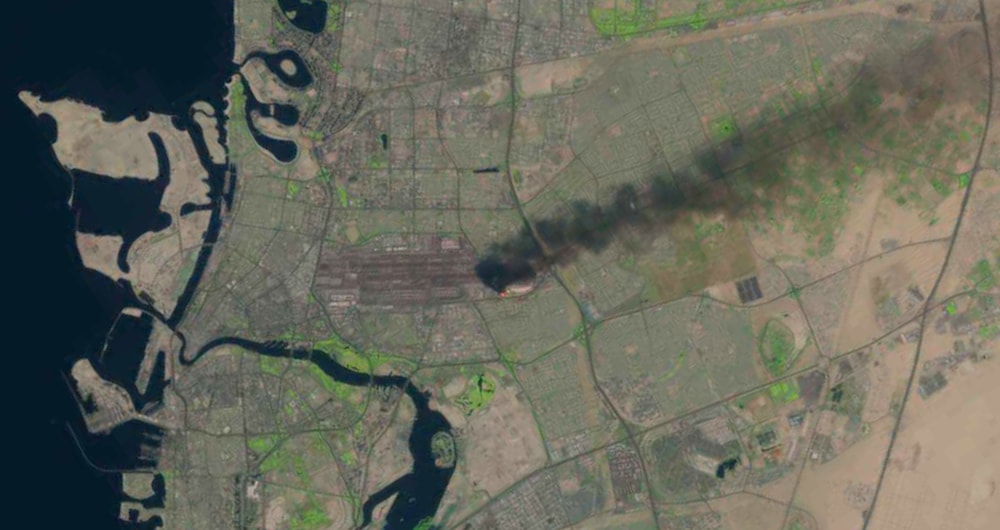
This satellite image taken by a US Geological Survey Landsat satellite shows the fire after an Iranian drone attack targeting the Dubai International Airport in Dubai, United Arab Emirates, Monday, March 16, 2026 (AP)
The US-Israeli war on Iran has exposed the vulnerability of Gulf states, despite years of efforts to present themselves as influential “middle powers” in an increasingly multipolar world.
That was the central argument made by writer Emma Ashford in an article for Responsible Statecraft, where she said the war revealed the limits of Gulf states’ autonomy when confronted with the consequences of great-power escalation. Ashford opened by pointing to Canadian Prime Minister Mark Carney’s remarks at Davos in January, when he called on “middle powers” to cooperate in resisting pressure from major global powers.
However, according to Ashford, the war on Iran has revealed how limited that autonomy can be when middle powers are confronted with the fallout of great-power escalation. She said Gulf states, despite their wealth, diplomatic reach, and global influence, were unable to shield themselves from the consequences of the American and Israeli confrontation with Tehran.
Economic transformation and strategic contradictions
Over the past decade, Gulf states have attempted to recast themselves as modern economic hubs, global investors, and diplomatic mediators, while remaining tied to the US-led security system. Ashford said this has created a fundamental contradiction: their economies depend on calm and predictability, while their security depends on a great power increasingly willing to escalate.
She noted that Saudi Arabia, the United Arab Emirates, Qatar, Kuwait, and other Gulf states have worked to move beyond older images of oil-dependent monarchies. The UAE, she wrote, has become a major financial and transit center, while Saudi Arabia has pursued broad social reforms under Crown Prince Mohammed bin Salman, even as economic diversification has proven more difficult.
At the same time, Gulf energy exports have increasingly shifted toward Asia, especially China, while Washington remains the region’s main security provider. This has pushed Gulf states into a balancing act between the United States, their traditional military partner, and China, their increasingly central economic partner.
Ashford said that before the war, Gulf states appeared well-positioned to become key middle powers in the emerging global order. But the conflict with Iran, she argued, has made that future far less certain.
Physical and economic fallout of the war
She identified three main areas of damage: physical, economic, and reputational. Physical destruction, she said, was the least severe overall, though not insignificant. The most serious infrastructure hit was Ras Laffan, Qatar’s main gas processing and export facility, which she said lost around 15% of its capacity and may take three to five years to fully repair.
The economic impact was broader. Ashford said major Gulf energy exporters lost revenue after being forced to “shut-in” production, while aviation and tourism were also hit. More than 6,000 flights through the Middle East were canceled in the early days of the war, and regional tourism losses may have reached $30 billion.
She added that the IMF downgraded growth projections for the region in April, including a real GDP contraction of 8.6% in Qatar. Repairing Gulf energy facilities could cost nearly $60 billion, she said, while regional governments are now examining costly measures such as bypass pipelines and new port infrastructure to reduce vulnerability to future disruptions in the Strait of Hormuz.
Reputational risks and security dilemmas
Ashford warned that the reputational consequences may prove more lasting than the immediate financial losses. If Gulf states can no longer present themselves as stable, safe destinations for investors, expatriates, and global companies, the foundation of their development model could be weakened.
The war also raised questions about US security guarantees. Ashford said Gulf states have long sought to maintain strong ties with Washington while expanding economic cooperation with Beijing. Yet the conflict demonstrated that US protection can also create risks, especially when Gulf states are pulled into regional escalation despite trying to prevent it.
She said every member of the Gulf Cooperation Council was affected, including states that had pursued mediation. At the same time, the United States appeared to prioritize defending “Israel” over protecting its Gulf partners.
From the perspective of the Axis of Resistance, this outcome would be read as confirmation that the US security umbrella does not guarantee Gulf stability, but instead binds the region to Washington’s wars. In this view, US bases, normalization with “Israel,” and alignment with American regional strategy have turned Gulf territory, airspace, ports, and energy infrastructure into potential extensions of the US-Israeli battlefield.
This interpretation also challenges the idea that Gulf states can remain neutral economic hubs while hosting the military infrastructure of a power directly involved in wars across the region. For Iran and its allies, the war has shown that wealth and diplomatic influence cannot compensate for the loss of strategic sovereignty when national security remains tied to US decision-making.
Shifting alliances and future outlook
This has left Gulf states with limited options. Ashford argued that moving away from Washington would carry major risks, especially because the United States is unlikely to accept losing key regional bases easily. But relying on Washington also leaves Gulf states exposed to future conflicts they may not want and cannot control.
China, she added, remains crucial economically but has shown no desire to replace the United States as the Gulf’s security guarantor. As a result, Gulf states are likely to seek new ways to rely more on themselves and regional partnerships.
Ashford said Saudi Arabia and Qatar are exploring possible accommodation with Iran to reduce the chances of another war, while Saudi Arabia is also deepening relations with Turkey and Pakistan. The UAE, by contrast, is moving closer to “Israel", betting on a more confrontational security approach.
For the Axis, the first path would be seen as the more sustainable one: a regional security arrangement based on dialogue with Iran and neighboring states, rather than dependence on foreign military protection. The second path, particularly deeper alignment with “Israel,” would be portrayed as a dangerous wager that could further expose Gulf states to the consequences of future escalation.
She predicted that Gulf states will continue increasing defense spending, diversify their military partnerships, and invest in technologies to better protect their populations, energy facilities, and infrastructure.
Washington’s waning leverage
For Washington, Ashford said the relationship with the Gulf will also need to change. Gulf leaders are unlikely to demand a US withdrawal, but they may be less willing to fund reconstruction, bankroll concessions to Tehran, or support US priorities as freely as before.
She wrote that the Gulf states are likely to reduce “no-strings attached” financing for Washington’s projects, adding that “the Trump administration is likely to soon find out that Gulf leaders have little appetite for serving as an ATM to repair damage they did not cause.”
Ashford concluded that a sudden rupture between the Gulf and the United States is unlikely. Instead, she expects a gradual recalibration, with Gulf states seeking stronger defenses, diplomatic understandings with regional rivals, and greater freedom from Washington’s unpredictable policies.
Over time, she argued, US influence in the Gulf is likely to decline, a shift she suggested may ultimately benefit both sides. For regional observers, that decline would not be an accidental byproduct of the war, but part of a broader regional lesson: that lasting security in West Asia cannot be built through US military dominance or Israeli integration, but through the removal of foreign tutelage and the creation of regional arrangements independent of Washington.
Read more: Gulf states reassess security after US failures exposed: NYT


