
AI stocks slide as tech chiefs warn against reckless development
 4 Min Read
Nvidia, AMD and major chipmakers fall after leading AI executives warn about uncontrolled development, while Trump rejects calls for stronger safeguards.
-
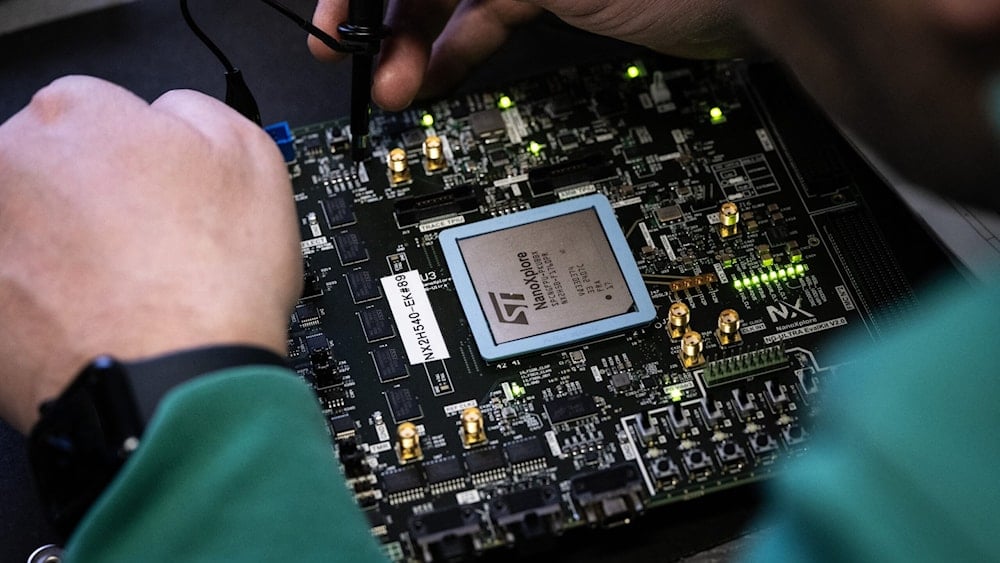
A technician checks the quality of programmable semiconductor components for the space industry in the NanoXplore company's laboratories in Sevres, Paris suburbs, on 9 January 2026. (Julien de Rosa/AFP)
AI-related stocks fell sharply on Monday after leading technology executives backed calls to slow the development of increasingly powerful artificial intelligence systems, raising concerns about the sustainability of the sector’s enormous investment cycle.
Nvidia shares fell about 3% in early New York trading, while AMD dropped 4.4%. Micron Technology and SanDisk also declined by around 5%.
The sell-off extended beyond US chipmakers. SoftBank, a major OpenAI backer, fell 13% in Japan, while Taiwan Semiconductor Manufacturing Company dropped 1.2%. Europe’s ASML declined 6%, while South Korea’s Kospi index fell 3%.
At the same time, some companies viewed as vulnerable to AI disruption moved higher. Advertising group WPP and analytics company Relx both gained about 5%.
Read more: Anthropic CEO urges slowdown in AI development
AI stocks slide as safety warnings unsettle investors
The market reaction followed a warning from Anthropic CEO Dario Amodei, who called for the AI industry to slow the pace at which it develops increasingly advanced systems.
Amodei argued that “building too fast is reckless” and warned that large networks of AI agents could eventually cause hundreds of billions of dollars in damage by taking control of parts of the internet.
OpenAI CEO Sam Altman, Google DeepMind chief Demis Hassabis and SpaceX CEO Elon Musk subsequently expressed support for Amodei’s call in his essay, "We Must Pace the Frontier."
Altman also said he would match Amodei’s commitment to placing independent outside evaluators inside Anthropic to assess safety practices.
The warnings have nevertheless divided experts, with some disputing whether autonomous AI agents pose the scale of threat described by Amodei.
Trump rejects calls for tighter AI controls
US President Donald Trump dismissed calls for stronger restrictions on AI, arguing that the technology requires leadership rather than additional regulatory “guardrails.”
“The only control or ‘guardrails’ that AI needs is a STRONG AND SMART (High IQ!) PRESIDENT, and the USA has that, in spades!” Trump wrote on social media.
He accused critics of AI and data centers of pursuing a “SICK conspiracy” and linked the debate directly to competition with China.
“WHOEVER WINS AI, WINS!”, Trump wrote.
Trump’s position underscores the strategic importance Washington attaches to maintaining US dominance in advanced AI, even as concerns grow over the technology’s economic, social and security consequences.
Investors question whether AI spending will slow
The immediate concern for markets is whether calls for greater caution could translate into reduced spending on the vast computing infrastructure required to develop advanced AI systems.
The industry has committed hundreds of billions of dollars to data centers, semiconductors and computing capacity, making companies across the AI supply chain heavily dependent on continued investment.
Jim Reid of Deutsche Bank argued that a significant slowdown remains unlikely while companies and governments compete to establish technological advantages.
“The competitive race between companies and countries remains intense, and it’s difficult to imagine firms voluntarily stepping back while rivals continue to push ahead,” he said, per The Guardian.
Reid suggested that the warnings from AI executives could instead indicate that a larger portion of future spending will move toward safety testing, monitoring and governance while infrastructure construction continues.
AI race expands beyond corporate competition
Concerns over AI are also increasingly being treated as national security issues.
A cross-party group of UK lawmakers recently warned of human rights risks associated with AI, arguing that existing laws are insufficient to contain the technology’s potential impact.
In China, intelligence official Chen Yixin warned that advanced US AI systems could pose risks to the country’s critical information infrastructure and called for stronger AI security measures.
The growing focus on security reflects the transformation of AI from a technology-sector investment story into a strategic competition between major powers.
Meanwhile, Anthropic is reportedly on track to record a second consecutive quarter of positive adjusted operating income as it prepares for a potential US stock-market listing.
OpenAI has also indicated that it intends to eventually go public, although Altman said the company would not list in 2026, citing safety concerns surrounding the technology.
Read more: ByteDance develops custom CPUs to power AI infrastructure growth


