How an article published a day after Toufan al-Aqsa (07.10) exposed the weakness of tolerating a counter-hegemonic narrative and analysis
-
 Makram Khoury-Machool
- 20 Oct 2026 17:03
- 3 Shares
 7 Min Read
In the hours after the Al-Aqsa Flood operation, Palestinian social media posts expressed a shift from indignation toward jubilation, relief and a temporary sense of empowerment.
-

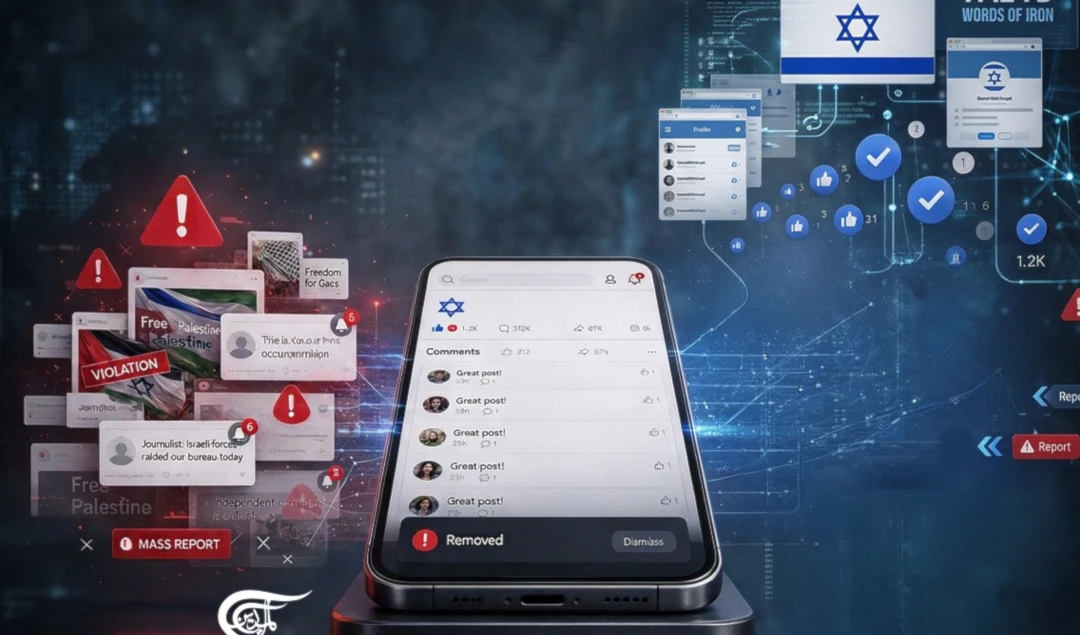
Palestinian social media offered a window into the emotional reality of life under occupation, capturing popular responses beyond official statements and elite political narratives (Illustrated by Zeinab al-Hajj to Al Mayadeen English)

Exactly a day after the “Al-Aqsa Flood” – Toufan al-Aqsa operation was conducted by the Palestinian Resistance on 07.10.2023 from the Gaza Strip, I authored an article published here under the title “Palestine: From indignation to Jubilation”! and was published the day after.
Whilst my knowledge and expertise count, my field work experience as a former journalist (who was shot in the face in the Gaza Strip on 15.12.1987 and announced to the world as a journalist the outbreak of the first Palestinian Intifada) combined with my academic skills (with mastery of both Arabic and Hebrew) who happens to be a particular kind of Palestinian: a Nakba Survivor (those who miraculously managed to remain in their homeland under Zionist occupation, which, after 29.11.1947 and the ethnic cleansing and massacres, became "Israel") are an additional value.
The article published on October 8, 2023, drew criticism, both publicly and privately, from some Zionists and Europeans who struggled to understand its message. Rather than considering the victims’ suffering or the author’s knowledge and expertise, these critics appeared more concerned with their own interests and perspectives.
The article used longitudinal observation combined with discourse analysis of hundreds of Arabic-language social media posts by Palestinians in the immediate aftermath of 7 October 2023.
It maps (in less than 24 hours) a shift in collective Palestinian sentiment from long-term indignation (anger, humiliation, despair under occupation; who can dispute this?) to jubilation (relief, revenge, catharsis, and temporary empowerment) as a reaction amongst the oppressed. Let alone that no full independent state commission of inquiry into 7 October 2023 has been established. The Israeli Occupation has repeatedly declined to set one up under the Commissions of Inquiry Law, while self-serving narrower military and oversight probes have gone ahead.
Any reasonable and fair academic will notice the methodological and analytical value of this Contribution.
The article gives Voice to Subaltern Affect (Emotional Reality). It is to be noted that most Western and Israeli analyses of 7 October focused on Hamas’s military tactics, casualty numbers, or geopolitical implications.
The article in discussion structurally presents Palestinian popular sentiment as a legitimate object of study.
By systematically analysing everyday Arabic posts (not elite statements), it reveals the affective dimension — the lived emotional reality of the Palestinian population under decades of occupation, blockade, and repeated military crimes in the 17-year-long besieged Gaza Strip in particular.
As a researcher who published academic articles about Palestinian Youth and Social Media, I detected an endless number of posts that were published in Arabic. The benefit of the results presented in the article stems from the fact that they counter the common reduction of Palestinians to either victims or terrorists, showing them as political subjects with memory, accumulated collective grievance, and emotional agency.
Furthermore, the longitudinal method employed in the article connects decades of structural violence (Nakba of 1948 and the destruction of the Palestinian socio-economic and political structure→ occupation of the second part of Palestine in 1967 → the Sabra and Shatila (refugee camps) massacres in Lebanon in September 1982 - the first intifada of December 1987 → the second intifada of September 2000 the Israeli wars on Gaza from December 2008 till 2022 → daily humiliations, control of all aspects of life of 2.3 m Palestinians in the most densely populated area in the world “an open air prison” to the specific emotional eruption on and after 7 October (Toufan al-Aqsa).
The article frames jubilation not as mere celebration of violence (most of the Palestinian fighters were killed), but as a psycho-political release after prolonged Qahr (Arabic term for accumulated, suppressed rage, vanquishing and humiliation). That they managed to achieve an act in the imbalance of power structure.
The result of the analytical observations creates causal continuity. It helps explain why a significant segment of Palestinian society (especially outside the elite) experienced 7 October as a moment of “compensation” or “restoration of dignity,” even if morally problematic to outsiders who cannot experience what the Palestinians have been going through over the decades.
Moreover, analysing hundreds of authentic, vernacular Arabic posts (rather than English-language or curated media) reduces translation bias, gatekeepers’ editorial policies, and (global) elite filtering. It treats social media as a digital public sphere (as per Jürgen Habermas) for the oppressed — a space where raw collective emotion circulates more freely than in official channels.
The essay presented a solid empirical contribution to political psychology and affect theory in conflict studies. It shows how suppressed emotions can suddenly invert power perceptions (“the mighty have been humbled”).
The essay also challenges Dominant Narratives on Both Sides. For pro-Palestinian audiences: It validates their emotional reality without romanticising violence. For Western/Israeli audiences, however: It forces confrontation with the psychological consequences of long-term brutal occupation and asymmetry.
Jubilation after 7 October becomes comprehensible (though not necessarily justifiable) as a symptom of structural oppression rather than inherent hatred.
Not only does this type of writing remind the “shocked” reader in the West (who has done little if anything to help the Palestinians in the last eight decades and has been chiefly exposed to Zionist propaganda topped on their WWII feel of guilt) It rather moves the analysis beyond “who started it” toward structural emotional dynamics, which are crucial for any serious conflict resolution or de-escalation strategy.
Having published elsewhere (but in particular in my PhD thesis (SOAS, London 2002) Palestine-related work with the concept of hegemony and counter-hegemony), it was not surprising that the author also presented a theoretical contribution. The article implicitly draws on concepts from Fanon (violence of the colonised), Memmi (psychology of the oppressed), and contemporary affect theorists. It highlights the cycle of humiliation → repression → explosive release that characterises many asymmetric conflicts. This enriches understanding of why ceasefires or tactical short-term victories often fail to resolve underlying longstanding injustices and national grievances — because they do not address accumulated indignation.
Therefore, the article should be seen as a valuable counter-hegemonic contribution. It does what good critical scholarship should do: (otherwise why do we study all these disciplines?) it takes the emotional and discursive world of the weaker party seriously in an asymmetric conflict, using transparent methodologies (longitudinal + discourse analysis).
This helps outsiders (who have no fascist agenda to stifle debate) to understand why 7 October 2023 produced such divergent moral interpretations between Palestinians and Israelis/Westerners.
It contributes to a more anthropologically rich understanding of the conflict — one that includes not just geopolitics and international law, but also the social psychology, politics of dignity, memory, and affective justice. Such work is essential for anyone seeking genuine comprehension rather than partisan victory or revenge, such as the CleansOcide (Ethnic Cleansing & Genocide) which has been perpetrated by the Israeli Occupation since 07.10.2023.