
'Israel' defies while Trump courts Syria
 5 Min Read
US-Syria ties warm under Ahmed al-Sharaa, but "Israel" resists Trump’s push for normalization, escalating tensions in the region.
-
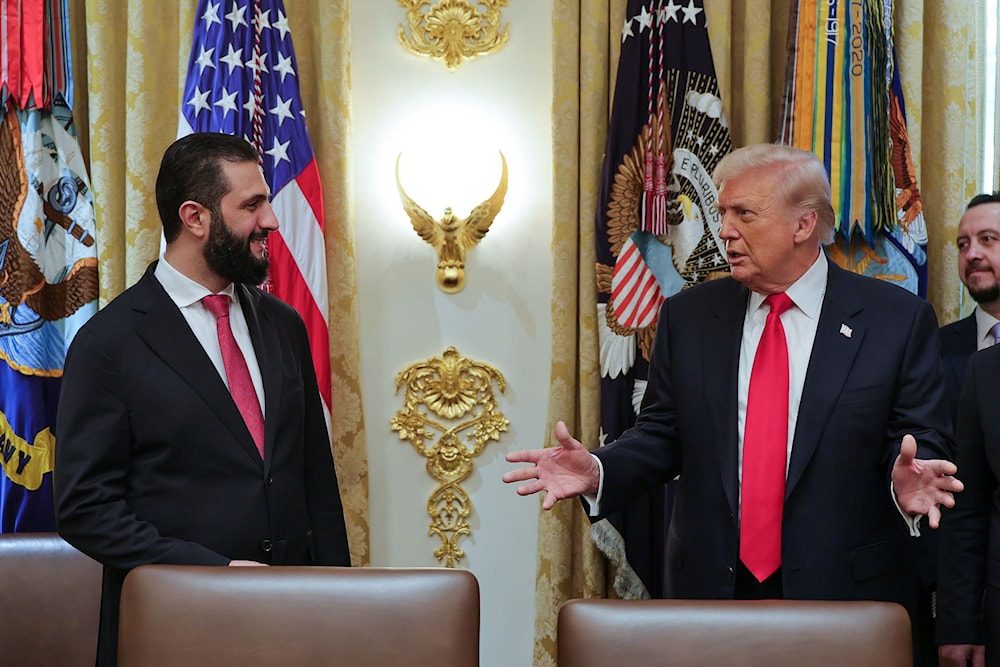
In this photo released by the Syrian Presidency press office, President Donald Trump, right, speaks with Syria's President Ahmad al-Sharaa, at the White House in Washington, Monday, November 10, 2025 (AP)
"Israel’s" confrontational stance toward Syria’s new government has become a rare point of friction with Washington, according to an opinion article in The Wall Street Journal, as US President Donald Trump pushes for a swift resolution to long-running tensions between the two countries.
The article reports that Trump, encouraged by regional allies such as Saudi Arabia and Türkiye, has lifted sanctions on Syria’s new president, Ahmad al-Sharaa, praising him as a “young, attractive guy” and a “fighter” who is “doing a good job.” Washington, it says, views progress on Syria as a key piece of its broader diplomatic push, at a moment when the US is also managing a Gaza cease-fire and renewed efforts to end the war in Ukraine.
According to the WSJ commentary, US-brokered talks on a security deal between "Israel" and Syria have stalled. Trump has urged "Israel" to move forward, arguing publicly that maintaining “a strong and true dialogue with Syria” is essential to the country’s future stability.
The divergence highlights the risks created by "Israel’s" more muscular regional approach since Operation Al-Aqsa Flood.
Since a ceasefire with Lebanon in late 2024, "Israel" has continued to occupy positions in southern Lebanon and committed more than 10,000 ceasefire violations.
Netanyahu may be pushing too far: Israeli officials
Some former Israeli security officials, according to WSJ, warn that Prime Minister Benjamin Netanyahu may be pushing too far, particularly in Syria, and risking unnecessary strain with Washington. Netanyahu insists that any agreement with Damascus must include the demilitarization of territory from southern Damascus to the Israeli border, a condition al-Sharaa rejects, saying it would create a dangerous vacuum in the south.
Avner Golov, a former senior director at "Israel’s" National Security Council, told WSJ that "Israel" should compromise quickly on a security pact that would allow Syrian forces to patrol the border region while banning heavy weapons or Turkish troops. "Israel", he says, must shift from “projecting military power to creating diplomatic power,” warning that cooperation with Trump on broader strategic issues may depend on reaching a deal in Syria.
A central part of Trump’s strategy, WSJ notes, is his hope of eventually bringing Syria into the normalization framework between "Israel" and several Muslim-majority states that he helped broker in his first term. Israeli, Syrian, and US officials, however, say it is far too early for that step, saying both sides would first need to agree on a security arrangement likely modeled on the 1974 disengagement pact that created a demilitarized buffer zone between the two countries.
Syria conforms, while 'Israel' defies
Tom Barrack, Trump’s envoy to Syria and ambassador to Turkey, told The National that Syria’s government has been meeting Washington’s requests on "Israel", while "Israel" has yet to respond in kind. “Everything we ask them to do, and dragging them towards Israel, they’re doing it,” Barrack said in an interview published Friday. "Israel is not trusting yet, so it’s a little bit slower,” he added.
"Israel" and Syria have fought three wars and remained adversaries since "Israel" established its occupation regime in 1948, though the two countries have not engaged in direct conflict since 1973.
During Assad's rule, the front between the occupation and Syria was quiet; however, the former regime was closely allied to Iran and had played a significant role in aiding arming efforts for Hezbollah. While the current administration is opposed to Iran, "Israel" remains suspicious of it, as many of its members were Al-Qaeda members.
'Israel' skeptical of Al-Sharaa's future success
Across Syria, the wider Middle East, and the US, many officials and analysts view "Israel" as working to keep Syria weak and fragmented along ethnic lines, undermining efforts to support Sharaa’s attempts to centralize authority.
As "Israel" slows diplomatic talks with Damascus, sporadic clashes have continued between the two countries.
This week, "Israel" raised concerns with Washington over social media videos showing Syrian troops marching in Damascus during anniversary celebrations, chanting in support of Gaza and appearing to threaten "Israel", and an Israeli official said "Israel" asked the US to urge Syria to repudiate the chants.
“There’s clearly an escalating line and a much more hawkish tone toward Israel in recent weeks,” emanating from Damascus, said Carmit Valensi, head of the Syria program at the Institute for National Security Studies, an Israeli think-tank.
William Wechsler, senior director of Middle East Programs at the Atlantic Council in Washington, said he recently met with senior officials in Damascus who signaled openness to cooperating with "Israel" to address shared challenges, including sectarian unrest. But he warned that the window for such cooperation is narrowing, arguing that "Israel’s" increasingly assertive posture is pushing Syria closer to Türkiye, a supporter of Sharaa and a longstanding adversary of "Israel".
“If the goal of Israel is to self isolate, then it’s on the right track,” Wechsler stated.


