
Defense $1.5T budget surge fails to fix deep US weapons shortage
 5 Min Read
Pentagon officials warn Congress that US munitions stockpiles have been dangerously depleted by support for Ukraine and the US-Israeli war on Iran.
-
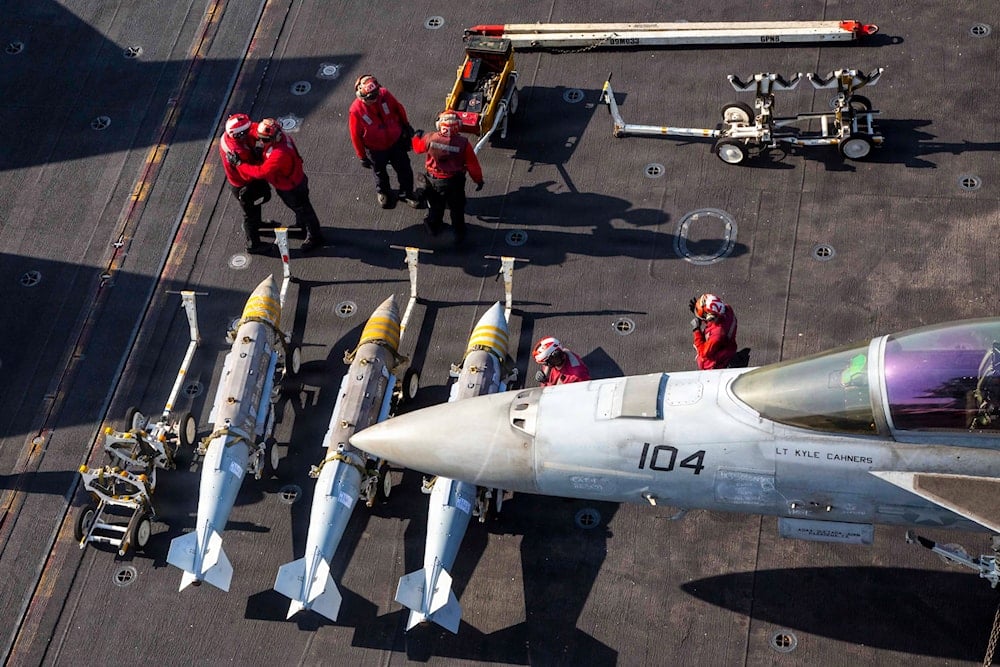
This image provided by US Central Command shows Navy sailors preparing to load ordnance onto an F/A-18F Super Hornet on the USS Abraham Lincoln (CVN 72) at the launch of the US-Israeli war on Iran, on Saturday, Feb. 28, 2026 (AP)
Pentagon leaders defended the Trump administration’s $1.5 trillion defense budget request on Capitol Hill last week, but a stark warning emerged from the hearings: the United States' munitions arsenal is dangerously depleted, drained by arming Ukraine and the US-Israeli war on Iran, Responsible Statecraft reported.
The administration is seeking $70.5 billion for critical, high-value munitions, a staggering 188% increase from last year’s fiscal request. Yet, despite bipartisan concern over the rapid drawdown of weapons stockpiles, analysts and some congressional voices argue that merely approving the massive funding boost would amount to an expensive band-aid, failing to address the root cause of the crisis.
In hearings that laid bare the strain on US readiness, lawmakers from both sides of the aisle expressed alarm over three interconnected issues: the rapid depletion of munitions for an unauthorized war on Iran, the fallout from draining stockpiles to support Ukraine, and the decrepit state of the defense industrial base, which cannot respond nimbly to strategic demand.
All of these concerns are valid, but none are at the root of the problem, Responsible Statecraft reported. The United States is in a munitions crisis, experts argue, because both the executive and legislative branches, regardless of which party holds power, have failed to exercise restraint in protecting the US war chest.
Presidential Drawdown Authority at center of crisis
The crisis traces directly to the response to the war in Ukraine. Congress and the Biden administration aggressively used a tool called the Presidential Drawdown Authority (PDA), legally intended for narrow “unforeseen emergency” cases, to rapidly provide weapons to Kiev.
Prior to 2021, Congress maintained an annual cap of $100 million worth of weapons under PDA. But through a series of supplemental appropriations bills, lawmakers authorized three separate increases to the cap, dramatically expanding the authority to allow up to $14.5 billion in drawdowns for Ukraine.
“Congress and the Biden administration together dug a huge hole in the US weapons arsenal,” the report detailed, with little regard for long-term consequences on American readiness and the ability to respond to conflict elsewhere in the world.
The Trump administration inherited stockpiles at a deficit, a fact the president himself has acknowledged as a massive strategic error by his predecessor. However, critics argue the president then committed a serious error of his own by launching a war on Iran, despite knowing the additional demand it would place on already-depleted stocks.
High-value weapons depleted by more than half after war on Iran
A recent report from the Center for Strategic and International Studies (CSIS) estimates that expenditure of high-value weapons, including Tomahawk, JASSM, and Patriot missiles, now numbers in the thousands. For some of these systems, the report notes a likely depletion of “more than half of pre-war inventory.”
Those figures help explain the extraordinary increases in the new budget request. For example, the Navy procured only 55 Tomahawk missiles last year. The new target is 785, an increase of more than 1,000%. Notably, even if Congress approves the full request, delivery of such high-value munitions would take at least three to five years.
“Pulling the thread on how we got into this munitions crisis tells us that we have a foresight problem,” Responsible Statecraft stated. American leaders are willing to arm foreign nations or jump into war, but fail to consider what the US is trading off or how it is limiting itself strategically.
With budget discussions heating up, some experts argue Congress should not blindly grant the gargantuan increase. Instead, lawmakers should condition munitions funding on receiving a strategy and timeline for the Iran war; impose legal limits on how many high-value munitions must be maintained for US readiness at all times; and proactively reform PDA to prevent it from ever again being used at a reckless scale.
Reform remains unpopular within Congress
Reality, however, is that political appetite for such reforms remains extremely low in Congress. Despite the growing influence of America First foreign policy, putting sound defense strategy above political risk, defense lobbyists, and foreign influence is still anathema in Washington.
That apathy could prove disastrous. Amid a munitions shortfall, the United States is currently balancing a hot war in Iran, a military campaign in the Western Hemisphere, a proxy war in Ukraine, and the looming threat of a war with China in the Indo-Pacific.
The United States is not invincible, and it cannot fight or manage multiple wars at a time successfully, Responsible Statecraft stated, adding, “There is no quick fix that can make the US munitions arsenal immune from scarcity, tradeoffs, and mathematical reality.”
Unless Congress reckons with the strategic failures that created and worsened the stockpile deficit and passes the necessary reforms to protect the war chest going forward, observers caution the nation will soon circle back to the same problem on the same balance sheet.


