
US faces interceptor crisis after heavy use in Iran war: The Economist
 7 Min Read
Western air-defense missile stocks are under growing strain after heavy use during the US war on Iran and in Ukraine, exposing production shortfalls and raising concerns over Washington’s readiness for future conflicts.
-
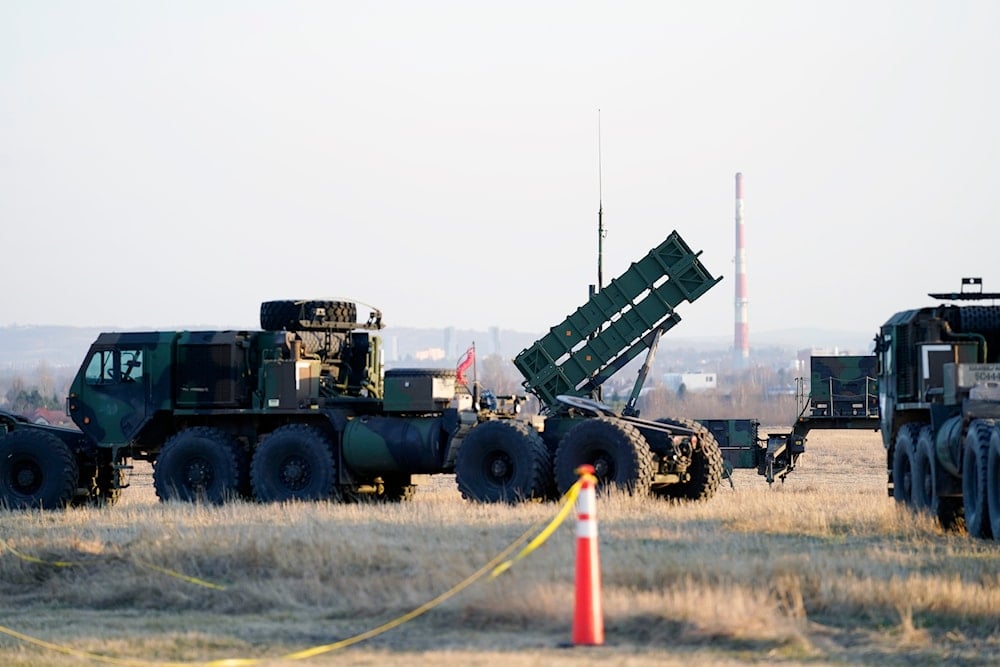
Patriot missiles are seen at the Rzeszow-Jasionka Airport, March 25, 2022, in Jasionka, Poland. (AP)
The West is facing a mounting shortage of air-defense interceptor missiles after heavy battlefield use exposed longstanding production weaknesses, leaving Ukraine increasingly vulnerable to Russian ballistic missile attacks and raising concerns over Washington’s ability to sustain another major conflict, The Economist reported.
According to the report, Ukraine is experiencing the most immediate consequences of the shortage as its supplies of Patriot interceptors decline while Russia intensifies attacks on Kiev using ballistic and hypersonic missiles.
The deterioration has forced residents of the Ukrainian capital back into metro stations and underground garages as air defenses struggle to keep pace with the volume of incoming strikes.
Ukraine’s military is effectively “going Winchester,” a military expression referring to the exhaustion of available ammunition.
Patriot systems had previously enabled Ukrainian forces to intercept a large proportion of Russian ballistic missiles, but their effectiveness has fallen sharply as ammunition stocks have dwindled.
Ukraine claimed in March that it was intercepting roughly 70% of ballistic missiles. That rate reportedly fell to around 20% by July, while on August 5 no ballistic missiles were intercepted at all.
Russia, recognizing the growing vulnerability, has continued expanding missile production and increasing pressure on Ukrainian air defenses.
Iran war accelerated US interceptor depletion
The wider problem extends far beyond Ukraine.
The Economist said Washington’s own interceptor reserves were heavily depleted during the US war on Iran earlier this year, when American forces and regional allies used large quantities of missiles to confront Iranian retaliatory missiles and drones.
The Center for Strategic and International Studies estimates that the Pentagon fired nearly two-thirds of its pre-war Patriot stockpile during the war, along with significant portions of other interceptor inventories.
The shortage has become one factor shaping Washington’s calculations over any renewed aggression onTehran, the report said, noting that US President Donald Trump has repeatedly stepped back from threats to resume large-scale hostilities.
US allies are also confronting delays.
Switzerland reportedly expects its Patriot deliveries to be postponed by as much as seven years, while Taiwan fears that 102 interceptors ordered earlier may not arrive according to schedule.
Lockheed Martin, which manufactures the advanced PAC-3 MSE interceptor, has said it cannot guarantee delivery schedules for foreign customers because the Pentagon retains authority to redirect production to US requirements.
Production unable to match battlefield demand
The shortage reflects deeper structural problems within Western defense industries, which have remained organized around relatively limited peacetime production despite years of increasing military tensions.
CSIS estimates that restoring American Patriot stocks to their pre-war levels could take until 2029, even if additional funding is approved.
Patriot interceptors have nevertheless become essential to the air-defense architecture of numerous US allies, particularly for protecting high-value facilities such as military bases. “Patriot is a dinner-jacket solution: you don’t need it very often, but when you do, very little else will do,” Justin Bronk of the Royal United Services Institute said.
Western militaries also face a severe cost imbalance.
A PAC-3 MSE interceptor costs around $4 million to $5 million, while many of the missiles and drones it is used against are substantially cheaper. Iranian Shahed-type drones, for example, can cost only a fraction of the price of the interceptor used to destroy them.
“If your adversary can field a one-way attack UAV for the price of a used car, and your answer is a surface-to-air missile that costs the same as a small apartment here in London, you’re losing the exchange even though you’re winning every single engagement,” Kuwaiti officer Colonel Sabah Al Sabah said at a recent RUSI event.
The financial imbalance becomes even greater because air-defense crews often launch two interceptors at a single incoming missile to raise the probability of a successful hit.
Ukraine seeks hundreds of additional Patriots
Kiev has requested at least 300 Patriot interceptors as it prepares for another winter of Russian attacks.
Several European countries, including Germany, Greece, Poland and Spain, still possess notable stocks, but governments have become increasingly reluctant to reduce their own reserves.
Manufacturers are attempting to increase production, with plans to raise annual PAC-3 output from roughly 600 interceptors to around 2,000 by the early 2030s. However, CSIS analyst Tom Karako noted that the Pentagon has yet to sign contracts sufficient to guarantee the proposed expansion.
Japan currently produces approximately 30 PAC-3 interceptors annually under license, while European defense manufacturer MBDA is preparing to manufacture older PAC-2 missiles in Germany.
Alternative systems are also being developed.
Ukraine and European firms are working on the Freyja project, which aims to create an interceptor costing roughly one-quarter of a PAC-3 without relying on US technology.
Douglas Barrie of the International Institute for Strategic Studies described the effort as “a moon shot”.
Taiwan is meanwhile expanding production of its own Sky Bow interceptor family, while Lockheed Martin is developing the smaller PAC-3 ACE, or “Baby Patriot,” which could cost roughly half as much as the PAC-3 MSE and potentially enter production in 2028.
Offensive strikes no simple alternative
The report also examined calls for militaries to attack missile launchers and production sites before weapons can be fired.
“Air defence cannot be separated from offensive operations,” former US Air Force General David Deptula said. “The cheapest interceptor is the one you never have to fire because the weapon was never launched.” However, suppressing missile forces has proved difficult even when an attacker enjoys overwhelming air superiority.
During the war against Iran, US and Israeli forces claimed they had reduced Iranian missile launches by striking launchers and entrances to underground missile facilities.
Despite extensive surveillance and control of the skies, Iranian missile fire was never completely halted.
The report said US forces lost radars, command centers, early-warning aircraft, refueling tankers, drones, fighters and other assets during the confrontation.
Even after the April ceasefire, Washington has also been unable to prevent Iranian attacks on vessels operating in the Strait of Hormuz.
Meanwhile, US stocks of offensive long-range weapons have also fallen.
CSIS estimates Washington has used approximately one-third of its inventory of more than 3,000 Tomahawk cruise missiles, contributing to reluctance to transfer the weapon to Ukraine and potentially delaying deliveries to other buyers.
China conflict exposes larger vulnerability
The most serious concern raised by the interceptor shortage is how the United States would cope with a future conflict against China.
A Heritage Foundation study estimated that US forces could require more than 19,000 Patriot interceptors to defend against the People’s Liberation Army, more than 20 times CSIS estimates of current American stocks.
Chinese missile forces are capable of striking US bases across the Pacific, including facilities as distant as Alaska and Hawaii. Attempting to destroy Chinese launchers would introduce additional risks, particularly because the PLA Rocket Force operates both conventional and nuclear missiles.
Strikes on Chinese missile units could therefore be interpreted as an attempt to degrade Beijing’s nuclear deterrent, increasing the danger of nuclear escalation. US forces have instead begun placing greater emphasis on dispersing aircraft and equipment, hardening bases, concealing military assets and rapidly rebuilding damaged infrastructure.
The interceptor crisis, The Economist concluded, has exposed the limits of a Western military-industrial system that has struggled to adapt to prolonged, high-intensity missile warfare.
While new production lines, cheaper interceptors and alternative technologies are being pursued, most will require years before they can meaningfully expand available inventories, leaving Ukraine and other US allies to confront immediate shortages in the meantime.
Read more: US Patriot stocks depleted by up to 67% during Iran war: CSIS


