
Marandi, Schlanger: Firmer Iran, weaker US shaping global order | Exl.
 14 Min Read
Dr. Mohammad Marandi and Harley Schlanger discuss Iran’s resistance, US vulnerabilities and the shifting global balance amid the war on Iran.
-
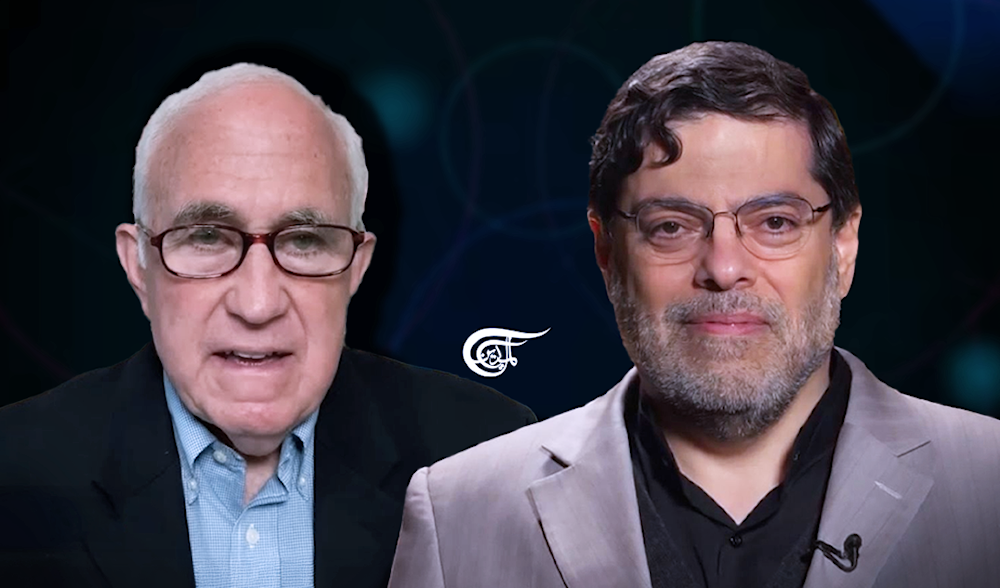
Marandi, Schlanger: Firmer Iran, weaker US shaping global order | Exl (Illustrated by Zeinab al-Hajj)
The regional landscape has undergone a profound transformation over the past year, with the war on Iran exposing what Professor Mohammad Marandi coined the deepening vulnerabilities within the United States and its regional allies.
Speaking on Al Mayadeen’s The Grand Standoff: Iran and the World, Marandi said the devastation inflicted across Gaza, Lebanon, and Syria has not translated into a strategic victory for Washington or the Israeli regime, arguing instead that the broader regional balance is shifting against them.
“The empire has suffered a major defeat at the hands of the resistance, at the hands of Iran, and at the hands of Yemen,” Marandi said.
He acknowledged the scale of destruction across the region, including the killing of civilians in Gaza and devastation in Lebanon, but argued that the same policies had also weakened the US-led regional order. “Despite all that, you do see the empire itself in retreat,” he said.
Marandi: US allies in the region face growing vulnerability
Marandi focused particular attention on Saudi Arabia and other Arab governments aligned with Washington, arguing that their participation in US policy toward Iran and Yemen had exposed them to growing strategic risks.
“Saudi Arabia is deeply vulnerable today,” he said, referring to Riyadh’s support for Washington and its confrontation with Yemen.
Iran’s position is not changing despite #US pressure, Professor Mohammad Marandi affirmed on Al Mayadeen’s The Grand Standoff: Iran and the World, arguing that Washington and its Western allies should not misunderstand of minsinterpret what Mohsen Rezaee said.
— Al Mayadeen English (@MayadeenEnglish) September 20, 2026
"#Iran is… pic.twitter.com/D5Rd6cWl1I
He placed Saudi Arabia, Qatar, the United Arab Emirates, Kuwait, Bahrain, and Jordan within a broader US regional architecture, arguing that the weakening of these partners would, by extension, diminish Washington’s position.
“When US proxies are weakened, the United States is weakened,” Marandi said.
He also linked the regional confrontation to the US economy, stating that Washington had expected capital and resources extracted from the region to help sustain domestic financial markets and emerging industries.
“The economies are in decline, in rapid decline,” he said, pointing to bond and stock markets as well as investment in artificial intelligence.
Marandi maintained that the economic consequences would become increasingly visible, arguing that Washington would ultimately be forced to reconsider its regional policy.
Iran rejects pressure as Washington weighs its next move
Turning to Iran’s position, Marandi said Tehran remains firmly committed to the demands it has set out and does not intend to alter its position because of military or economic pressure.
“Iran is completely set fast,” he said.
He argued that Washington had misunderstood the balance of power by assuming that war, sanctions, or economic pressure could force Tehran to change course. “The West is in a position of weakness,” Marandi said.
According to Marandi, the seven demands presented by Iran encompass issues extending beyond the nuclear file, including the situation in Gaza and Lebanon as well as Iranian assets.
“All of these issues that we saw discussed or written in the MOU, they have to be fulfilled,” he said. “The Americans have to implement their obligations. There is no way out of this.”
Marandi further reiterated that Iran was preparing for multiple scenarios, including another US or Israeli assault, while maintaining that Tehran would not abandon its position even if the confrontation continued for years.
“We may have more warfare. We may have another assault by the Americans and the Israeli regime,” he said. “The Iranians are preparing for that.”
He added that Iran was also preparing for a prolonged war extending through the remainder of the Trump administration if necessary.
Washington, not the UN, holds the key to de-escalation
Marandi also rejected the idea that major progress would emerge simply from diplomatic activity surrounding the UN General Assembly.
“The Americans have to make a decision. And that decision has to be made in the White House, not in the corridors in the UN building,” he said.
“If there's going to be a decrease in tensions, it has to begin in the White House and it has to end in the White House.”
He simultaneously warned Arab governments aligned with Washington that continued support for US policy could expose them to consequences as the regional confrontation develops.
“They are moving closer and closer to their own destruction,” Marandi said.
He urged these governments to distance themselves from Washington’s policy, warning that continued alignment with the United States and the Israeli regime could carry increasingly serious consequences.
“If they want to survive, they have to get off this ship. They have no other option,” he said.
Iran prepares for another major battle
Marandi said Tehran was not relying on a change in US policy before the midterm elections, even though he argued that the economic and military consequences of the war could affect the political environment in the United States.
“Iran is preparing itself for a very long war, and it's preparing itself for military escalation as well,” he said.
He argued that the midterm elections represented only one factor in a much broader Iranian strategy. “Iran's calculations do not depend on the midterm elections at all,” Marandi said.
While he said Iran could take developments surrounding the elections into account, he maintained that Tehran’s strategic calculations extended well beyond the electoral cycle.
“The Iranian policy will continue come what may,” he said.
Marandi also addressed reports concerning US military casualties and losses, saying the actual figures were substantially higher than those publicly released by Washington.
“A lot of damage has been caused to the United States, to the military. The death casualties are substantially higher,” he said, emphasizing that the economic consequences would become more significant over time.
“The damage that's being done to the U.S. economy is enormous. And we're just seeing the tip of the iceberg now,” Marandi said.
Marandi warns of wider escalation
With no major breakthrough visible in the immediate term, Marandi said Iran was preparing for the possibility of a major military confrontation involving the United States and the Israeli regime.
“The expectation in Iran is that there's a high probability for a major battle between Iran, the Israeli regime, and the Trump regime,” he said.
Marandi warned that a new assault could provoke a significantly stronger Iranian response than previous rounds of fighting, saying, “And if that happens, Iran will respond in a much more devastating manner than during the 40 days of fighting and even during the 13 days of fighting.”
He added that Iran was preparing continuously for another war and would not base its strategy on expectations of an imminent shift in Washington. “Iran is preparing itself 24 hours a day for another war,” Marandi said.
He also warned that if Washington and the Israeli regime targeted Iranian infrastructure, regional governments supporting the operation could face repercussions.
“If the United States carries out a major attack, as I said earlier, if it carries out an attack alongside the Israeli regime and targets Iran's infrastructure, Iran will be relentless and ruthless,” he said.
The central issue, he said, remains whether Washington will ultimately accept Iran’s demands and pursue a different regional policy. “If it wants a normalization, it will have to implement all of Iran's demands. There's no escaping that,” he said.
Schlanger: Global power shift exposes limits of US strategy
Meanwhile, Schiller Institute spokesperson Harley Schlanger similarly argued that the war on Iran is unfolding amid a broader transformation of the international system, with countries across the Global South increasingly resisting the political and economic structures associated with Western dominance.
Speaking on The Great Standoff: Iran and the World, Schlanger said the emergence of the Global South represented a long-term structural shift rather than a temporary reaction to the current war.
“The emergence of the Global South, the former colonial sector, is no longer willing to sacrifice its raw materials and its population for the benefits of the empire,” Schlanger said.
He argued that this process was connected both to the rise of resistance movements and to what he sees as deep weaknesses within the US political and economic system.
“This is a 500-year European colonial empire that's collapsing now, and it's not going to be stopped,” he said.
US elites are confronting a changing world
Schlanger directed particular criticism at the US political, financial, and corporate establishment, arguing that sections of the ruling elite continue to operate according to assumptions inherited from the era of Western global dominance.
He referred to this grouping as the “Epstein-class ruling” in the United States and argued that its approach was rooted in the expectation that Washington could continue extracting resources from other countries without facing serious resistance.
“That’s changed, and it’s never going to go back,” Schlanger said, linking this transformation to the declining Western moral authority and mounting economic pressure inside the United States and Europe.
“Everything's going into the military, militarization of everything,” he said, while pointing to pressures on retirement, healthcare, infrastructure, and industrial production.
Schlanger also drew comparisons with the British Empire, arguing that Washington had overestimated its ability to impose its will on other countries.
Afghanistan, Libya and Syria: lessons for Washington
Schlanger pointed to Afghanistan, Libya, and Syria when discussing the limits of US military power. “Look at the situation with Libya, with Syria. They can destroy countries, but they can't organize them or bring them in as part of a continuing effort of the empire,” he said.
He compared the situation to the 1956 Suez crisis, arguing that the British Empire had similarly overestimated its ability to impose its will through military and political power.
“The basic problem is the same problem that the British had up till 1956 in the Suez crisis,” Schlanger said.
In his view, Washington’s difficulties are compounded by an institutional belief that previous US dominance can continue indefinitely.
“There is such a thing as a higher law, a natural law,” he said, arguing that economic and industrial realities ultimately constrain military power.
Economic pressure is hurting the US as well
Schlanger also addressed Washington’s economic pressure campaign against Iran, arguing that the policy has failed to produce the outcome its architects expected.
“There is a delusion that is in the White House, in the Congress, and in the American people,” he said.
He argued that the economic pressure campaign was intended to force Iran to surrender, but that the resilience of the Iranian population had prevented that outcome.
“The economic D-Day is hitting the United States in a way that the American people are hurting,” Schlanger said.
He maintained that President Donald Trump lacked a clear strategy for ending the war and pointed again to the MOU as a potential pathway.
“There is an easy way to end the war, which is, as Dr. Marandi just said, to fulfill the agreements of the Memo of Understanding,” Schlanger said.
He argued that political resistance in Washington to such an agreement stems from concerns that accepting Iran’s demands would demonstrate that US power has limits. “They have to come to recognize that reality,” he said.
China and BRICS emerge as diplomatic pressure points
Schlanger also highlighted the growing role of China, Russia, India, and other major powers in opposing continuation of the war.
He pointed to the BRICS summit and the positions of Russia and India, arguing that major non-Western powers were increasingly asserting their opposition to Washington’s approach.
“The fact that you have the most populous population, largest countries in the world, who have growing economies standing up now saying the United States should stop this war,” Schlanger said.
He singled out China as particularly significant ahead of a meeting between Trump and Chinese President Xi Jinping. “The Chinese are clear on this,” he said.
Schlanger argued that Beijing’s diplomatic activity indicated a broader effort to bring the war to an end, adding that Xi could potentially influence Trump’s calculations.
“I think Xi Jinping has some influence on Trump,” he said.
US military spending faces economic constraints
Schlanger also questioned Washington’s ability to sustain its current level of military expenditure while confronting rising debt and economic pressures.
“The US already has a $1 trillion defense budget. He wants to make it one and a half trillion,” Schlanger said.
He contrasted the proposed increase with the scale of US federal debt, which he said had exceeded $40 trillion, while also pointing to pressures in the bond market and rising interest rates.
Schlanger further argued that US military procurement was facing difficulties, citing problems with replacing missiles, anti-aircraft systems, and other military equipment.
“We're seeing the problem with defense procurement,” he said.
According to Schlanger, the pressure extends into the US industrial base and supply chains, with rising costs complicating efforts to sustain military operations.
“There’s a serious problem with the supply chain in the United States and the costs are going up,” he said.
Schlanger questions US political and media institutions
Schlanger also turned to the domestic political environment, arguing that the US government and media had concealed major issues from the public.
“In the United States, we're covering up lots of things,” he said, before citing the assassinations of President John F. Kennedy, the September 11 attacks, the Russia investigation, and the COVID-19 pandemic.
Schlanger argued that the US media and political establishment had become closely intertwined with powerful private interests.
“But the media is a part of that same cartel,” he said.
He pointed to US lawmakers Thomas Massie and Marjorie Taylor Greene as examples of figures who have raised questions about government policy, while arguing that more members of Congress should do the same.
Schlanger also discussed the US House of Representatives’ legislative schedule ahead of the midterm elections, presenting it as part of a broader political environment in which scrutiny of the war could remain limited.
A broader struggle over the international order
Both Marandi and Schlanger placed the war on Iran within a wider transformation of global power, though each approached the issue from a different angle.
For Marandi, Iran’s refusal to yield to military and economic pressure reflects a shift in the regional balance, with Washington and its allies facing growing strategic and economic vulnerabilities.
For Schlanger, the confrontation forms part of a larger transition away from a Western-dominated international system, driven by the rise of the Global South, resistance to economic coercion, and the emergence of China, Russia, India, and other major powers as increasingly independent centers of influence.


